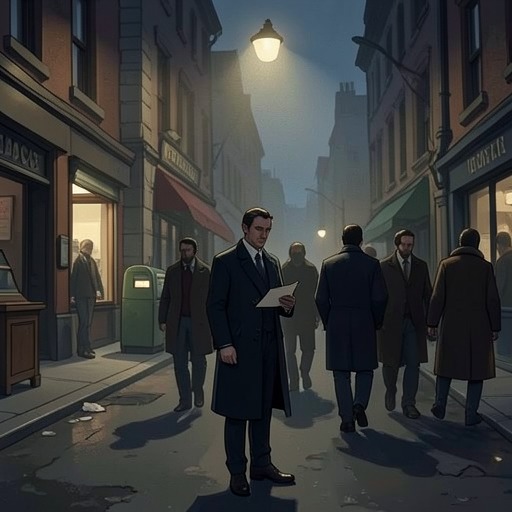
Trawler’s poster sequence
The ShardsThe Trawler’s poster sequence is a theory Bret Ellis develops while trying to make sense of the Trawler’s crimes and his own connection to them. A poster for the 5th Dimension found among the mail at Debbie Schaffer’s home alarms him because he believes the Trawler leaves posters in a meaningful sequence. The scene makes the proposed pattern a clue in Bret’s investigation, but not a verified rule: Debbie’s account offers an ordinary explanation for the poster’s presence, and the evidence does not confirm that it was a message from the Trawler.
The poster at Debbie’s home
On a Sunday preoccupied by several troubling associations, Bret remembers that he needs to ask Debbie where she found the 5th Dimension poster. When he asks, she says it had been on the foyer table with the mail. Bret becomes nauseous and his hand holding the remote begins to tremble. The poster’s mundane location does not settle the question for him; instead, it gives a physical object to his suspicion and connects an everyday household detail to the larger story he believes he is tracing.
Bret’s alarm depends on information Debbie does not share. He recognizes that neither Debbie nor Susan Reynolds has been following the Trawler’s story closely, and he struggles to explain why the poster matters. When he finally names the Trawler, Debbie asks what that is and says she does not follow the news. Bret explains that the killer leaves posters and that he believes there is a sequence. The exchange establishes the theory through Bret’s account, not through an independently confirmed discovery of a complete sequence.
A clue interpreted as a pattern
The poster’s significance rests on Bret’s interpretation of the Trawler’s methods. He has already linked the crimes to signs that include missing pets and other disturbances; when Matt Kellner disappears, Bret recalls anonymous silent calls, rearranged furniture, missing fish, and a missing cat as elements that might form a pattern. He also recognizes that he does not yet understand the significance of the posters. The poster theory thus belongs to an unfinished investigation in which separate details seem to acquire meaning retrospectively, while their relationships remain uncertain.
The broader history of the Trawler’s crimes reinforces both the appeal and the risk of pattern-making. Early home invasions appeared random, and reports of vanished pets later emerged as a recurring warning sign. Yet the connection between those disappearances and the eventual crimes was not understood at first; the reasons for the animals’ disappearance became clear only later. That history shows how an apparently incidental detail can become legible as a clue after the fact. It does not, by itself, verify Bret’s claim that posters follow a deliberate sequence.
Doubt and competing explanations
Debbie’s response directly challenges Bret’s certainty. She tells him, “Sometimes a poster is just a poster, Bret,” then says that he is frightening her. The remark gives the object a competing, ordinary interpretation: it may simply have arrived with the mail, rather than carrying a coded message. Bret does not demonstrate that the poster is connected to a victim, a crime scene, or a specific position in a confirmed sequence. His suspicion remains a hypothesis rather than proof.
The conversation also exposes the personal cost of treating the theory as settled. Debbie says Bret has frightened Susan as well, because he suspects Robert Mallory of having some connection to Matt’s death. Bret brings up the phone calls Debbie has been receiving and says they belong to the pattern too, but the exchange supplies no confirmation that the calls, poster, and crimes share a source. His attempt to organize disparate clues intensifies the tension between his wish to warn others and their perception that his conclusions are alarming.
The poster within Bret’s larger theory
Bret’s fixation on the poster sits beside a more intimate piece of evidence: the Maxell cassette he keeps in a drawer. The recording has made him fear that Matt was questioned about a sexual relationship with a man and that Bret himself could be implicated. He considers playing it for Debbie, then decides against it because listening again would be unbearable and because the recording implicates him. The poster theory therefore unfolds alongside evidence that points not only toward Robert or the Trawler but also toward Bret’s own concealed involvement with Matt.
At Dr. Croft’s office, Bret argues that a timeline links the Trawler’s activity to Robert’s presence in Los Angeles. Dr. Croft calls this “an awfully big leap.” The response supplies a useful measure of the poster theory’s evidentiary limits: Bret can assemble details into a coherent account, but coherence does not establish that each connection is true. The novel preserves the distinction between an observed object, a suspected pattern, and a proven explanation.
Narrative significance and limits
The poster becomes a small but consequential test of how Bret constructs a case. It is specific enough to provoke a question—where Debbie found it—and to make the larger pattern feel tangible. But the answer, that it was on a table with the mail, does not resolve its meaning. The gap between the ordinary circumstance and Bret’s increasingly charged interpretation keeps the clue suspended between warning and coincidence.
That uncertainty matters because Bret’s public account of Robert eventually becomes influential despite its disputed basis. Abigail Mallory disputes Bret’s account of what happened between him and Robert on the night of November 7, and the narrative Bret advances becomes central to how others understand Robert. After the Trawler abducts Leslie Slavin and claims responsibility for Audrey Barbour’s death, it becomes apparent that Robert was not the killer Bret had insisted he was, but a target of the Trawler’s manipulation and obsession. The poster sequence is not shown to prove Bret right; rather, it belongs to the unstable process through which he turns clues into a story, and through which that story shapes other people’s judgments before the truth is clear.