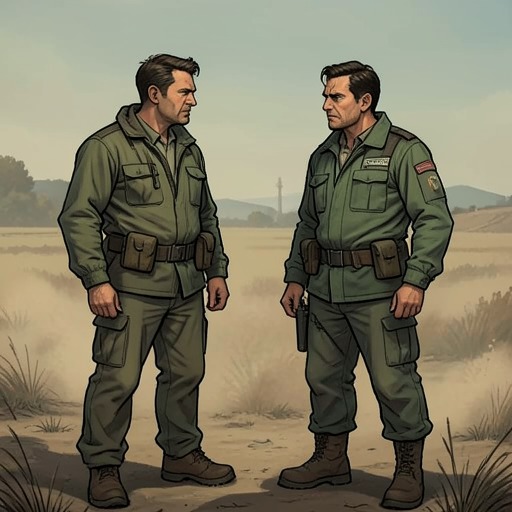
Dera Ismail Khan alley attack
The ShepherdThe Dera Ismail Khan alley attack turns a sudden knife assault into a lethal security decision: Lawson stops an attacker from striking Haydar, but Haydar kills the subdued man to prevent him from identifying them. The encounter ends not with an arrest or escape alone, but with both men hiding the body beneath the debris of the alley.
Ambush and Counterattack
After a meal, Lawson and Haydar were returning toward their Landcruiser when Haydar stopped partway there. Lawson sensed a subtle shift in the airflow; the nearest shadow came alive, and a blade flashed toward Haydar’s neck. Lawson intercepted the descending strike with his outer arm, locked the attacker’s elbow, and used his momentum to throw him off balance among the alley junk. The assailant quickly recovered and redirected his curved blade at Lawson’s heart. Lawson held his ground until the attacker had committed to the thrust, then pivoted at the last moment. In the exchange that followed, Lawson caught the attacker’s wrist and twisted it back until the bone connecting wrist and hand broke. He swept the joint lock around and took the man’s legs out from under him. The attacker fell, clutching his useless limb, but did not cry out.
Haydar's Decision and Concealment
Lawson frowned at Haydar’s order to stand aside, but moved. Haydar crouched beside the attacker; a moment later came the slightest double report, and the cowering street urchin crumpled onto the dirty ground. Haydar turned away with a compact Model 21 Beretta Bobcat in his hands, its stubby suppressor still smoking. The pistol looked almost like a toy, but Lawson recognized it as a weapon suited to concealment at extremely close range. The suddenness of the killing also disclosed what Lawson had not known during the fight: Haydar was armed.
Haydar first described the dead man as a human being reduced to his last reserves of hope and faith, then explained why he had killed him. In their circumstances, he reasoned, the attacker could sell information to anyone for the price of a piece of bread. A man who had met two strangers in an alley, been disarmed, and had his wrist broken would be unlikely to keep quiet about them. Killing him, Haydar argued, was therefore their safest course: it ensured he could not identify them to anyone. Lawson recognized the force of the argument even as the decision made the encounter more than an act of self-defense; the threat now had to be erased along with the evidence of their presence.
Haydar pocketed the Bobcat and told Lawson to help with the body. They dragged it to a pile of masonry, where Haydar made a shallow hollow among cinder blocks, bricks, and assorted refuse. The corpse was heavier than it looked. They laid it in the depression and spent the next ten minutes covering it again with the surrounding debris. Their escape thus depended on a grim piece of shared work: after Lawson had physically stopped the attack, he helped Haydar conceal the man Haydar had killed.
The Logic and Cost of Secrecy
The attack’s aftermath rests on a distinction between what the assailant has done and what Haydar predicts he may do. By the time Haydar approaches him, Lawson has broken the attacker’s wrist and taken him down; the man is left cowering in the alley, not shown passing information to anyone. Haydar’s justification is prospective: a person desperate enough to trade information for bread could expose the two strangers, and their identities would then be at risk. Lawson accepts that reasoning, but the scene does not turn the prediction into proof. The attacker is identified only as a street urchin, while Haydar acknowledges his remaining hope and faith; those details make the killing a calculated response to vulnerability as well as a means of protecting the mission. The decision therefore extends the violence beyond the moment of danger: secrecy is secured not by escape alone, but by removing a possible witness and concealing the body.
Division of Roles and Shared Responsibility
The attack briefly exposes how differently Lawson and Haydar operate under the same pressure. Lawson reacts to the blade with close-quarters skill, first diverting it from Haydar and then disabling the attacker; Haydar’s concealed pistol supplies the lethal response Lawson did not anticipate. The exchange shifts Lawson from protecting his companion to accepting Haydar’s judgment about what the encounter requires. His recognition that Haydar’s reasoning makes sense does not erase the distinction between stopping an immediate assault and killing a subdued man to prevent a possible disclosure. By helping hide the body, Lawson becomes involved in the consequences of Haydar’s choice, not merely its witness. The scene makes their cooperation practical and morally consequential at once: the threat to their secrecy is dealt with, but only through an act whose necessity rests on Haydar’s prediction rather than on anything the attacker is shown doing afterward.