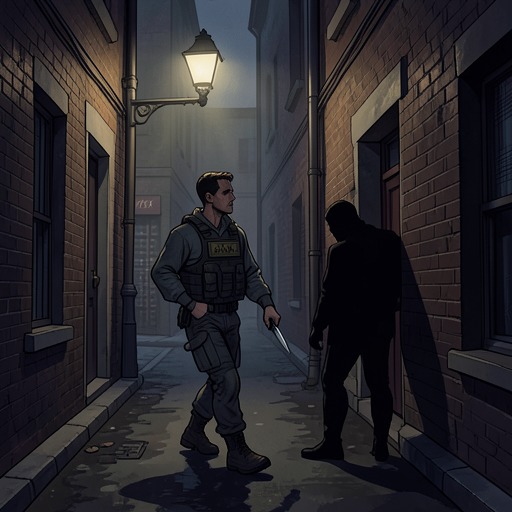
Fixer
The ShepherdThe Fixer is a Council operative whose role places field action alongside the intelligence network that informs it. Through Lawson, the novel presents the work not as a fully specified job description but as a practical combination of operational readiness, awareness of how information is gathered, and judgment about which threats demand action. His mission against a vampire assisting the Taliban makes those elements concrete: the target is identified through Council intelligence, while Lawson’s response is sharpened by his own moral limits.
Identity and Institutional Position
Lawson describes himself as a Fixer and says that he knows a great deal about how the Council acquires intelligence about events elsewhere in the world. His account establishes that the role is connected to the Council’s wider activity, but not that Fixers themselves form its intelligence service. Rather, Lawson’s work can intersect with information gathering: sometimes his job figures prominently in its collection, while at other times information is acquired more discreetly.
The distinction matters to the role’s shape. A Fixer may be directly involved in the process by which the Council learns what is happening, yet the Council also has methods that do not depend on force. Lawson’s explanation therefore resists reducing the work to a single tool or procedure. He understands the intelligence system from within, while recognizing that the Council can obtain information through channels less conspicuous than his own interventions.
Operational Doctrine and Its Limits
Lawson’s account of his training at STA-F Selection gives the role a concise operational principle. He recalls that the attitude there was that location did not change the fundamentals: “Get in, get it done, and get home.” The phrase presents efficiency and safe return as a compact working ideal. It is not, however, proof that every assignment can be handled by repeating the same method unchanged.
Niles explicitly challenges Lawson’s confidence about applying familiar fundamentals in Afghanistan. He warns that the country is unlike any place Lawson has operated and that its landscape has defeated outside forces attempting to control it; locating the target will be difficult. The exchange sets the Fixer’s portable training against the particular conditions of an assignment. The work may depend on a stable operational principle, but the terrain and circumstances still determine how hard that principle is to carry out.
Intelligence and the Shepherd Assignment
The assignment shows the Council’s information network furnishing a specific target. Niles tells Lawson that the Council has identified a vampire operating in Afghanistan, then reveals that the target is a shepherd. He explains that the Taliban supplies the man with young children in return for his services, and that he drains them. The intelligence is not merely a general warning about the region: it identifies a particular threat and describes the arrangement sustaining it.
Lawson’s explanation of the Ferrets clarifies one way the Council gathers such information without equating their work with his. The Ferrets are a small subunit within the Council’s intelligence service, created to remain nearly invisible while acquiring as much useful intelligence as possible. Haydar’s affiliation with them is presented as the reason he is “with us.” Their method is discreet collection; Lawson’s account, by contrast, allows for his involvement in collection as well as his operational work. The passages establish overlapping functions, not an identity between Fixers and Ferrets.
Ethical Commitments and Narrative Significance
Lawson’s decision to take the assignment follows an explicit moral response to the target’s treatment of children. He recalls becoming especially sensitive to people who torture or kill children after helping Talya take down The Kensei in Japan. For Lawson, such harm allows no second chance; his maxim is that three strikes mean death. His reaction makes the mission more than a routine response to a Council-identified target: the reported abuse touches a boundary he has already stated plainly.
The Fixer concept thus joins institutional action to personal judgment without making them identical. Council intelligence identifies the vampire and his connection to the Taliban; Lawson supplies the perspective that marks the target’s conduct as intolerable. His words also expose a hard edge in the role’s ethical logic: his stated refusal to grant a second chance is decisive, not a promise of measured restraint. The available account does not define a complete set of Fixer rules or establish that every Fixer shares Lawson’s view. It does show how his professional readiness, knowledge of intelligence collection, and particular moral threshold converge in this assignment.