Lawson—Veena
The ShepherdLawson and Veena’s relationship develops from an armed meeting into a shared pursuit, a partnership of practical trust, and a final exchange of care. Their common objective brings them together, but the story gives the alliance a personal foundation and an intimate ending: Veena joins the hunt after her younger brother goes missing, and Lawson ultimately promises to bring her home.
An armed meeting and a common target
Their first interaction places danger and recognition side by side. Veena keeps a Dragunov sniper rifle at the base of Lawson’s throat, while the twilight allows him to see her sparkling eyes above the shemag covering her face. The weapon is not incidental: Lawson identifies it as a high-quality rifle, and his attention to it registers the skill and seriousness of the person confronting him. At this point, their connection is not yet trust but a close-quarters standoff in which each must assess the other.
Veena resolves the immediate uncertainty by explaining that they are hunting the same person. The statement establishes the practical basis of their alliance without suggesting that they have identical histories or motives. She then reveals that her little brother went missing two months earlier. That loss gives her pursuit a specific personal context; the evidence does not establish what happened to him, but it makes clear that Veena’s participation is bound up with a family disappearance rather than being merely a coincidence of objectives.
The two speak directly about their respective capabilities. Lawson tells her that she handles the Dragunov impressively, an acknowledgment that recognizes her competence even after their introduction as potential threats to one another. Veena’s widened smile and self-assured manner make confidence part of the impression she leaves on him. When she asks his name, the exchange also shifts from assessing an armed stranger toward establishing a personal acquaintance. Their early rapport therefore emerges not by removing the danger from their meeting, but through the respect they show within it.
Shared pursuit and mutual agency
The alliance takes a practical form when Veena asks Lawson whether he wants point or whether she should take it. The offer presents leadership in the immediate movement as something to be decided between them. She does not simply follow Lawson, and he does not need to assume command without discussion: Veena openly proposes taking the forward position, while leaving the choice to him. Together with her demonstrated handling of the Dragunov, the exchange establishes her as an active participant in the pursuit.
This moment also clarifies the relationship’s balance. Lawson’s compliment recognizes Veena’s skill, but the offer to take point shows that her competence is expressed through action and decision, not merely through his appraisal. Their partnership rests on a shared target and on negotiating how to proceed. The available evidence does not detail the full division of their work, so the significance lies in this concrete exchange: Veena is prepared to lead the immediate advance, and the two treat that possibility as a joint operational choice.
Their cooperation continues through a later encounter in which Lawson turns and finds himself facing a dark face streaked with camouflage paint and hears a command not to move. The evidence does not identify that figure as Veena, so the moment cannot establish that she is the person confronting him. What it does show is that the pursuit places Lawson in danger amid armed opposition. Afterward, Veena and Lawson watch others disappear back into the darkness, and she leans closer to thank him. Her gratitude is direct, but the precise action for which she thanks him is not specified in the available account. The scene nevertheless records a change from their first standoff: they are now together, watching the same danger recede, and Veena addresses Lawson with personal warmth.
Care at the end of the pursuit
The alliance reaches its most consequential point when Veena makes a final shot with Lawson’s M4. Lawson sees the arm holding the weapon fall back into the dirt, with a single shell casing nearby. The detail ties her last act of agency to the firearm she is using at that moment: even as her condition is beyond repair, she has managed to fire. The account does not describe the full circumstances of the shot here, but it makes clear that her action occurs when she is already gravely compromised.
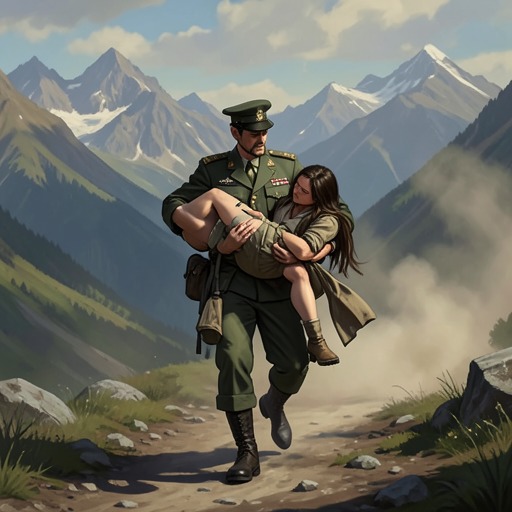
Veena speaks to Lawson with affection, while acknowledging that the damage cannot be undone and that making the shot was difficult. Her words are not a claim that she will recover; the subsequent events confirm otherwise. Lawson holds her close and strokes her hair, then promises to bring her home. This is no longer the operational negotiation seen when Veena offered to take point. The language of the promise turns their shared pursuit into a personal obligation, and his physical care answers her final address with tenderness rather than tactical instruction.
Burial and the meaning of the bond
When night falls, Lawson buries Veena miles outside Peshawar, beneath a small tree beside a single chunk of granite jutting from the ground. He places the Dragunov in the makeshift grave and then steps back to look at her peaceful expression. The rifle recalls their first meeting, when it rested at his throat and first disclosed her capability. At the grave it has a different function: it accompanies Veena into burial, carrying the memory of the skill and agency that marked their partnership from its beginning.
The relationship’s arc is therefore shaped by a series of changes in what their shared weapons and choices signify. The Dragunov first marks the danger between them, then becomes part of the grave; Lawson’s M4 is the weapon Veena uses for her last shot. Between those moments, a common hunt becomes mutual cooperation, Veena’s thanks records trust, and Lawson’s promise expresses attachment. The ending does not undo the loss or fulfill the promise as a return home: instead, Lawson carries it out as far as the evidence shows, burying Veena outside Peshawar and remaining with the memory of the woman who began as an armed stranger and became his partner.