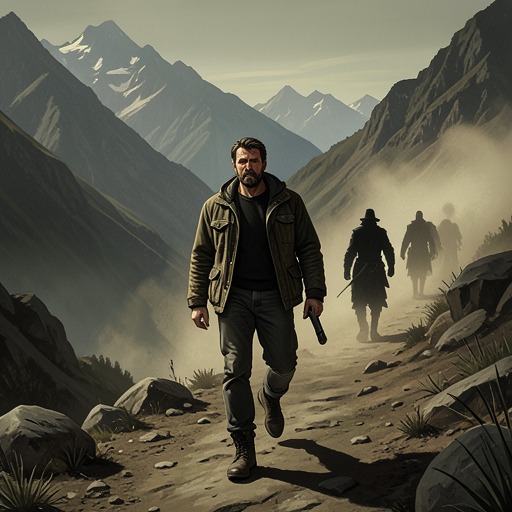
The final confrontation with the Shepherd
The ShepherdThe final confrontation with the Shepherd is the culmination of Lawson and Veena’s pursuit: a minefield and a hidden explosive turn their attempt to reach him into a struggle for survival, and Veena’s intervention brings the Shepherd’s violence to an end at the cost of her own life.
Setting and Stakes
The confrontation unfolds against the dangers of a landscape still marked by war. Earlier, Veena steps onto a land mine, and Lawson realizes that they are surrounded by more. He has never dealt with mines before, but knows that Afghanistan is heavily affected by those left during the Soviet occupation. The field is not cordoned off, and he sees no warning signs. The danger is therefore not confined to the armed pursuers: the mines also threaten anyone who might unknowingly cross the area.
That threat becomes immediate when the Shepherd’s hidden explosive goes off. In the aftermath, Lawson sees Veena lying some distance away and believes she may not have survived. The blast also gives the Shepherd the advantage, leaving Lawson vulnerable as the two men come face to face. Their confrontation is not simply a contest to capture or kill a target; it is bound up with the Shepherd’s claimed justification for exploiting children. He argues that their poverty leaves them with little to hope for, and presents their deaths as a supposed release from that life. Lawson rejects that reasoning, while the earlier account of poverty in Orangi Town and Haydar’s explanation of Taliban recruitment establish the deprivation that the Shepherd manipulates without making it an excuse for his actions.
Ideological and Physical Contest
The Shepherd presents his actions as a form of mercy, arguing that children facing extreme poverty have little prospect of a better life and invoking reincarnation to frame death as release. Lawson rejects the claim that this reasoning makes the Shepherd’s violence benevolent. When he alludes to the children’s blood, he unsettles the Shepherd’s self-justification by pointing toward the predatory nature of what he does, rather than accepting poverty as an excuse for killing.
The exchange gives way to a close struggle. The Shepherd shoots Lawson, but the trauma plate in Lawson’s body armor stops the bullet. When the Shepherd moves to fire again, Lawson sweeps his footing and surges at him, knocking the pistol away. Neither gains lasting control: each counters the other, and the confrontation becomes a contest of timing and stamina rather than a clean execution.
Both men spot Lawson’s M4 and lunge for it at once. Their collision sends the weapon sliding away, toward the mine that had presumably killed Veena. The gun is now beyond either man’s immediate reach, and the fight remains unresolved; the battlefield’s hazards continue to shape the encounter even as the two men struggle for control.
Veena’s Intervention and Aftermath
The struggle turns when the Shepherd raises his pistol to shoot Lawson again. A shot rings out, but Lawson is unharmed: Veena, who had been presumed dead after the explosion, has fired the M4. The single spent casing nearby marks the intervention that ends the Shepherd’s attack. His fangs have emerged, but he is beyond recovery; Veena’s shot has stopped the pursuit at the moment the Shepherd was about to kill Lawson.
Lawson turns to Veena and offers to help, but she tells him the damage cannot be undone. She is gravely wounded, yet the shot she managed to make has secured her vengeance against the man responsible for her brother’s death. Lawson tells her that her brother’s spirit would be proud. Veena answers with sadness, questioning the violence that has brought them to this point; her victory is inseparable from its cost, not a simple triumph over the Shepherd.
As Veena grows weaker, she asks Lawson to take her home. He promises to bring her back and holds her until she dies. The confrontation therefore ends with the Shepherd dead and Veena’s revenge accomplished, but also with Lawson losing the ally who had shared the pursuit. Afterward, he breaks radio silence and calls Niles, who says he will arrange for Haydar to meet him near the insertion point.
Operational Context and the Final Revelation
Before the confrontation, Lawson receives Haydar’s message that the target has been located. The hide lies in sparsely inhabited country: scrub grass, rock formations, and dusty soil stretch across reddish-brown plains, while greener hillsides rise in the distance. Lawson understands his task in stark operational terms—to intercept the target, kill him, and get out. The remote terrain frames the final encounter as the end of a pursuit conducted far from the urban deprivation that the Shepherd invokes to defend his crimes, but not beyond the consequences of those crimes.
The Shepherd’s fangs, visible as he is dying, confirm that the target is not merely a human predator. Their expected disappearance with his death makes the shot a decisive end to both his immediate violence and his vampiric existence.