Horace Derwent
The ShiningHorace Derwent is the most enigmatic and influential figure in the Overlook Hotel's history, a millionaire inventor, film producer, and entrepreneur whose ownership from 1945 to the early 1950s transformed the dilapidated relic into a glittering showplace, yet whose subsequent shadowy involvement through dummy corporations and organized crime associates made the hotel a nexus of post-war American ambition, corruption, and violence. His legacy permeates the hotel's physical fabric—from the roque court he installed to the Presidential Suite's decor—and his spectral presence haunts Jack Torrance's research into the hotel's dark past, ultimately revealing the depth of the Overlook's entanglement with wealth, power, and moral decay.
Identity and Background
Horace Derwent was a self-made tycoon who rose from poverty in St. Paul, Minnesota, never finishing high school before joining the Navy. He left the service after a bitter patent dispute over a propeller design, and in the late 1920s and early 1930s turned to aviation, buying a bankrupt cropdusting company and building it into a successful airmail service. His inventive genius produced numerous patents, including a new monoplane wing design, a bomb carriage used on Flying Fortresses, a machine gun cooled by alcohol, and a prototype ejection seat. Alongside his inventions, Derwent accumulated investments in munition factories, textile mills, and chemical plants, often buying controlling interests at abysmally low prices during the Depression. Rumors swirled that some of his methods were less than savory, involving bootlegging, prostitution in the Midwest, smuggling in the South, and eventually associations with nascent western gambling interests. His most famous investment was the purchase of the foundering Top Mark Studios, which had not had a hit since its child star died of a heroin overdose in 1934. Derwent hired a businessman named Henry Finkel to run the studio, and in the two years before Pearl Harbor, Top Mark ground out sixty movies, fifty-five of which flouted the Hayes Office and became huge successes. During one film, an unnamed costume designer jury-rigged a strapless bra for the heroine, and Derwent received credit for this invention as well. The war made him rich, and by the time he purchased the Overlook, he was reputed to be the richest man in the world, with holdings in United Air Lines, multiple Las Vegas hotel-casinos, and vast real estate.
Ownership of the Overlook and the Grand Renovation
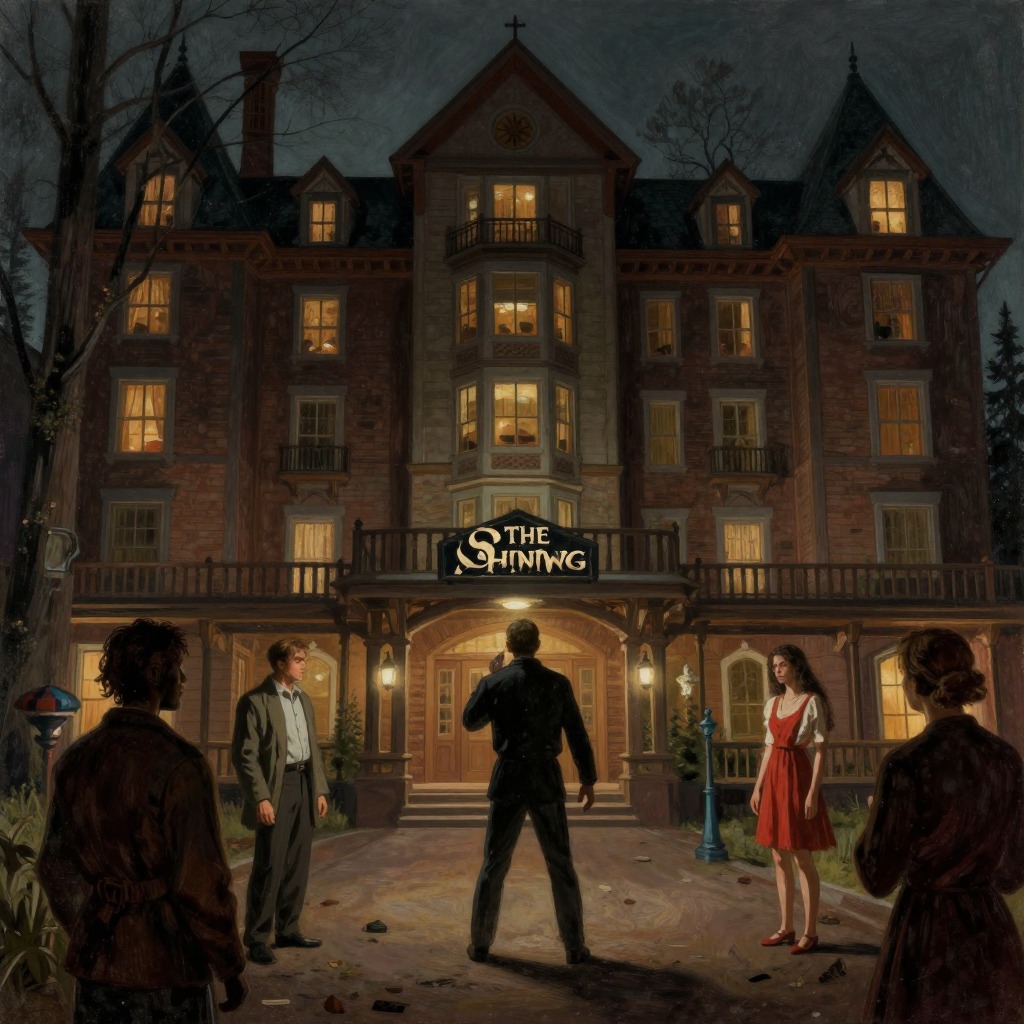
Derwent purchased the Overlook Hotel at the end of World War II, after it had stood vacant for years, and funneled over a million dollars—some said closer to three million—into its renovation before the first postwar guest ever stepped through its doors. He turned the decrepit relic into a showplace, adding the roque court that Jack Torrance admired upon his arrival. Derwent learned the game from his social secretary and fell completely in love with it; the Overlook's roque court may have been the finest in America. He also installed electric flambeaux throughout the hotel, fashioned to look like London gas lamps, and oversaw most of the third-floor decorating scheme, including the Presidential Suite. The grand opening was a masked ball on August 29, 1945, with dinner at eight and unmasking at midnight. The invitation, which Jack Torrance later found in a scrapbook, featured a raised engraving of the Overlook with every window alight and the lawn decorated with glowing Japanese lanterns. The guest list was stellar, ranging from designer Corbat Stani to a host of Hollywood and business luminaries. Derwent himself was described as a balding man with rimless spectacles and a forties-style pencil-line mustache, but his eyes pierced even from old newsprint photos—the face of an accountant, but the eyes of something else entirely.
The Scrapbook and Hidden History
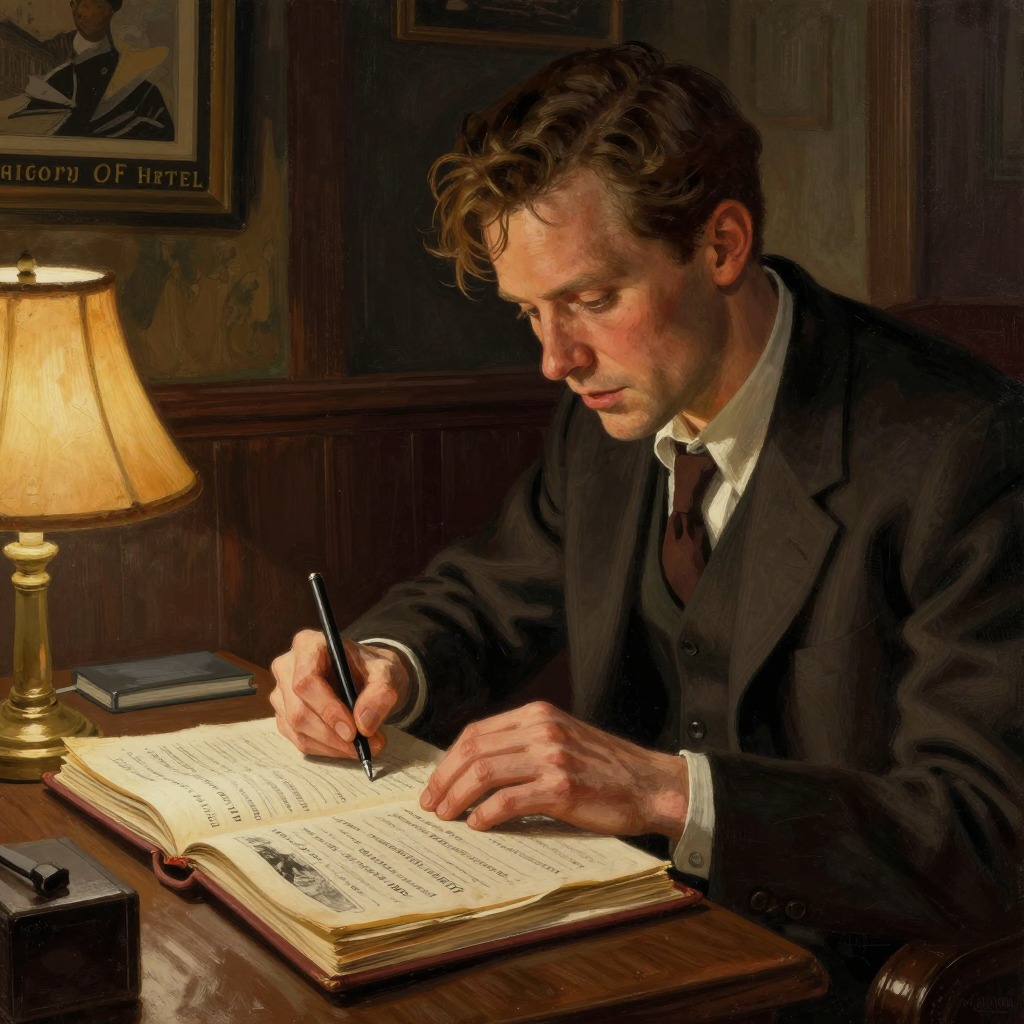
Jack Torrance discovered a white leather scrapbook in the basement of the Overlook, bound with gold string, that contained a meticulous record of the hotel's most sordid history, much of it centered on Derwent's involvement. The scrapbook included the invitation to the 1945 masked ball, a full-page ad from the New York Sunday Times travel section, and a story on Derwent himself. It also contained clippings documenting Derwent's sale of the Overlook in 1952 to a California group, and subsequent revelations that the buyer, Charles Grondin, was a former director of California Land Development Corporation who later became executive vice president in the Chicago home office of Derwent Enterprises. This led to speculation that Derwent had reacquired the Overlook through a front company called High Country Investments, which operated the hotel as a key club for wealthy executives. Investigative journalist Josh Brannigar published a column suggesting that the Overlook had become a Mafia free-zone, with guests including Charles "Baby Charlie" Battaglia, Richard Scarne, Peter Zeiss, Vittorio "Vito the Chopper" Gienelli, and Carl "Jimmy-Ricks" Prashkin—all figures with extensive criminal records and ties to Las Vegas gambling and organized crime. The scrapbook culminated in a clipping about a gangland-style triple shotgun slaying at the Overlook in June 1966, in which Gienelli and two bodyguards were killed in the Presidential Suite. Below the clipping, someone had written in ball-point pen: "They took his balls along with them."
Connections to the Overlook's Later History
After the Gienelli murder, the Overlook was sold again, and Jack Torrance discovered that it eventually came to be owned by a private citizen named Sylvia Hunter, who had been Sylvia Hunter Derwent from 1942 to 1948—Horace Derwent's former wife. Jack deduced that she ran the hotel as a brothel in 1967 and 1968, until a well-known U.S. senator died of a heart attack there under scandalous circumstances. When Jack confronted Stuart Ullman about this history, Ullman confirmed that Derwent no longer owned the hotel, but revealed that Al Shockley, Jack's friend and benefactor, owned the largest block of stock himself, better than thirty-five percent. Jack pressed Ullman on whether Derwent was still involved with the Overlook, but Ullman refused to answer. The scrapbook and its revelations became a central obsession for Jack, fueling his desire to write a book about the hotel and ultimately contributing to his conflict with Al Shockley, who demanded that Jack abandon the project.
Narrative Role and Thematic Significance
Horace Derwent functions as a spectral embodiment of the corrupting power of wealth and the American dream gone sour. He is the unseen architect of the Overlook's dark legacy, a figure whose influence persists long after his physical departure. His story—from rags to riches, from inventor to alleged mob associate—mirrors the hotel's own trajectory from grand ambition to moral ruin. The scrapbook that Jack finds is, in a sense, Derwent's ghost: a collection of clippings and documents that reveal the truth behind the hotel's glamorous facade. Derwent's presence is felt in the Colorado Lounge, where Jack hallucinates a fully stocked bar and a bartender named Lloyd, and in the ballroom, where the clock under glass that Jack winds is a remnant of the Derwent era. The masked ball of 1945, with its promise of unmasking at midnight, becomes a recurring motif that haunts Jack's dreams and hallucinations, symbolizing the revelation of hidden truths and the stripping away of illusion. Derwent's legacy is ultimately one of exploitation and decay, a warning about the dangers of unchecked ambition and the ease with which power can be corrupted.