2007-2009 Great Recession
The Short and Tragic Life of Robert PeaceThe 2007–2009 Great Recession is a decisive structural force in the later stages of Rob Peace’s story. It converts the neighborhood’s abandoned houses into symbols of accumulated urban loss and possible instruments of repair, while simultaneously undermining the financing on which Rob Peace’s legitimate ambitions depend. The recession therefore does not function merely as background economics: it exposes the fragile connection between education, aspiration, property ownership, public policy, and social mobility.
Economic Shock and Newark’s Vulnerability
The recession struck Newark and its surrounding townships with particular force because the city already had a large population living below the poverty line, high taxes, poor high-school graduation rates, and an employment sector that had been contracting for years. These conditions made residents unusually vulnerable to the social and economic effects of the downturn. Newark was also less able to recover once the national recovery was declared, because municipal revenue depended heavily on property taxes while demands on social safety-net programs increased.
The housing collapse appeared first as a possible opening for Rob Peace. In the fall of 2007, as he began to believe that he understood the hidden intricacies of the real-estate market and could move confidently when the right property appeared, the housing bubble burst in earnest. Falling prices and the mass offloading of property seemed, in theory, to offer cheaper acquisitions. The simultaneous breakdown of the subprime-lenders market, however, removed the financing he needed. Rob’s plan depended on being a viable subprime lending candidate himself, and he gradually learned that even suitable properties would be unreachable because money was no longer available. Peace Realty’s holdings consequently remained limited to one property at 122 Greenwood Avenue.
Abandoned Houses and the Section 8 Proposal
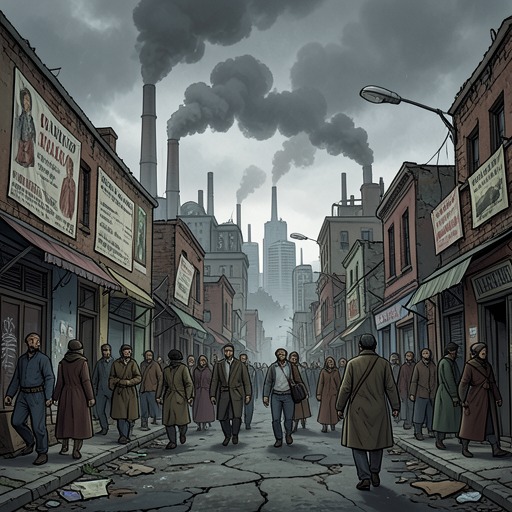
The recession’s most visible local effects became a recurring landscape of abandonment. Rob Peace and Tavarus Hester watched properties in Newark’s poorest stretches deteriorate in a recognizable sequence: windows went dark; red-inked city housing forms were stapled to the buildings; waist-high weeds grew behind chain-link fences; windows were smashed by people seeking shelter, using drugs, or scavenging pipes and appliances; and boards eventually replaced the glass. Seven or eight houses on a single block might enter this process. The decay was especially painful when Rob Peace and Tavarus Hester knew the former occupants, particularly when children had lived there.
Against this slow collapse, Rob Peace and Tavarus Hester developed a new vision for Peace Realty involving the Section 8 housing program. Tavarus understood the program from having grown up around its living spaces and regarded it skeptically, as a system in which suburban landlords could charge the city premium rents for severely neglected apartments. Their proposal sought to convert that grievance into a business and a public benefit.
They imagined the city selling abandoned houses to Peace Realty at wholesale prices of roughly $20,000. Rob Peace and Tavarus Hester would invest another $15,000 to $20,000 in renovations, bringing the properties to a standard well above Section 8 code requirements. They would then sell the renovated homes back to the city for approximately $50,000 to $75,000, still below market rate, so that the properties could enter the Section 8 program as owned homes rather than rented apartments. The city would save money by avoiding premium rents, families would gain greater residential stability, and the partners could earn between $10,000 and $25,000 per property. If the first round succeeded, they believed the enterprise could expand into a six-figure annual career—income that would be life-changing for the Burger Boyz while remaining modest by conventional real-estate standards.
This plan reveals how the recession reshaped Rob Peace’s idea of legitimate opportunity. The proposal was not presented simply as speculation. It joined profit, neighborhood repair, and housing stability in a single design, offering a lawful alternative to the abandoned properties’ descent into blight. Yet its feasibility depended on public finances and available credit, the same structures that the recession had weakened.
Public Austerity and the Return of Violence
The recession also damaged Newark’s capacity to maintain public order. As foreclosures proliferated, property-tax revenue declined while social demands rose. In the late fall of 2010, more than a year after the federal government had officially declared the recession over, Cory Booker made severe budget concessions, including the cutting of 163 police officers—13 percent of the force. Residents, store owners, remaining officers, and public-school administrators began to say that the city’s atmosphere resembled the 1970s again. During the following four months, Newark’s murder rate rose by 65 percent compared with the same period the previous year.
That reversal complicated the city’s earlier claims of progress. Operation Impact had produced more directed patrols, a citywide camera system, and major drug stings in high-risk areas such as the Garden Spires complex. In the spring of 2010, the operation there produced 149 arrests and the confiscation of $50,000 worth of drugs. But the recession made clear that policing alone could not stabilize a city whose residents lacked secure work, housing, and income. The public argument remained divided between intensified enforcement and the need for alternatives to crime, with poverty identified as the underlying cause.
The recession thus appears in the narrative as a form of cumulative pressure rather than a single dramatic scene. Its consequences move through foreclosed houses, shrinking city revenue, reduced police capacity, and renewed violence. The damage is gradual and distributed, but its effects eventually become visible in the streets and in the narrowing of choices available to people trying to build lawful lives.
Consequences for Rob Peace’s Trajectory
For Rob Peace, the recession created a contradiction between preparation and opportunity. He had education, scientific training, entrepreneurial ambition, and the confidence to imagine a business that could benefit both his associates and Newark families. Yet the collapse of the housing bubble stripped away the credit that would have allowed those resources to become stable property ownership. His free flight benefits, initially connected to business travel, became more useful for traveling the world than for expanding Peace Realty.
The failure of legitimate economic routes did not automatically push Rob Peace into illegal activity, but it narrowed the space in which his ambitions could operate. His later effort to pursue a Leadership Development Program at Johnson & Johnson shows the continuing search for a lawful future: he hoped to begin as a laboratory bench worker, perform work resembling his first laboratory role at Yale, earn a graduate degree at NYU with tuition paid by Johnson & Johnson, and accept a long-term contract in return. The existence of that plan alongside the abandoned-house proposal and the drug economy emphasizes that his trajectory was divided among several competing futures rather than governed by a single settled identity.
The recession’s significance therefore lies in the gap it exposes between capability and access. Rob Peace and Tavarus Hester could identify the city’s needs, calculate renovation costs, estimate profits, and imagine a socially useful enterprise, but they could not control the lending system or municipal resources on which the plan depended. The Great Recession made Newark’s ruins available as a vision while making the capital required to transform them harder to obtain. In that sense, it intensified the Newark–Yale divide and the larger conflict between education as social mobility and the structural conditions that prevent mobility from becoming secure.