34 Smith Street
The Short and Tragic Life of Robert Peace34 Smith Street is Curtis Gamble’s house in East Orange and the central domestic space of Rob Peace’s high-school and adult friendships. Its basement first functions as a refuge where Rob, Curtis, Tavarus, and Julius “Flowy” Starkes study, eat, and form a durable brotherhood; years later, the same basement houses Rob’s marijuana operation and becomes the scene of the home invasion in which he is shot twice and killed. The address therefore embodies both the sustaining shelter that helped shape Rob and the dangerous economic world that ultimately consumed him.
A House That Becomes a Family
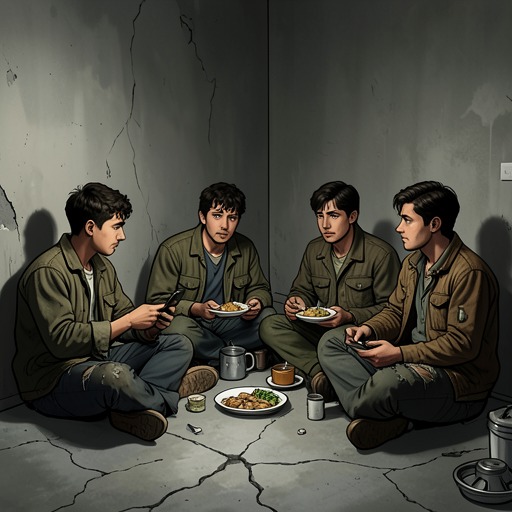
Curtis’s home stood on Smith Street, about a mile southeast of Rob’s house and within walking distance of most of the boys. Curtis’s parents, both schoolteachers, offered a comparatively comfortable and stable household. Curtis’s mother routinely collected the boys downtown and fed them, despite the expense of nourishing five high-school swimmers whose own homes often provided little food. Curtis’s father was usually upstairs watching the news or preparing lesson plans, and his ordinary, constant presence impressed Rob and Flowy, who had never experienced that kind of dependable fatherly presence. For Tavarus, Curtis’s father suggested a kinder version of the present than the one he had been given.
The basement, beside the laundry area, was cramped and crowded with metal storage shelves and boxes of old clothes. A refrigerator stocked with soda gave the boys one small luxury, and the room became a clubhouse where they squeezed together with books on their laps. The space was warm, fed, and removed from the conflicts that surrounded them elsewhere. Rob used it as an improvised classroom, explaining what his friends needed to know in every subject, including courses he was not taking himself. On this foundation of practical care and shared time, 34 Smith Street became more than a convenient gathering place: it became a family structure that felt unexpectedly stable, permanent, and good.
The Study Basement and the Burger Boyz
The house’s importance grew out of the institutional discipline of St. Benedict’s Preparatory School for Boys. Summer Phase required the incoming students to remain constantly occupied with classes, sports, group activities, songs, memorization, and color-group loyalties. The school’s purpose was not only academic instruction but also prevention: its faculty sought to keep urban boys away from fights, theft, drugs, emotional abuse, and dropping out by controlling their time and strengthening their identification with the school. At Smith Street, Rob reproduced a different kind of discipline on his own terms. He organized a weekly study group after swim practice when he saw that Tavarus had earned a 0.7 grade-point average, while Rob had again earned a 4.0.
The study sessions made the basement a workshop for mutual advancement. Rob did not need the extra work, and helping his friends limited the time he could spend getting farther ahead, but he recognized that Tavarus was caught in a depressive pattern and found a concrete way to assist him. The basement’s atmosphere also contrasted with other systems that defined Rob’s life. Trenton State Prison represented confinement, anonymity, and institutional permanence; Yale University represented elite opportunity but also social distance and racial and class tension. Smith Street offered a smaller, improvised institution governed by food, friendship, study, and presence rather than by walls, regulations, or status.
The house remained a recurring gathering place after high school. Friends came through the kitchen, basement, and backyard, and the address retained the intimacy of the boys’ earlier years even as their lives became more fragmented. In early September during Rob’s real-estate efforts, he returned from the airport to find Flowy, Curtis, and Tavarus in the kitchen, smoking and eating chicken wings. He cracked every joint in his body, poured vodka with cranberry juice, removed his boots, and complained that building an empire was taking longer than expected. The scene connected the adult ambitions of Peace Realty to the older refuge that had made ambition imaginable in the first place.
From Refuge to Business Premises
By the later years of Rob’s life, 34 Smith Street also became a working site for his attempts to convert education, labor, and criminal enterprise into financial security. Rob and Tavarus researched the history of the Section 8 housing program and property values in the Hall of Records, then returned to the kitchen table at Smith Street to revise their business proposal and debate its wording. They planned to approach investors, many of them St. Benedict’s alumni reachable through Friar Edwin Leahy, and understood that their limited entrepreneurial experience made the proposal especially important. The house thus served as an informal office where the friends tried to turn their shared history into a legitimate real-estate enterprise.
The address also preserved the social rituals of the Burger Boyz. At a backyard cookout, friends moved through the side alley, passed joints along the fence, and listened to old-school music while Flowy talked, Curtis displayed the watermelon vines in his garden, and Christopher played until bedtime. Rob spent hours at the grill slow-roasting Brazilian pork, holding a spatula in one hand and a drink in the other. The gathering felt like a return to the hundreds of nights that had followed high school, but it also carried the knowledge that the group’s old form could not last indefinitely. Smith Street remained a place of continuity even as its residents entered more precarious adult lives.
That precariousness became literal when Rob stored fifty pounds of marijuana in the basement and began converting it into Sour Diesel. The quantity looked surprisingly small—roughly twenty-five gallons, a few dozen ziplocked bags resembling potting soil—despite the nearly half-million dollars he hoped to earn. Rob sealed the basement door and the doorway to the laundry area with tarps, but the unventilated fumes still made his eyes tingle and water. Because a larger sieve would have sent butane fumes upstairs and endangered Christopher, Rob had to process the marijuana a fraction of an ounce at a time. Each pound required roughly ten to fifteen hours of work, making the full cache a commitment of more than five hundred hours, while he continued processing Amin’s smaller shipments of two to five pounds a week.
The basement’s old emotional meaning did not disappear immediately. On the first night, the Burger Boyz smoked the new product, talked, laughed, and briefly felt like children again in their former retreat. By morning, however, the room had become a place of isolation and labor. Rob woke hungover and confronted the months of work ahead, then disappeared for full days, climbing the back stairs only to eat or use the bathroom. He kept himself moving by talking about eventual profits, laundering the money, and the wider possibilities those profits might create. The same room that had once supported study and collective uplift now concentrated risk, secrecy, exhaustion, and the hope that illegal work could purchase freedom.
The Home Invasion and Rob’s Death
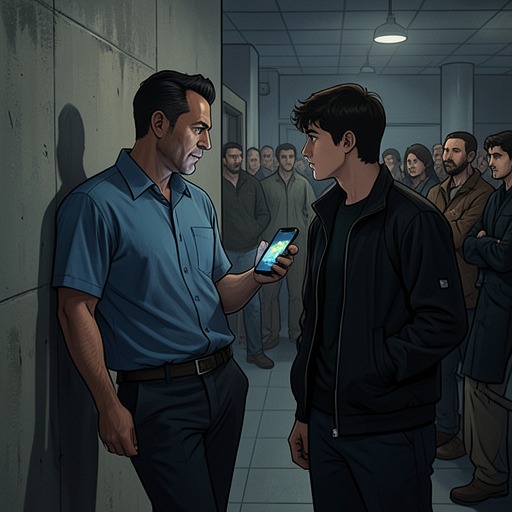
The transformation of 34 Smith Street reached its violent conclusion on the night of May 18, 2011. Curtis was in the kitchen when he heard Rob open the back door on the stairwell landing to see who had arrived. Rob muttered in alarm and began closing the door, but froze with it half open. Curtis later believed that, within seconds, a gun had already been aimed at Rob. The door swung open, Rob said for the intruders to calm down, and at least two men forced or prodded him down the stairs toward the basement.
The attackers bypassed the rest of the house, indicating that they knew where Rob kept his money and drugs. Curtis ran toward the front door, hoping to draw neighbors into the street, while yelling and confusion spread through the house. In the basement, gunfire occurred as Curtis tried to intervene. The intruders fled, but Rob was found facedown near the sunken love seat, his arms folded under his chest and blood beginning to run toward a small drain in the faux-tile floor. Curtis turned him over; Rob’s shirt was saturated with blood, and his eyes were closed. Tavarus reached the body and cradled Rob’s head until East Orange police arrived more than twenty minutes later.
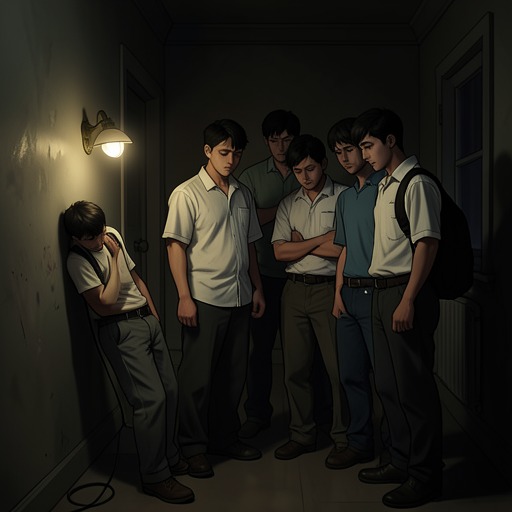
The basement’s physical details make the death inseparable from the house’s earlier history. The same enclosed room that had held schoolbooks, soda, food, jokes, and the boys’ sense of family now held Rob’s body and the evidence of an operation that had exposed everyone in the house to danger. The police search left the home disrupted for days, yet the friends continued to eat and sleep there because they had nowhere else that could carry the same meaning. Their inability to leave was practical, emotional, and symbolic: they remained inside the space where their brotherhood had been formed, now forced to inhabit the vacancy his death created.
Memory, Mourning, and Significance
On the day of Rob’s funeral, the Burger Boyz held their own small ceremony in the backyard, only a few yards from where he had died. Police were still coming and going, and Curtis had been released after three nights in a cell while legal charges connected to the basement’s drug commerce remained imminent. The friends shared a mournful blunt and raised a toast without fully processing the absence of Rob’s shoulders, voice, and constant presence. Christopher rode around the driveway on the bicycle Rob had given him, now exactly the right size for him—a surviving object from the years when the house represented care rather than danger.
The friends could not determine whether the intruders had initially intended to kill Rob or only to steal from him. They suspected that Rob might have tried to confront the smaller intruder after Curtis fled upstairs, perhaps relying on the martial-arts training he had recently begun. They also believed that Rob’s being shot may have saved Curtis, Tavarus, Darlene, and Christopher from being killed or wounded. That interpretation became part of the group’s attempt to give meaning to the scene: even at the end, Rob may have acted to protect the people gathered in the house.
Afterward, 34 Smith Street remained the address through which grief, loyalty, and unresolved consequences circulated. Raquel raised $5,000 through Facebook to help pay Jackie Peace’s funeral costs, while Curtis briefly tried to recruit private attackers to avenge Rob before Tavarus persuaded him that violence would not solve violence. Flowy marked the bond with the tattoo “Real Peace Never Die BB4Life.” The house therefore survives in the narrative as a compressed map of Rob’s trajectory: a basement where education and friendship created social mobility, a workplace where illegal commerce promised autonomy, and a crime scene where the collision between those aspirations and the violence around them became final. At its center is the black door at the foot of the stairs, opening directly onto the basement where Rob Peace was shot twice and killed.