50-pound marijuana operation
The Short and Tragic Life of Robert PeaceThe 50-pound marijuana operation was the largest and most consequential drug venture undertaken by Rob Peace. Conceived in early March 2011 as an alternative to working for Amin, it promised nearly $400,000 in collective profit and the possibility that Rob could finance a legitimate future in real estate, support his family, and stop dealing. Instead, the operation converted his ethic of caring for friends into an enterprise whose risks ultimately outran his ability to control them.
Origins and the Gray Area
The immediate opportunity came through Curtis, who presented an ambitious and perilous scheme just as winter was giving way to spring. Curtis’s connection could supply fifty pounds of bulk marijuana at $4,000 per pound, less than ten percent of the market rate. The group calculated that resale might produce roughly $400,000 within a few months—a 2,000 percent return. The money would repay the participants’ investments, support their mothers, grandmothers, girlfriends, and children, provide suits for job interviews, and perhaps allow them to stop hustling altogether.
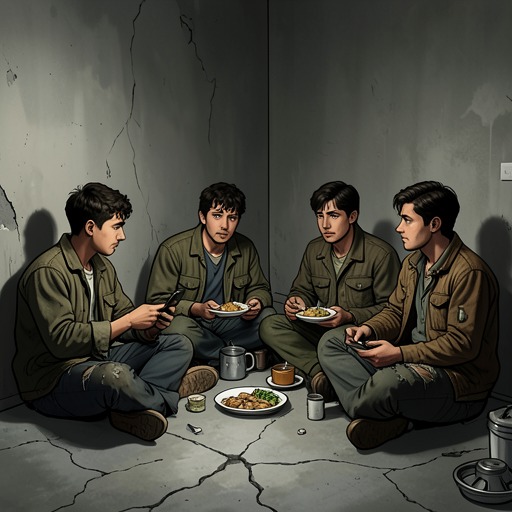
Rob framed the proposal as a moral compromise rather than a simple pursuit of profit. Sitting with Flowy, Drew, Tavarus, and Curtis, he called the enterprise their “gray area,” arguing that every important man had compromised something on the way to success. He invoked public figures and entertainers who had supposedly hustled, cheated, or behaved dishonestly before becoming powerful. When Flowy objected that two of the rappers Rob named had been murdered, Rob answered that money had made them lazy and insisted that the same fate would not overtake the group. His reasoning turned danger into a temporary passage toward independence.
The group’s projected individual rewards made the proposal persuasive. Rob and Tavarus could begin their housing venture without outside investors; Flowy could leave the neighborhood; Curtis and Drew could decide what to do with their shares. Flowy nevertheless worried that Curtis’s house, where the marijuana would be stored, would become a target and that the operation was too large to remain hidden. Rob promised that the drugs would be gone before anyone discovered them and said he would assume the primary risks himself. At about one in the morning, the decision became unanimous: they would obtain the marijuana, convert it into Sour Diesel in Curtis’s basement, and sell it.
Processing and Labor
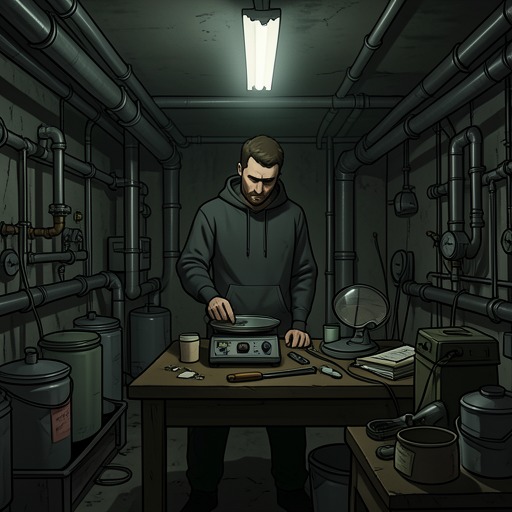
The shipment looked far less impressive than its projected value. Fifty pounds occupied perhaps twenty-five gallons and would have fit inside the glass walls of Rob’s old snake tank. Stored in several dozen ziplocked bags, it resembled potting soil more than nearly half a million dollars. Yet the marijuana’s smell immediately made the basement hazardous. Rob insulated the basement door and the passage to the laundry area with tarps; without ventilation, the fumes caused his eyes to sting and water, forcing him to work with a gas mask.
The physical process was extraordinarily slow. Because the available equipment was small, Rob had to convert the marijuana a fraction of an ounce at a time through a cylindrical sieve no larger than a bicycle pump. Each pound required ten to fifteen hours of work, making the full fifty pounds a project of more than five hundred hours. At the same time, Rob continued processing two to five pounds a week for Amin. The time-consuming method had seemed useful when planned because it would force sales to proceed gradually, but once the work began, the winter and early spring became an isolating stretch of repetitive labor.
Rob initially attacked the conversion with ferocity, spending entire days in the basement and climbing the back stairs only to eat or use the bathroom. He countered the physical grime and confinement by speaking constantly about the eventual profits, the laundering of the money, and the future those profits might create. The work resembled his earlier understanding of education: an unpleasant passage that had to be endured before a larger field of possibility opened. The difference was that the new passage depended on an illegal product, volatile fumes, and a market he could not fully command.
The marijuana was already at least three months old when acquired, and humidity in the basement caused some bagged clusters to develop mold. Freezing it might have prolonged its usable life, but it would have altered the quality of the high and damaged Rob’s reputation as a seller. The operation therefore carried a deteriorating inventory as well as a mounting labor debt. The projected fortune was not simply waiting to be collected; it had to be manufactured, transported, and sold before the product lost value.
Distribution and Unequal Burdens
Rob’s most serious miscalculation concerned distribution. Each pound produced about 450 dime bags, creating approximately 22,500 units to sell. Tavarus could not drive because of his prior possession record, while Curtis and Drew hesitated to act as couriers. Their earlier agreement had been made in the excitement of collective planning, but the practical danger produced a retreat from the responsibilities that planning had implied. Rob did not turn their reluctance into a quarrel. He had promised to carry most of the burden, and he now accepted that role.
Only Rob and Flowy were initially willing to make deliveries, a limitation that made the volume nearly impossible to move without attracting attention. Rob set a ceiling of ten drop-offs per night for each of them, quantities designed to resemble his earlier one- or two-pound transactions. He refused to sell in East Orange, where many of his friends’ contacts were located, because he feared that Amin might believe he was diverting supply from the operation for which Rob still worked. The choice narrowed the market just as the scale of the inventory demanded expansion.
Rob eventually hired four young men, aged eighteen to twenty-two, to serve as couriers. Each received $400 a week, gas money, and commissions. One recruit fell to his knees and cried when he was hired, saying the work would keep him from homelessness. Rob treated the men like younger brothers, avoiding an authoritarian manner, giving small kickbacks, and insisting that their cars have current registrations and working taillights and that they obey traffic laws. He presented himself as a mentor who could show them how to advance. None of them saw the basement or understood the full structure of the enterprise; their work took place in parks, parking lots, and side streets.
For roughly three weeks, this system functioned. The group moved nearly a pound a day, though overhead reached about $8,000 a month and reduced the original projections. The first profits went toward repaying Curtis, Tavarus, Drew, and Flowy for their investments. Rob used his share for back mortgage payments on the Greenwood Avenue house, contributions to Jackie, radiator repairs at the Chapman Street house, and medical debts incurred during Frances’s dialysis and emphysema. He also resumed helping friends with rent, car repairs, and marijuana. At the existing rate, the supply might have been exhausted by midsummer, leaving time for Rob to prepare for the Johnson & Johnson application process.
Kamar, Exposure, and Collapse
The apparent success depended on information remaining contained, and Kamar became the breach. Kamar was nineteen, quiet, punctual, reliable, and unusually hardworking. Rob admired his follow-through and told Flowy that the young man had a future, preferably outside the drug trade. Their private meetings may have allowed Kamar to regard himself as an associate rather than a subordinate. By late April, buyers reported that Kamar was calling Rob smug, dishonest, and incompetent while also talking about his Yale background.
The immediate danger was not merely disrespect. Rob feared that Kamar would reveal that he was operating a large independent enterprise while still working for Amin. The rumors might reach people beyond the buyers and expose the operation’s scale. Rob dismissed Kamar outside the Smith Street basement, an improvised confrontation that occurred on the sidewalk because Rob was hungover and did not want to drive elsewhere. Curtis heard Kamar shouting from inside while Rob responded in a low, controlled voice. After the car left, Rob returned and treated the incident uneasily as evidence that younger workers had become difficult.
Kamar then approached the Double II Set Bloods, claiming that Rob was secretly running a major operation in their territory. The claim was false: Rob’s instructions had specifically directed the couriers away from the gang’s territory. But the gang did not wait for careful verification. Rob suspended his dealings and tried to find a quiet, safe way to explain the truth, expose Kamar as a resentful former employee, and prevent the young man from being harmed. The operation had begun as a plan to protect people through money; it now required Rob to manage rumors, gang politics, and the possibility of immediate violence.
Rob finally told his partners what had happened. They did not respond with anger, although his crisis contradicted his original promises that he could control the risks. Curtis urged him to abandon the enterprise. Rob asked for three days, insisting that Kamar could not cause serious damage in that time and that he could repair the situation. His friends were more persuaded by his appearance than by his assurances: he looked cold and agitated rather than peaceful. Around the same period, Newark’s violence was rising sharply after a brief improvement; the first quarter of 2011 showed a 71 percent increase over the same period of the previous year. The operation’s economic promise had therefore entered a city environment in which information could become violence faster than explanation could contain it.
Meaning and Consequences
The venture grew out of Rob’s established pattern of mutual aid. As a student at St. Benedict’s, he redirected buyers to Tavarus rather than selling marijuana himself and accepted a small referral payment that he split with Jackie. Later, dealing networks supplied not only income but a way to remain responsible for people from Oakdale, Mt. Carmel, East Orange, St. Benedict’s, and his older friendships. He gave money for rent and children’s clothing, offered rides, helped with tenants, and relied on friends when he needed assistance. The fifty-pound operation magnified that reciprocal economy until generosity, obligation, and criminal risk became inseparable.
The plan also followed the death of Skeet Douglas and Rob’s abandonment of the goal of freeing his father. After Skeet’s final appeal was denied and he died in prison from brain cancer, Rob turned toward Peace Realty. By renovating the Greenwood Avenue house and renting its three units while living with Jackie on Chapman Street, he was earning about $1,000 a month. He imagined real estate as a lawful form of usefulness: a house meant shelter, heat, security, and family. The marijuana operation promised the capital to realize that vision without investors, but it substituted speed and danger for the slower, uncertain work of building property income.
Rob once told Oswaldo Gutierrez that he wanted to succeed, even while carrying roughly five pounds of marijuana in a car. Oswaldo answered that Rob wanted to succeed both in business and as a dealer and would have to choose one. Rob’s attachment to people made him unlike the ruthless drug kingpins Oswaldo had known; he cared about workers’ circumstances, families, and stories. That compassion helped explain both his generosity and his vulnerability. He could organize a large operation, but he could not make it morally or socially equivalent to the legitimate future he hoped it would fund.
The operation’s decisive reversal was therefore not simply that drugs were sold or that profits were reduced. It was that the venture designed as a bridge toward freedom increased Rob’s dependence on secrecy, intermediaries, and violent networks. The basement’s fumes, the five hundred hours of conversion, the 22,500 units awaiting distribution, the couriers’ fear, the aging product, and Kamar’s betrayal all exposed the same contradiction: Rob’s intelligence and endurance could expand the enterprise, but they could not remove the structural dangers that made the enterprise necessary. The 50-pound marijuana operation became the clearest expression of his effort to convert care into capital—and of the point at which that effort began converting care itself into risk.