Cannabis dependence
The Short and Tragic Life of Robert PeaceCannabis dependence is not presented as an isolated medical condition in Robert Peace’s story. It is woven into the way he moves between Newark and Yale, between scientific competence and illicit commerce, and between intimacy with other people and retreat into a private mental world. Marijuana offers him temporary control over pressure, but it also helps sustain the compartmentalized existence he calls “Newark-proofing” himself.
Definition and Pattern
Cannabis dependence appears in the book as frequent, self-aware marijuana use rather than as a condition Robert openly treats or seeks to eliminate. He understands the drug’s science and its costs, and the narrative explicitly describes him as addicted according to the frequency of his use. At the same time, he considers himself capable of controlling that addiction and calls himself “High functioning.” This formulation captures the central tension: his dependence does not initially prevent academic success, scientific work, employment, friendship, or long-term planning, but it remains a persistent force shaping how he manages stress and chooses among competing identities.
Robert’s preferred state is neither extreme sedation nor overstimulation. He distinguishes the indica effect, or “body stone,” also known as “couch lock,” from the more energetic sativa “head high.” The first brings intense lethargy, indifference to practical tasks, and a desire for solitude; the second produces talkativeness, laughter, heightened sensory experience, and sometimes paranoia. Robert prefers an intermediate condition in which he can still accomplish tasks and operate in the world without feeling pulled in every direction. His use therefore becomes an effort to engineer a mental state suited to functioning under pressure rather than simply to pursue intoxication.
Marijuana and Emotional Self-Protection
At Yale, marijuana accompanies Robert’s strongest experiences of humiliation, anger, and social estrangement. When a group of crew-team students leave their dirty trays behind in the dining hall, he experiences the encounter not as a minor breach of etiquette but as an assault on dignity. He is left in a starched white uniform and hairnet, cleaning the wasted food while the students ignore him. His anger escalates into fantasies of “curbing” them, and he punches a wall in the dish room, swelling three knuckles. Hours later, after smoking, he recounts the incident while watching a bootleg kung fu film, his anger still active long after the immediate encounter has ended.
The marijuana does not erase that anger; it provides the setting in which Robert can narrate and contain it. His friend can recognize the event as a careless slight but cannot fully connect it to the larger social injury Robert feels. Robert understands this gap and withdraws into a world his friend cannot access, a struggle rooted in his Newark childhood and guarded as his own burden. Cannabis thus operates within his compartmentalization: it helps him inhabit the immediate room while keeping other pressures at a controlled distance.
The same pattern surrounds his bitterness toward Yale and its privileged students. Robert objects to what he calls “fronting,” the performance of identities that conceal cowardice, privilege, ignorance, or fear. He sees role-playing everywhere, while other students regard his grin, humor, marijuana use, and apparent ease as evidence that he is relaxed and socially secure. His drug use becomes part of the public persona through which he crosses these settings, even as the narrative shows that the persona conceals anger and vulnerability rather than resolving them.
Dependence and the Drug Economy
Robert’s dependence is also connected to his participation in the illegal marijuana trade. He sells to students at Yale, where the business is comparatively cushy because classmates come to him and pay his prices. After graduation, dealing in Newark exposes him to a harsher market: dangerous nighttime driving, negotiations over five- and ten-dollar amounts, desperate users, suppliers, and the human costs of the commerce. His knowledge of marijuana lets him distinguish products and effects, while his own controlled use allows him to regard himself as different from people whose dependence is more visibly destructive.
That distinction becomes morally unstable. Robert sees users who rely on marijuana more heavily but lack the ability to understand what their reliance means. His pity appears outwardly as scorn; he calls them lazy while friends believe he is deeply sensitive to the city’s widespread suffering and perhaps guilty that, without his particular intelligence and his mother’s care, he might not be different from them. His dependence therefore produces a double consciousness. He recognizes himself in those he judges, yet uses that recognition to maintain a boundary between his own “high functioning” consumption and the lives damaged by the trade from which he profits.
The summer of 2003 forces that boundary into crisis. A bulk supplier pulls a revolver on Robert after a failed negotiation, and the weapon reduces his accumulated knowledge and achievements to the immediate fact of a barrel pointed at him. He pays the additional money demanded and then begins teaching high school, leaving the drug trade. The gun encounter does not by itself explain the entire decision, but it crystallizes the anxiety and danger already consuming the business. Dealing had become more costly in emotional wear than it was rewarding in cash, while regular exposure to dealers and users made the consequences of the trade impossible to keep abstract.
Engineering the High
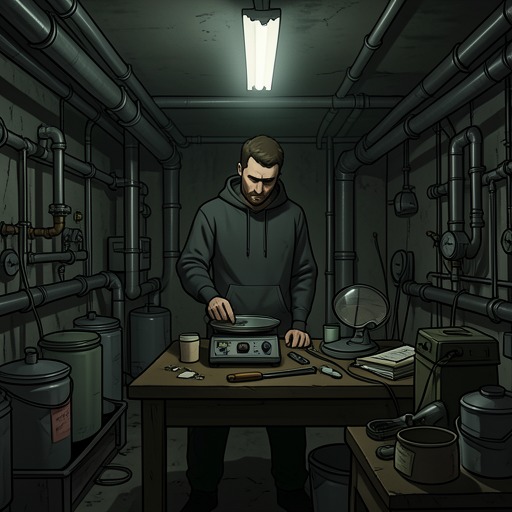
Robert later returns to marijuana commerce in a more technically ambitious form. In the basement of 34 Smith Street, where Curtis now lives alone, he builds a hydroponic growing operation beneath LED lights that take up more than three-fourths of the floor. He develops his own indica-sativa hybrid, Sour Diesel, using parent plants shipped from California and applying a process of biological trial and error that recalls his laboratory work. The operation is too small for mass production, but it provides enough product to blend with less selective marijuana purchased through his connections.
He also distills hash oil from discarded stalks and leaves with butane, dripping the concentrate onto smokable buds to intensify the effect and increase profits. The process is repetitive, laborious, and dangerous: poisonous fumes require him to wear a gas mask, while police patrol the surrounding neighborhood. In the winter of 2006, much of his free time is spent alone in the basement making designer marijuana. The scene turns scientific ingenuity into criminal production. His capacity to classify effects, design a preferred balance, and refine a product gives the dependence an industrial and intellectual dimension, even though the resulting enterprise deepens the risks that had earlier driven him away from dealing.
Dependence, Identity, and Consequence
Cannabis helps Robert sustain several identities that he cannot fully reconcile. He is remembered as “The Professor” from childhood, admired as an authentic figure by Isabella Peretzian, and viewed by privileged acquaintances as a Yale graduate whose confidence and marijuana use make him seem unusually self-possessed. In Newark, however, he must manage the legacy of his father, the pressure to carry the family name proudly, and the demand to move among people who interpret education and class through suspicion. His “Newark-proofing” allows him to wall off one self from another; marijuana becomes one of the practices through which that separation is maintained.
The dependence also remains tied to Robert’s unresolved anger about class, race, and institutional power. His defense of Skeet Douglas before the Elihu society frames his father’s conviction as part of a system designed to suppress black men, while his reactions to Yale’s dining hall hierarchy turn ordinary acts of disrespect into evidence of a larger social order. These experiences cannot be reduced to marijuana use, but the drug repeatedly accompanies the moments in which Robert retreats from explanation into anger, humor, or controlled detachment. It is both a coping mechanism and a way of remaining inside the emotional world he believes others cannot understand.
By the time Nathan asks him in South Orange what he is doing, Robert answers that he went to Yale and knows what he is doing, but does not provide a present account of his life. The exchange exposes the limit of the “high functioning” identity. Academic achievement, technical knowledge, friendship, and periods of legitimate work have not dissolved the dependence or the conditions that sustain it. Cannabis remains part of the larger pattern in which Robert repeatedly converts intelligence into control while leaving the underlying conflict unresolved: he can design a strain, manage a business, and regulate his own intoxication, yet he cannot make the separate parts of his life cohere.