Copacabana
The Short and Tragic Life of Robert PeaceCopacabana is the beach landscape at the center of Rob Peace’s first sustained experience of Rio de Janeiro, a place where geographic distance, racial mixture, public sociability, and temporary freedom converge. Its significance lies less in tourism than in the identity it permits: on Copacabana, Rob is briefly released from the histories, obligations, and social classifications that have shaped his life in Newark and at Yale.
Setting and Appearance
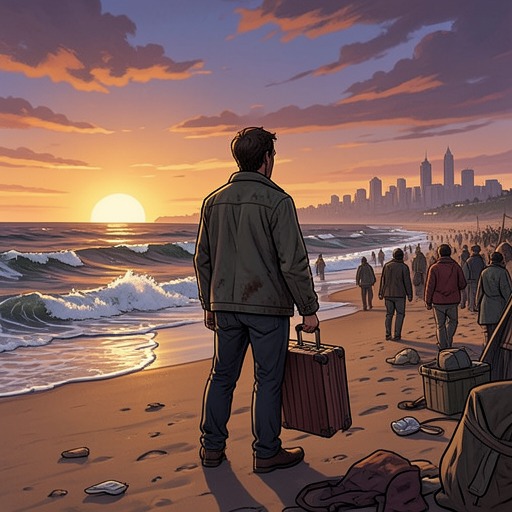
Copacabana first appears as an expansive coastal panorama. White sand extends along the shore, green water opens toward Antarctica, Sugarloaf Mountain rises sharply to one side, and the Cristo Redentor statue stands above the city with open arms. Across the water, the Vidigal favela cuts into the rain forest, its densely stacked roofs and narrow passageways appearing almost beautiful from a distance despite the poverty they contain. The beach therefore holds the city’s contrasts in a single view: spectacular nature, mass public life, religious monumentality, and visible inequality.
The scene is also collective rather than secluded. Thousands of people occupy the stretch of sand between the city and the water, and Rob watches them as the sun sinks over Vidigal. When the sunset arrives, the crowd applauds, a local ritual that gives the beach a shared rhythm and makes Rob an immediate participant in public life rather than an isolated observer. Copacabana is presented as a place whose beauty is inseparable from the people gathered there.
Rob’s Life on the Beach
Rob arrives with a duffel bag and nowhere to stay, but he soon finds a studio in the South Zone for four hundred dollars a month, with French doors opening directly over Ipanema Beach and a balcony above the sand. Copacabana and the neighboring beach become the setting for a repeated daily pattern: coffee by the water while reading the news in Portuguese, long walks along the ocean, drinks and people-watching, and a return to the shore for sunset. The beach gives his days a structure based on movement and sensation rather than work, legal pressure, family responsibility, or financial calculation.
At times Rob smokes a blunt on the sand and shares it with passersby, treating the gesture as part of the local culture. He swims while daylight remains, sometimes going half a mile straight out through the green water among fishing boats and yachts before turning back toward the illuminated shoreline. The sequence makes the beach both physical challenge and emotional release: his strong, choppy strokes carry him away from the city, while the glowing coast draws him back toward civilization.
Copacabana also changes how Rob is seen. In East Orange, he had stood out as a nerd in a pink school uniform; at Yale, as a Black man wearing a skully. In Rio, he does not feel marked in either way. He walks the beach as an ordinary traveler, free from the need to explain his intelligence, class position, race, or neighborhood. He does not have to monitor every bill entering or leaving his wallet. The beach thus becomes a temporary social space in which identity is less defensive and less divided.
Contrast with Newark
Rob understands Rio through Newark. Both cities experienced the arrival of rural minorities seeking industrial work, the segregation of many of those migrants into favelas or public housing, racial tension, violence, manufacturing decline, permanent poverty, and the growth of drug traffic. Copacabana does not erase those parallels. The nearby favela remains visible from the shore, and the city’s beauty exists alongside deprivation.
The crucial difference is the relative fluidity of public space. In Rio, Rob can move among varied neighborhoods and socioeconomic groups with less fear than he feels in Newark. Copacabana represents that permeability most clearly: people from different backgrounds occupy the same beach, share the spectacle of sunset, and participate in a common public culture. The comparison makes the beach an implicit criticism of the rigid boundaries that have organized Rob’s home city.
Narrative Significance
Copacabana marks a rare interval in Rob’s life when obligation appears to fall away. Arriving in Rio, he realizes that he has nothing to do and no one to worry about, and the beach sustains that sensation through repetitive walks, swimming, smoking, drinking, and sunset rituals. Its open horizon offers a temporary escape from the Newark-Yale divide and from the family history that Rob has carried into every institution he enters.
That freedom is powerful precisely because it is temporary. Copacabana does not resolve the inequalities Rob has crossed oceans to escape, nor does it permanently stabilize his identity. It gives him a glimpse of a life in which he can move, observe, and belong without constantly performing competence or responsibility. The beach’s importance therefore rests on contrast: against the constrained streets of East Orange, the guarded social world of Yale, and the accumulating pressures of adulthood, Copacabana becomes the clearest image of Rob’s brief, embodied freedom.