Deindustrialization
The Short and Tragic Life of Robert PeaceDeindustrialization is the structural decline of industrial employment and urban manufacturing that forms one of the central conditions of Rob Peace’s life. In the book, it is not treated as a single collapse but as a prolonged transformation: factories close, working-class families leave, public institutions deteriorate, and the remaining residents inherit the social costs. Its consequences reach from Newark’s industrial economy into East Orange neighborhoods, schools, family finances, racial identity, and the narrowing space between educational achievement and secure work.
Industrial Collapse and Urban Displacement
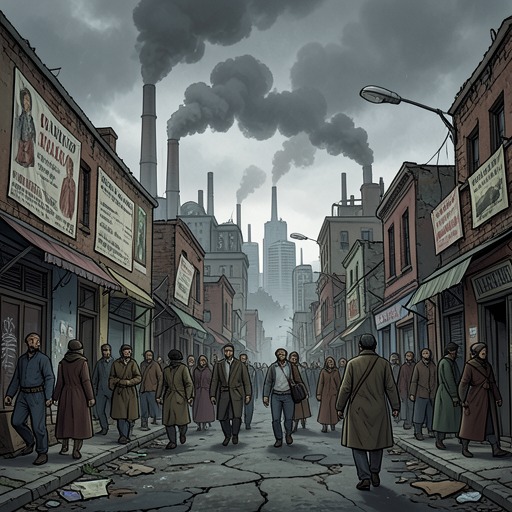
Deindustrialization accelerated when improved transportation allowed manufacturing companies to move toward cheaper land outside urban centers, while Japan and China became major exporters and American companies outsourced labor overseas. The United States service economy expanded as the industrial economy contracted, especially from the late 1960s onward. In and around Newark, more than six hundred factories—including tanneries, glass and plastics plants, and manufacturers of industrial machine parts—closed between 1970 and 1980. These establishments had helped make the Port of Newark the busiest port in the nation for decades; their disappearance therefore represented more than the loss of individual workplaces. It severed the economic foundation of an entire city.
The closures produced massive layoffs at the same time that public housing was already full. As unemployment rose, the social damage associated with urban poverty spread outward from the project towers into spaces vacated by the working class. The movement crossed Newark’s northern and western wards, reached East Orange, and continued beyond it. The Peace family lived just across the boundary between Orange and the traditionally more dangerous East Orange, but formal municipal lines could not stop the deterioration. Areas that had once been associated with ordinary working-class life were gradually overtaken by abandoned houses, liquor stores, check-cashing centers, and nearby gunfire.
The Peace Family and the New Geography of Work
Jackie Peace’s family experienced this transformation through both race and employment. Her father spoke contemptuously about real-estate agents who exploited civic unrest by persuading white homeowners that the arrival of one black family would lead to falling property values and further black migration. Over several decades, neighborhoods such as Vailsburg, Irvington, and East Orange became increasingly black as residents moved west from downtown Newark. East Orange changed from 39 percent black and 53 percent white in 1960, when Jackie’s family arrived from Elizabeth, to 89 percent black and 4 percent white in 1980, the year Rob was born. The neighborhood’s later reputation as “Illtown” condensed a complicated history of racial transition, housing manipulation, and economic abandonment into a stigmatizing label.
Jackie’s everyday concern, however, was less demographic analysis than finding work and helping pay for necessities. Her father was likewise grateful simply to remain employed while factories disappeared. This emphasis on holding a job clarifies what industrial decline threatened: not only wages, but the ordinary expectation that work could anchor a household. By the time Rob grew up, the family remained in a place from which many former neighbors had departed. The westward bus ride Jackie later took to her job in West Orange exposed that contrast physically, carrying her past fields, woods, and ranch houses toward the suburban areas where many people from her old neighborhood had moved during the 1970s.
Institutions After the Factories
Deindustrialization made public institutions carry burdens they were not equipped to absorb. Oakdale Elementary School, once considered a reasonable neighborhood school, appeared to Jackie to have declined by the time Rob entered kindergarten. Its building was maintained and its curriculum followed federal guidelines, but she sensed indifference in the teachers and a laissez-faire attitude among parents. She believed many children were being sent there to be watched rather than taught. The school’s failure was therefore depicted as subtle and cumulative: the visible structure remained intact while expectations, supervision, and educational purpose eroded.
The broader Newark setting was similarly marked by accumulated losses. More than one in three Newark residents lived below the poverty line; violent crime remained persistently high; the public-school graduation rate was below 60 percent; and Newark had lost 130,000 residents since the 1967 riots. The Ironbound district, once a busy and diverse commercial center, had become a deteriorating stretch of shuttered storefronts and squatters. Companies such as Prudential Insurance considered leaving downtown because attracting workers had become difficult. The city even built enclosed skyways two stories above street level so downtown employees could move between buildings without walking outside, an architectural response to the insecurity that deindustrialization had helped intensify.
The election of Sharpe James as Newark mayor in 1986 carried the promise of reversing these conditions through jobs, housing, and downtown development. His proposed goals included replacing project towers with smaller-scale public housing and middle-income units and bringing a performing-arts center and sports arena downtown. Yet the persistence of poverty, violence, low educational attainment, and population loss showed how difficult revitalization would be. Deindustrialization remained the underlying terrain on which political promises had to operate.
Education as Escape and Its Limits
Against this background, Jackie treated education as Rob’s route out. Her decision to pursue private schooling arose from her perception that Oakdale could not provide enough, even though her parents regarded private elementary education as an unnecessary expense. Rob’s later admission to St. Benedict’s Preparatory School demonstrated both the possibility and the cost of institutional escape. The school’s student body was 89 percent black and Hispanic, and its strong alumni network allowed it to offer substantial financial aid. Tuition listed at $8,700 a year against an overhead cost of $16,000 per student, but Rob’s annual charge was reduced to $4,000 after Jackie fought to secure his acceptance.
At St. Benedict’s, achievement converted into social opportunity. Rob became an accomplished swimmer, tutor, leader, and near-valedictorian, eventually receiving acceptances from Johns Hopkins, the University of Pennsylvania, and Yale. At a school dinner, Charles Cawley recognized the scale of that achievement and gave Rob his telephone number, telling him, “You can go to college wherever you want.” Cawley’s support paid Yale’s four-year tuition, approximately $140,000, and made higher education an extraordinary bridge across the economic damage surrounding Rob’s childhood.
Yet Yale exposed rather than erased the distance created by deindustrialization. Rob entered a predominantly affluent institution as both black and poor, a minority within Yale’s black minority. Only 12 percent of his class was black, and roughly 20 percent of those students had grown up at or below the poverty line. He had come from a city where blackness had placed him within the majority; at Yale, race and class required constant repositioning. Activities that attracted him, including the water polo team, could be read by other black students as “acting white,” while black social spaces could appear exclusive to outsiders. His education expanded his credentials without dissolving the social geography from which he had come.
Work, Capital, and the Return of Industrial Logic
Rob’s later choices reveal the limits of education as a guarantee of secure mobility. He worked at Continental Airlines handling baggage, a job Jackie regarded as radically beneath the achievements for which his family and schools had sacrificed. Rob defended the work as a way to make ends meet, to obtain wages and benefits, and to exchange mental strain for physical labor. His position also resembled the stable employment that an airline job might once have represented for someone without elite schooling, as it did for his cousin Nathan. The argument exposed a contradiction produced by deindustrialization: the old promise of respectable work had weakened, but the social expectation attached to elite education remained.
Rob also studied real estate and developed the Peace Realty plan. He concluded that Newark and the Oranges were poor places to invest because property taxes had risen, tenants struggled to provide security deposits, rent collection was difficult, profit margins were thin, and lenders were suspicious or crooked. He looked instead toward Cleveland and surrounding Ohio communities, where modest houses stood on decent plots in diverse working-class neighborhoods supported by historically stable manufacturing companies. Ohio offered a version of the industrial stability Newark had once possessed, but Rob approached it as an investor rather than as a worker receiving security from the industrial economy.
Even his Yale degree could change meaning according to context. In East Orange, Tavarus presented “Shawn Peace” as the venture’s advantage because someone who had attended Yale would command lenders’ attention. Within the drug economy, however, Rob concealed the same credential. His Yale pedigree made suppliers suspicious, so he performed the role of a desperate, struggling, not-too-bright hustler and used Carl as a beard to make that performance credible. Education functioned simultaneously as symbolic capital in real-estate negotiations and as a liability in Newark’s underground economy.
Deindustrialization as Continuing Structure
The book connects deindustrialization to a chain of consequences rather than assigning it sole responsibility for Rob’s decisions. It helps explain the weakening of schools, the spread of poverty and violence, the migration of working-class families, and the scarcity of legitimate work that matched his education. It also helps explain why the drug trade could appear to Rob and his associates as a flexible economic bridge: at Yale, the Weed Shack connected him with a market and with other young men who understood the distance between the university and Newark; later, the same commercial logic supported larger operations and plans for property investment.
Rob’s friends and mourners struggled to explain his death, offering competing accounts that he dealt drugs to support his mother, wanted to live in South America, planned to return to school, hoped to open a pharmacy, or intended to leave the drug trade soon. The phrase “potential squandered” reduced this history to a moral failure, while the book’s account places his choices within a longer structure in which credentials, labor, race, neighborhood, and capital repeatedly failed to align. Deindustrialization is therefore not merely the background to Rob Peace’s story. It is the economic transformation that made his movement between Newark, Yale, airport labor, real estate, and illegal commerce both possible and perilous.