Drew Jemison
The Short and Tragic Life of Robert PeaceDrew Jemison is one of the central members of Rob Peace’s closest circle, first encountered through the St. Benedict’s water-polo team and later remembered as part of the Burger Boyz. His size gives him an intimidating physical presence, but his importance lies less in force than in steadiness: he helps make friendship tangible through his family’s home, his willingness to participate, and his continued practical support of Rob long after high school. Drew’s life also embodies the book’s contrast between educational possibility and the uneven, improvised adult paths available to the young men who grew up around Newark.
Identity and Background
Drew grew up in Montclair, a middle-class suburb northeast of the Oranges. His father left when Drew was four, but his mother’s boyfriend, Snow, remained a steadfast presence. Snow was not exactly a father, yet he was the next best thing, giving Drew a form of continuity that several of his friends lacked. Drew’s background therefore differs from Rob’s and from the more precarious histories of some members of the group, but it does not place him outside their shared emotional world.
Physically, Drew is massive, with wide shoulders, long arms, and a booming voice that contrasts with his relatively soft sensibilities. He is not a brawler because he does not need to be: standing upright is enough to project confidence and discourage confrontation. In the pool, he plays goalie, where his body nearly fills the net. The description makes his role immediately legible while also complicating it. Drew looks built for intimidation, but the narrative presents him as an amiable and fundamentally gentle person whose strength protects rather than dominates.
St. Benedict’s and the Water-Polo Brotherhood
Drew becomes part of Rob’s daily world after Rob joins swimming and water polo at St. Benedict’s. The team is unusual not only because it requires extensive travel but because the boys understand themselves to be perhaps the only all-minority water-polo team in the country, possibly even the world. Their shared participation gives them an identity that crosses differences in class, family structure, and neighborhood experience. At first, they do not disclose their histories to one another. They talk about music, food, parties, practices, teachers, and the immediate obligations of boyhood; the deeper commonality emerges indirectly through their unspoken pasts and intersecting circumstances.
The team travels across New Jersey and to tournaments in Pennsylvania, Connecticut, and Massachusetts. Because only three squads in New Jersey play water polo, St. Benedict’s must rent inexpensive motel rooms, with seven or eight boys crowded into rooms meant for four. These trips create a semi-private setting in which the team’s social bonds intensify. During one trip, Drew reacts skeptically when Rob introduces alcohol and marijuana into the room, asking whether the drinking will make him sick before the next day’s game. Rob reassures him that the game is not until the afternoon and that Drew is large enough to tolerate the liquor.
Drew and the others eventually drink the brandy, smoke with Rob, chant rap lyrics, talk sports, and laugh at the possibility that Coach Ridley might discover them and expel them from school. The episode marks a shift in the group’s perception of Rob: after he supplies the drugs and alcohol, Rob becomes, in their phrase, “the Man,” the person who can obtain what others want. Drew is not defined by the drug use, but his presence in the motel room shows how the team’s athletic brotherhood also becomes a setting where masculine performance, risk, humor, and loyalty are negotiated.
Family, Study, and Everyday Care
Drew’s home becomes the physical center of the group’s life. His mother regularly picks up the boys downtown and brings them to the family house on Smith Street in East Orange, where she feeds them despite the substantial cost of feeding five high-school boys who swim the miles they do. The meal is not incidental hospitality. The narrative emphasizes that many of the boys receive minimal nourishment in their own homes, so food becomes one of the first concrete forms of family the group experiences together.
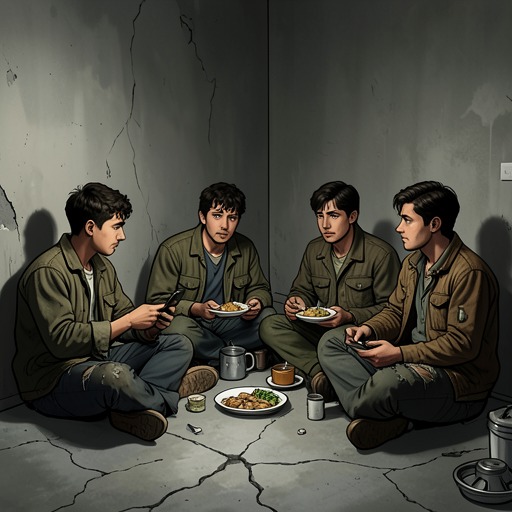
The basement beside the laundry area is cramped, surrounded by metal storage shelves and boxes of old clothes, but it has a refrigerator stocked with soda. The boys turn the space into a clubhouse, squeezing together with books on their laps. Rob teaches them what they need to know in each class, including subjects he does not take himself. Drew is therefore part of a setting where Rob’s academic brilliance becomes communal rather than merely individual: the 4.0 student spends time helping his friends instead of moving farther ahead alone.
Drew’s father is usually upstairs watching the news or preparing lesson plans for the following day at school. His steady presence astonishes Rob and Julius “Flowy” Starkes and appears almost miraculous to Tavarus Hester, who sees in him a vision of a kinder present. His repeated assumption that the boys will go to college gives their ambitions a social form. College is spoken of not as an improbable fantasy but as a future already waiting for them. Drew’s household thus provides food, adult presence, study space, and a model of family life, allowing the basement to become a refuge from conflict and the foundation of a brotherhood that feels permanent and good.
Loyalty Across Adulthood
Drew’s relationship with Rob persists after the boys leave St. Benedict’s. By the period after college, Drew has dropped out after two years and works in construction. His path differs from Rob’s Yale education and scientific training, but the difference does not dissolve their connection. Drew remains part of the network through which Rob continues to define responsibility: friendship means answering when someone needs practical help, rather than maintaining a polished image or performing independence.
Drew participates in Rob’s ambitions for Peace Realty. When Rob repeatedly itemizes the plan with Curtis Gamble and Tavarus Hester, Curtis’s stepfather is to help with incorporation, Oswaldo Gutierrez’s father is to assist with renovations, and Tavarus is to conduct title research. Drew belongs to this collaborative structure as one of the friends whose knowledge, labor, or connections can be mobilized. The plan reflects Rob’s effort to redirect money and street knowledge into property ownership and neighborhood improvement, but it also shows how much the project depends on the same informal community that sustained the friends in high school.
Drew’s practical role becomes more forceful when Rob has trouble collecting rent from tenants at the Greenwood Avenue property. Drew comes over to intimidate a payment out of them. The act is not presented as a formal business procedure; it is an extension of neighborhood loyalty and the group’s shared capacity to handle situations that institutions do not resolve for them. Drew’s physical presence, earlier described as enough to deter confrontation, now becomes a resource in Rob’s property venture. His support is therefore both protective and morally complicated, linking the brotherhood’s ethic of being there for one another to the coercive conditions of Rob’s adult life.
The same ethic appears in the group’s wider network. When Rob’s tire blows out at one in the morning on the Merritt Parkway, Julius “Flowy” Starkes drives to him, brings a spare, and works the jack despite the hour-long trip each way and the tolls. Drew’s rent-collection assistance belongs to this same pattern of reciprocal action. These friendships do not require anyone to pretend that life is under control. Their value lies in immediate presence, shared labor, and the assurance that a crisis will be answered by someone who knows the person involved.
Narrative Significance
Drew is a stabilizing figure in the book’s portrait of Rob’s social world. His mother’s meals and his father’s constant presence help create the domestic refuge that Rob, Tavarus Hester, Julius “Flowy” Starkes, and the others have not reliably known. Drew himself is neither the group’s academic center nor its most precarious member, but his physical confidence, amiability, and practical availability make him a necessary counterweight to Rob’s intensity and ambition.
His trajectory also resists a simple success-versus-failure judgment. Drew attends college but leaves after two years, later working construction, while remaining embedded in the same friendships formed at St. Benedict’s. The book does not treat him as a completed success story or as a cautionary failure. Instead, he illustrates how adult lives continue to be shaped by the durable networks built in adolescence. For Rob, Drew is not merely a teammate from the past. He is part of the family created in the Smith Street basement and part of the informal infrastructure through which Rob tries to survive, build a business, and remain responsible to the people who made him feel at home.