General Motors
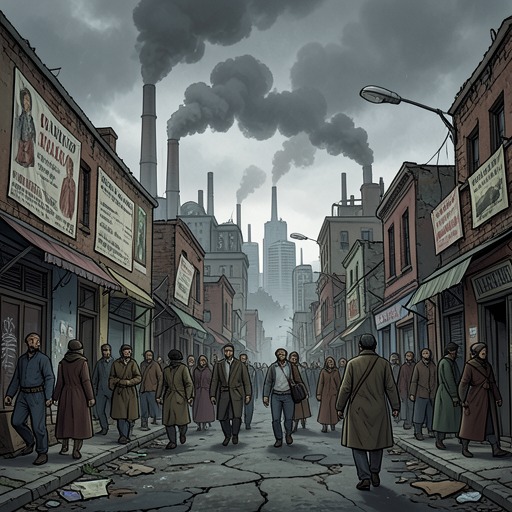
The Short and Tragic Life of Robert PeaceGeneral Motors appears in the narrative as the company employing Horace Peace at the Linden Assembly plant, three towns from the family home. Although Jackie Peace does not know his precise job, she understands that it consists of simple mechanical tasks repeated throughout the working day. The plant therefore enters the story less as a named institution than as an organizing force in family life: its routines, demands, and replaceability give shape to Horace’s conduct and to the household’s economic strain.
Industrial Labor and Horace Peace
Horace Peace’s work at General Motors is defined by repetition. He performs the same basic mechanical actions over and over, every day, in a setting where thousands of other workers could presumably do the same job. Jackie Peace imagines that this condition produces his sternness and his insistence on correct manners. To Horace, success means getting small things right every time, just as a worker must avoid carelessness if he wants to keep his position.
The plant’s discipline is thus transferred into domestic behavior. Horace expects Jackie Peace and her siblings to observe formal etiquette, including saying “May I please . . .” when asking for something; forgetting could bring a single hard slap to the back of the head. General Motors does not appear as the direct cause of these punishments, but the narrative places the factory’s repetitive standard of correctness beside Horace’s parental code, showing how industrial labor becomes a household ethic.
Economic Pressure and Family Size
Horace Peace’s employment is only one part of the family’s financial structure. He also works a second job, while Jackie Peace’s mother is away getting milk and the older children are sometimes out with friends. As the third of nine children, Jackie is left responsible for six younger brothers and sisters during one defining episode of her adolescence. The family’s growing number of bodies makes the house physically crowded, with three people eventually occupying each bedroom, and the effort required to keep everyone fed becomes a shared burden.
General Motors therefore represents relatively stable industrial work without implying comfort or abundance. Even with Horace employed at a major automobile plant, the household experiences mounting physical and financial pressure as more children are born. The contrast complicates the idea of factory employment as simple security: the job supplies the family structure’s economic foundation, but it does not prevent overcrowding, exhaustion, or the unequal distribution of care.
Discipline, Replacement, and Domestic Conduct
Jackie Peace associates Horace’s strictness with the logic of the assembly line. A worker who becomes lazy can be fired and replaced by one of the many people capable of doing the same task. In that imagined connection, human value is measured through reliable performance: chores must be completed, schoolwork must be done quietly, questions should be limited, and the smallest social forms must be observed correctly.
The result is a household organized around avoidance as much as affection. Nights are spent staying out of Horace Peace’s way, quietly, though quiet becomes increasingly difficult as younger children continue to arrive every two or three years. The factory is never described in detail as a physical scene, yet its implied structure—repetition, surveillance, replaceability, and the consequences of error—extends beyond the workplace into the rhythms of family life.
Narrative Significance
General Motors functions as a compact image of the industrial economy surrounding Jackie Peace’s childhood. Its Linden Assembly plant links the family to the region’s manufacturing labor while also exposing the limits of that connection. Horace Peace has work, but the work is monotonous and vulnerable; the household has income, but not enough ease to relieve the pressures created by nine children and limited space.
Through this single employer, the narrative connects public economic structures to private habits. Industrial repetition helps explain Horace Peace’s code of manners, while the wages associated with that labor coexist with overcrowding and exhaustion. General Motors consequently stands for both opportunity and constraint: a source of livelihood whose discipline is carried home, shaping the family even when the factory itself remains at a distance.