Gray area
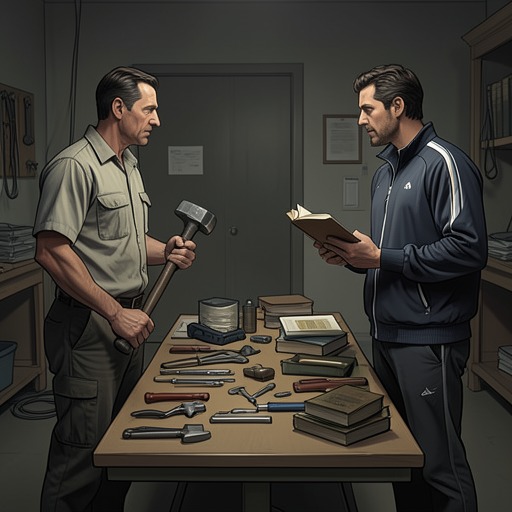
The Short and Tragic Life of Robert Peace“Gray area” is the expression Rob Peace gives to the morally compromised space in which he tries to reconcile his ambitions with the choices available to him. Its decisive use comes in early March 2011, when he names a proposed fifty-pound marijuana operation “our gray area.” The phrase does not erase the illegality of the plan; instead, it turns compromise into a theory of advancement, allowing Rob to imagine that one controlled transgression can finance stability, family care, and a return to a legitimate future.
Definition and First Use
In Rob’s formulation, a gray area is the compromise required to reach the top. Speaking to Flowy, Drew, Tavarus, and Curtis, he argues that no influential person becomes great without surrendering something along the way. He invokes Jay-Z, Biggie, Tupac, presidents, Lyndon Johnson, Kennedy, Bill Clinton, Cory Booker, and Barack Obama as examples of people whose success supposedly involved hustling, corruption, sexual misconduct, evasions, or other “shady” conduct. The argument is less a neutral observation than a moral comparison: if celebrated figures can carry compromising histories and still be accepted as successful, then Rob and his friends should be allowed their own exception.
The repeated naming is important. Rob first presents the idea as “This will be our gray area,” then restates it as “This right here will be ours. This will be our gray area.” By naming the venture, he converts a frightening proposal into a shared category of action. The phrase makes the plan sound bounded and temporary rather than like a return to the drug trade. It also shifts the question from whether the act is wrong to what price ambitious people must pay for advancement.
The 2011 Marijuana Plan
The immediate object of the expression was a supply of fifty pounds of bulk marijuana that could be purchased through Curtis’s connection for $4,000 per unit, less than ten percent of the market rate. The group calculated that selling it could produce roughly $400,000 within a few months, enough to support mothers, grandmothers, girlfriends, and children, buy clothing for job interviews, and free the participants from hustling for the foreseeable future. Rob promised that the drugs would be kept quiet, processed into Sour Diesel in the basement, and moved before anyone discovered them. He said he understood the principal dangers—police and other hustlers—and told the others that he would assume those risks himself, asking only that they watch his back.
The gray area therefore joins illegal commerce to a practical vocabulary of responsibility. Rob does not describe the plan as pleasure seeking. He presents it as a single, disciplined intervention that could pay debts, protect family members, and create the conditions for respectable work. When Drew asks why he cannot simply get a job or return to school, Rob answers that he has been looking for work every day and that St. Benedict’s and Yale mean nothing in the labor market confronting him. The phrase gives his frustration a structure: legal achievement has failed to deliver security, so an illegal opportunity appears to be the only route by which his plans can become real.
The group’s decision exposes both the persuasive power and the danger of the expression. Flowy and Drew initially oppose the venture, while Rob, Curtis, and Tavarus favor it. Rob’s argument changes their minds by presenting trust as the group’s greatest asset and the operation as something they need to do only once. Around one in the morning, they unanimously agree to obtain the marijuana, convert it into Sour Diesel, and sell it. Rob distributes five glasses of vodka, and the toast makes the imagined future feel close enough to grasp. The gray area has moved from description to commitment.
Earlier Pressures Behind the Phrase
The expression gathers a long history of blocked opportunity. As a student at St. Benedict’s Preparatory School, Rob possessed exceptional academic credentials, including a combined SAT score of 1510 out of 1600, placing him in the ninety-ninth percentile nationally. Yet his friends and counselors could see that college remained financially uncertain, while Flowy’s improvement from a 0.7 GPA to 2.1 made scholarship hopes equally material and precarious. Rob’s later confidence that he would “figure it out” at Yale concealed the fact that he had earned just over $100,000 selling marijuana, had given portions of it to his mother, spent about $10,000 on school supplies and travel, and reserved another $30,000 for her. The remaining “fifty large” was intended to fund his trip to Rio and carry him through the next year.
After Yale, the gap between achievement and legitimate opportunity widened. The summer of 2003 left Rob without a job, schoolwork, or money, living again in his mother’s house and unable to meet graduate-school deadlines because he had been in Rio. Teaching at St. Benedict’s offered purpose but not enough income, and drug dealing in Newark exposed him to dangerous negotiations over small sums. In August, a supplier pulled a revolver on him after a failed negotiation; Rob paid several hundred dollars more and then began teaching, temporarily leaving the trade. The gun’s muzzle reduced his education, scientific knowledge, and past accomplishments to a purely physical struggle for survival. The later gray area retains that lesson: danger is acknowledged, but necessity is made to outweigh it.
His work at Continental Airlines produced another version of the same conflict. Rob saw the baggage job as a way to earn money, receive benefits, and exchange mental wear for physical labor while pursuing real estate. Jackie Peace saw a Yale graduate, scientist, and teacher carrying luggage at the airport and feared that he was rebelling against the obligations of his talent. When the housing bubble burst in 2007, falling property prices did not help him because the collapse of subprime lending removed the financing on which Peace Realty depended. His holdings remained limited to 122 Greenwood Avenue. The legal plan that was supposed to create mobility became another blocked route, making a spectacular illegal return increasingly attractive.
Moral and Psychological Function
The gray area is not simply a euphemism for crime. It is Rob’s attempt to preserve a coherent identity while moving between incompatible roles: Yale graduate, scientist, teacher, son responsible for his mother, real-estate entrepreneur, and drug dealer. His decisions often make sense when viewed one day or transaction at a time, but friends and family struggle to see how the separate steps form a stable future. Ina Sideros recognizes that Rob has become lodged in the immediate moment—this shift, this flight, this city, this transaction, this sum of money—even while he describes each moment as part of a long-term plan.
The phrase also echoes the anger produced by repeated experiences of disrespect and exclusion. At Yale, Rob becomes enraged when wealthy crew-team students leave dirty trays for him while he works in the dining hall. He buses the trays for his coworkers and punches a wall, imagining a violent retaliation he cannot carry out under campus surveillance. The incident matters because the insult is small but the response is not: the abandoned food, smirks, clothing, wasted meals, and failure to acknowledge dining-hall workers become evidence of a social order in which some people expect service without accountability. Rob’s friend recognizes that the anger cannot be explained by etiquette alone.
That same structure shapes Rob’s defense of Skeet Douglas. In his Elihu biography, he portrays the murder case as an injustice engineered by a white establishment against ordinary black people, arguing that the police planted the weapon to close the case. Arthur Turpin hears the loose ends in Rob’s account, but also understands that every word about Skeet comes from a deeply emotional place. The gray area thus extends beyond the 2011 plan: it is part of Rob’s broader effort to answer a world in which his father’s alleged injustice, his own labor, and his community’s vulnerability seem to demand forms of self-protection that respectable institutions will not provide.
Limits and Consequences
The expression’s central contradiction is that Rob knows the boundary exists while treating it as negotiable. He had already stopped dealing once after the revolver incident, and his friends were even more surprised when he quit smoking marijuana after years of daily use. His later return is therefore not ignorance of the drug economy but a deliberate re-entry justified by unemployment, family obligations, blocked financing, and the promise of a single transformative profit. The gray area offers control over the narrative, but not over the risks themselves.
Rob’s difficulty finding work makes the phrase seem, to him, increasingly rational. He interviews with pharmacies, real-estate firms, and a Merck plant, but his résumé appears overeducated and underskilled: laboratory research followed by high-school teaching, airport manual labor, and a controversial firing. The texture of each decision disappears when compressed into bullet points. He also struggles to show interest in jobs that do not interest him. Oswaldo Gutierrez’s advice to stop appearing above the work is sensible, yet it asks Rob to suppress precisely the restless self-conception that the gray area protects.
When Nathan asks at the Gaslight Brewery what he is doing, Rob answers that he went to Yale and knows what he is doing. Nathan replies that Yale was ten years earlier and asks what Rob is doing now. The exchange exposes the phrase’s unresolved problem. “Gray area” can explain why Rob believes an illegal venture is necessary, but it cannot by itself supply a durable future or reconcile past achievement with present uncertainty. As an expression, it names the space between aspiration and consequence; as a decision, it begins another cycle in which the promise of one decisive compromise risks reproducing the instability it was meant to end.