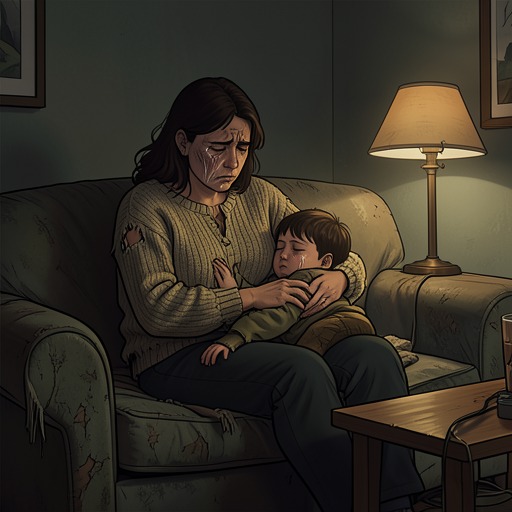
Grief and sorrow
The Short and Tragic Life of Robert PeaceGrief is presented as a continuing social and psychological condition rather than a moment that begins and ends with a funeral. In Rob Peace’s world, fathers disappear through cancer, imprisonment, or death, and the survivors carry the absence into friendship, ambition, anger, and care. The state becomes most visible in the Burger Boyz’s response to Curtis’s father’s death, in Rob’s concealed but consuming work for Skeet Douglas, and in the stunned silence surrounding Rob’s own death.
A Shared Geography of Loss
The Burger Boyz learn that grief is part of their common inheritance. Curtis’s father dies of cancer between Curtis’s junior and senior years at St. Benedict’s Preparatory School, following the earlier deaths of Tavarus Hester’s, Julius “Flowy” Starkes’s, Drew Jemison’s, and Rob’s fathers. Curtis’s father had been a steady presence on Smith Street: despite being gruff at times, he came home by six, helped with homework, and corrected the boys when they deserved it. His absence therefore removes not only a parent but also a source of discipline, encouragement, and an “eyes-on-the-prize” attitude.
The boys had maintained a silent agreement not to speak directly about painful subjects, but the accumulation of deaths makes that agreement impossible to sustain. They begin asking what grievance God could have against the fathers and sons of East Orange. The question gives their grief a communal form: none of them loses a father in isolation, and each new death reopens the earlier losses. Their friendship becomes the practical response available to them. They cling to one another fiercely, not because friendship erases bereavement, but because it helps them endure a lifelong absence that no later achievement can cancel.
Rob’s Hidden Grief and the Work of Loyalty
Rob’s grief is complicated by the fact that his father, Skeet Douglas, is alive but incarcerated. During his years at St. Benedict’s, Rob says almost nothing publicly about him, while visiting him secretly about once a month, more often when his sports schedule allows. The visits preserve a father-son relationship through Plexiglas and telephone receivers, but they also keep the original wound active: Skeet is present enough to remain emotionally central and absent enough to be unavailable in ordinary life.
Rob gradually turns grief into labor. During a summer internship with Tavarus at a real-estate firm, he spends lunch breaks in the Essex County Law Library studying capital-murder cases and the details of Skeet’s trial. The legal research becomes a way to confront the unanswered question of what happened to his father and to claim a role in correcting the past. Later, Rob helps prepare Skeet’s first appeal, organizes documents, writes judges, and treats the case as an obligation that cannot be abandoned simply because the legal system has already rejected it.
The cost of this loyalty is visible when Skeet’s postconviction relief victory is reversed. After the State files its counterappeal, Skeet must return to prison, and Rob once again walks with him across a prison parking lot before leaving him to await another decision. In Orange Park, Rob sits with Victor Raymond near midnight, sharing a joint and trying to conceal tears by pressing an index finger into his eye. He tells Victor that he does not know what he wants to do, but the immediate crisis is not merely college financing. It is the pressure of immense potential, filial responsibility, and the knowledge that every choice will close some doors while opening others. Rob ultimately chooses the less expensive path, even after Yale and Penn accept him, because he believes he owes it to Jackie Peace not to take more from her.
Illness, Care, and Institutional Absence
Skeet’s later illness transforms Rob’s grief from legal advocacy into medical advocacy. In prison, Skeet keeps a Yale bulldog button that Jackie sent after Rob’s acceptance, storing it beneath photographs, Rob’s letters, a postcard from Rio, and a mixtape Rob recorded in junior high. The small box gives material form to a relationship maintained through objects and correspondence. At the same time, Skeet begins asking Rob for advice about tenants, money, relationships, and work, even though he feels unable, as a prisoner, to advise his son about the world outside the prison walls. The guidance he can offer is narrow but emphatic: Rob should put Jackie above everything else.
Skeet’s own condition worsens in the winter of 2005–06. He feels a new, terminal fatigue but avoids the prison doctor because the medical ward is depressing and filled with other people’s diseases. Rob responds by writing letters that document Skeet’s good behavior, work, and participation in discussion groups, pleading for access to treatment beyond the prison medical ward. Drawing on his Yale study of cancer chemistry, Rob argues that his father needs clinical care immediately and that Skeet’s record should make such treatment available.
Rob also finds a lawyer willing to file one final appeal after reviewing the extensive records he has assembled. The appeal is based on an alleged improper standard of review, but the legal effort unfolds alongside the more immediate reality of Skeet’s decline. In the prison infirmary, Skeet is weak and heavily sedated; the facility has little cancer treatment but abundant pain medication. Rob visits as often as five times a week. For the first time since Skeet’s temporary release during Rob’s senior year, they can sit without Plexiglas, breathe the same air, and hold hands.
Brain cancer produces a particularly cruel form of separation. Steroids reduce Skeet’s dramatic weight loss, and medication makes the headaches and nausea manageable, but his mental faculties flicker. On some visits he retains his old charismatic force; on others he is distant, mouthing words Rob cannot hear. Rob sits silently beside him. The disease attacks the mind of a man whose intelligence had been central to his identity, while other prisoners lie behind yellowed curtains with illnesses poorly treated by the institution. On August 16, 2006, the final appeal is denied. The decision closes the legal route even as Skeet’s life is already narrowing toward death.
Grief as Anger and Moral Injury
The narrative also shows grief indirectly, through anger that seems disproportionate until its buried sources become visible. At Yale, Rob recounts an encounter in the dining hall with wealthy crew-team students who leave their trays and a dirty table for him to clean. Their carelessness, avoidance of eye contact, smirks, clothing, and wasted food provoke an anger rooted in more than workplace disrespect. He imagines violently punishing them and finally puts his fist through the dish-room wall. The incident exposes how class contempt can reactivate the older experience of being denied dignity and protection.
Rob’s anger is similarly bound to Skeet’s conviction. In his biography before the Elihu Society, he presents the murder case as a conspiracy in which the police removed a gun from Skeet’s apartment, used it in the Moore sisters’ murders, and returned it to frame him. He speaks for hours about the trial, prison visits, the successful appeal and its reversal, and the letters he continues to send to appellate judges. Arthur Turpin recognizes that this is not merely an intellectual position. Rob is constructing the defense he believes Skeet was denied, and each word carries the emotional force of a son trying to repair an unrepairable injustice.
The same emotional structure appears when a drug supplier points a revolver at Rob during a failed negotiation. In that instant, his education, scientific knowledge, and accumulated achievements become irrelevant; consciousness contracts around the weapon’s muzzle. He pays the additional money demanded and soon begins teaching at St. Benedict’s, leaving the drug trade. The episode reveals how grief, fear, and the memory of earlier killings remain active inside apparently separate decisions. Rob’s exposure to violence is never only personal: it includes the deaths of Charlene Moore and Estella Moore, former classmates, and people connected to both his parents.
Public Bereavement and the Failure of Closure
Grief finally reverses direction. After Rob is killed at 34 Smith Street, Flowy helps Jackie Peace search for him at East Orange Hospital. Hospital staff provide little information while Jackie sits rocking with her hands folded and eyes lowered. Flowy repeatedly asks for Shawn Peace, the name Rob used in the neighborhood, then for Robert Peace, the professional name Rob used elsewhere. The two names register the divided identity that grief must now reconcile.
A nurse eventually says that a John Doe has been brought in from 34 Smith Street. Nearly another hour passes before the family receives certainty, and Flowy notices Jackie crying as quietly as possible. He tells her that Shawn is all right, though the reassurance cannot last. At dawn, on the porch of 181 Chapman Street, Carl takes Jackie into his arms and whispers to her while Frances Peace wails faintly inside, her respiratory system too damaged to produce much volume. Jackie silently nods as if she already knows. The scene does not offer resolution; it shows bereavement entering the household as another physical fact, carried by bodies, names, silence, and the exhausted care of those left behind.
In this structure, grief links the book’s generations. Curtis’s father’s death renews the boys’ earlier losses; Skeet’s imprisonment and brain cancer turn Rob into a son, advocate, researcher, and caregiver; Rob’s death leaves Jackie, Frances, Carl, Flowy, and the wider community to absorb a loss that cannot be separated from the life he was trying to build. Grief is therefore both consequence and governing condition: it narrows choices, intensifies loyalty, fuels anger, and makes friendship an essential form of survival.