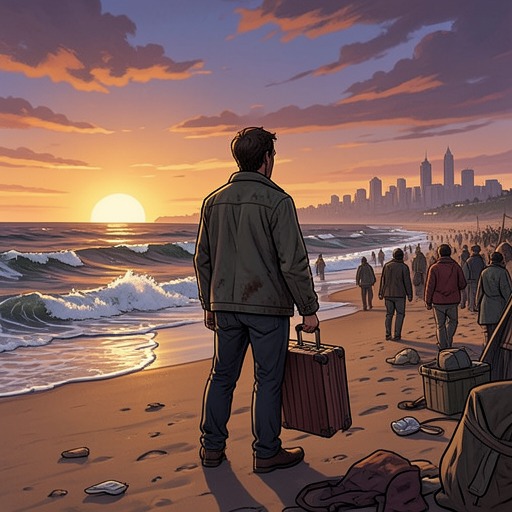
Ipanema Beach
The Short and Tragic Life of Robert PeaceIpanema Beach becomes the emotional center of Rob Peace’s 2003 journey to Rio de Janeiro. From a studio overlooking the beach, Rob constructs a temporary life organized around walking, swimming, reading, smoking, watching the city, and waiting for sunset. The beach offers him more than scenery: it is the rare setting in which his education, race, poverty, family history, and financial anxieties do not visibly determine how he moves through the world.
Setting and Daily Life
Ipanema Beach belongs to the South Zone, where Rob finds inexpensive lodging and access to Rio’s beaches and nightlife. His studio costs $400 a month and opens through French doors onto a marbled balcony above sand described as pearl-colored. The arrangement is strikingly modest compared with the prestige associated with his Yale degree, yet it gives him a direct relationship with the ocean and a freedom that institutional life had not provided.
His days follow a loose but repeated rhythm. He drinks coffee beside the beach while reading the news in Portuguese, walks for hours along the length of the city, has drinks while watching the people around him, and continues down the hard sand near the water. At some point he finds a dry patch of sand, smokes a blunt, and shares it with passersby who ask. He then waits for sunset, when people around him stand and applaud. The repetition turns the beach into a daily ceremony rather than a single tourist attraction.
Swimming extends Rob’s relation to the place beyond observation. While there is still enough light, he moves straight out into the water for roughly half a mile with strong, choppy strokes, passing fishing boats and yachts. He turns to tread water as dusk thins and the shoreline begins to glow with scattered electricity, then swims back toward civilization in the dark. The movement outward and return gives the beach a quiet structure: temporary disappearance followed by reentry into the city.
A Space of Social Ease
At Ipanema, Rob does not stand out in the ways he had elsewhere. He no longer appears as the Black student in a skully at Yale or as the academically conspicuous boy in a pink uniform in East Orange. He does not have to monitor the bills entering and leaving his wallet. Instead, he presents simply as a muscular man on vacation, walking along the southern horizon. The beach therefore functions as a social space in which several burdensome identities are temporarily suspended.
That ease also shapes Rob’s encounters. He goes out each night on foot or by bus, and within a week has made friends among tourists, American and European transplants, and lifelong residents from Rio’s neighborhoods. His friendship with Curtis Gamble becomes especially revealing in this setting. After preparing dinner for Kaliana and Iris on the balcony, Rob speaks Portuguese with evident pleasure, accepts correction when he makes grammatical mistakes, and becomes absorbed in the life the city seems to represent. Curtis recognizes that “peace” for Rob means this kind of existence: mobile, informal, socially open, and free from the constant pressure to explain himself.
The beach’s openness contrasts with the spatial divisions Rob knows from Newark. Rio contains racial and economic inequalities, favelas, poverty, and drug traffic, and its history of segregation resembles Newark’s in important ways. Yet the city’s public spaces allow socioeconomic groups to intermingle more fluidly, enabling Rob to travel widely without the same expectation of confrontation or vigilance. Ipanema thus embodies a conditional freedom rather than an escape from inequality: it is a place where Rob can move through the city with less fear, even though the surrounding social structure remains unequal.
Escape, Memory, and Return
Rob’s beach life is also a fantasy of release from responsibility. On arriving in Rio with no place to stay, he watches the first sunset and experiences, for the first time he can remember, having nothing to do and no one to worry about. Ipanema gives physical form to that condition. Its long walks and open water replace the schedules, obligations, and watchfulness that define his life in Newark, Yale, and his family’s struggle.
The freedom is not entirely solitary. Rob imagines experiences that he could later give to his father, Skeet Douglas, who is imprisoned at Trenton State Prison. Yale’s world is inaccessible to a man convicted of murder, but Rio’s beaches seem imaginable even from a prison cell. Rob wants to tell Skeet about the women, beaches, favelas, Carnival, and other experiences that might allow them to walk together in imagination. Ipanema therefore becomes part of Rob’s continuing attempt to maintain a father-son relationship across imprisonment.
That imagined gift cannot repair the material consequences of the trip. After returning to East Orange, Rob has no job, no schoolwork, and suddenly no money; most graduate-school deadlines have passed while he was in Rio. His visits to Skeet remain much as they had been before. The journey has not transformed his interior life in the lasting way he intended, and Rob still wants to return. Ipanema remains a remembered possibility, but the return to family, neighborhood, and economic uncertainty shows how quickly its freedom recedes.
Narrative Significance
Ipanema Beach marks a temporary alternative to the institutional worlds that organize Rob’s life. St. Benedict’s Preparatory School disciplines boys through schedules, color groups, memorization, songs, and the occupation of their time. Yale regulates conduct through formal rules and threatens expulsion for drug possession or distribution. Trenton State Prison encloses Skeet behind walls, cells, schedules, and anonymity. Against these spaces of formation and confinement, Ipanema offers open water, unstructured time, public movement, and a life that appears to require no credential.
The contrast also exposes the limits of escape. Rob can experience the beach as a place without labels, but he cannot permanently leave behind the obligations attached to his education, his mother, his father, and his own expectations. The same man who swims into the dark water and waits for the city to light up must eventually return to work, money, and the unresolved question of what his Yale degree is supposed to produce. Ipanema’s significance lies in that tension: it is the clearest image of Rob’s desired peace, and the setting that most sharply reveals how temporary that peace is.