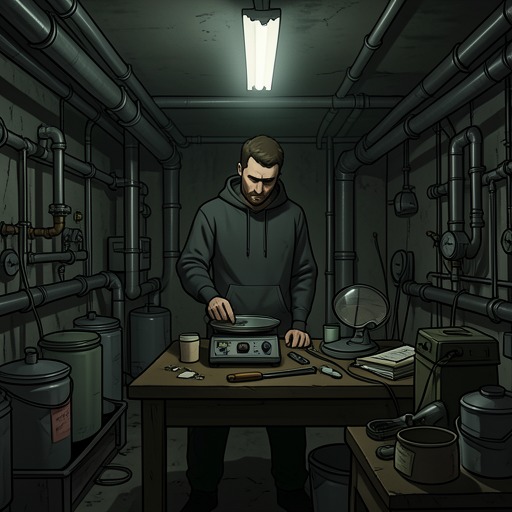
Kamar
The Short and Tragic Life of Robert PeaceKamar is a nineteen-year-old courier in Rob Peace’s large-scale marijuana operation, first presented as an unusually dependable young worker and later as the person whose talk places the entire enterprise in danger. His role is small in rank but decisive in consequence: through Kamar, the operation’s carefully separated territories, personnel, and information begin to leak into the wider world of East Orange’s criminal hierarchy.
Identity and Function
Kamar is physically small but carries himself with the weight and confidence of a much larger man. At first he is quiet, attentive, punctual, and dependable. His car does not break down, he works harder than the other couriers, and he never attempts to renegotiate his stipend. These practical qualities distinguish him from the unreliable people Rob has encountered elsewhere in the drug trade. Rob respects Kamar’s work ethic and follow-through, telling Flowy that the young man has a future, preferably somewhere outside the game.
That judgment gives Kamar an unusual position within Rob’s organization. He is one of the mules, not an equal partner, yet Rob’s approval appears to make him feel more important than a disposable employee. Their meetings take place privately, one on one, and the secrecy of those exchanges leaves no witnesses who can say exactly when the relationship changes. The narrative therefore presents Kamar’s transformation less as a sudden revelation than as a gradual failure of boundaries: Rob begins to treat a subordinate as a trusted associate, and Kamar begins to act as though he possesses a larger claim on the operation.
From Reliable Courier to Liability
By late April, Kamar has become a problem. Buyers report that he is speaking contemptuously about Rob, describing him as smug, dishonest, and incompetent. He also talks about Rob’s Yale background, the very credential that carries prestige in some settings but provokes resentment in others. The Yale marker turns Rob’s education into a form of exposure: it identifies him as an outsider with status, and Kamar uses that status as part of his attack.
The immediate rumors do not yet damage sales. In the ordinary hierarchy of illicit work, low-ranking employees often undermine their bosses through gossip, and words can function as a way of making oneself appear more powerful than one really is. Rob’s concern is that Kamar’s words will travel beyond buyers and reveal that Rob is operating independently while still working for Amin. More dangerously, they might disclose how extensive the operation has become. Rob has tried to protect himself by ensuring that his employees have no history with Amin, the local Bloods, or other groups capable of intruding into the business. Kamar threatens that compartmentalization simply by talking.
The severance occurs outside Smith Street. Rob is hungover and chooses convenience over discretion, allowing Kamar to pull up beside the basement door. Curtis hears the argument from inside while playing video games. Kamar’s voice is high-pitched and profane; Rob’s remains low and controlled, answering the outburst with weary platitudes. After the car leaves, Rob returns and treats the encounter with uneasy humor, remarking that the young people have become uppity. The casual aftermath conceals the seriousness of what has happened: Kamar has been fired, but dismissal does not erase what he knows.
Betrayal and Escalation
Kamar apparently deduces that the work he has been involved in is far larger than a few bags of marijuana. Seeking to raise his position, he approaches the Double II Set Bloods, the most powerful criminal organization in East Orange, and tells them that Rob is secretly running a major operation in their territory. The claim is false. Rob’s instructions to Kamar and the other couriers specifically kept them away from designated blocks, and the operation was structured around avoiding precisely this kind of territorial intrusion. But the story emphasizes that immediate action, rather than careful fact-checking, governs gang behavior.
Kamar’s betrayal is therefore not merely personal disloyalty. It converts private knowledge into a territorial allegation. Rob’s business depends on distance, silence, and the belief that no single courier can see the whole structure. Kamar breaks that system by presenting Rob as a hidden Yale-connected dealer operating on a large scale. The lie becomes dangerous because it is plausible enough to trigger action before anyone verifies it.
Rob suspends the operation while trying to find a quiet and safe way to reach someone associated with the Double II Set Bloods. He believes that, given the right opportunity, he can explain his intentions and establish Kamar’s unreliability. His proposed solution is still verbal and procedural: he wants to talk, clarify the facts, and prevent Kamar from being hurt. At the same time, he understands that approaching the wrong person under the wrong circumstances may leave no time for explanation. Kamar’s betrayal thus exposes the contradiction at the center of Rob’s criminal enterprise: Rob believes intelligence and careful organization can keep violence manageable, but the surrounding system can turn rumor into immediate danger.
Consequences for Rob and His Friends
When Rob finally tells his friends what has happened, they respond calmly rather than angrily. They had not fulfilled as much of their promised support as he had expected, but they still want to help repair the situation. Their reaction briefly restores the cooperative, almost entrepreneurial character of the venture, including the real-estate vision that Rob and Tavarus have developed alongside it. Yet the group recognizes that Kamar’s conduct has created a threat that cannot be solved by spreadsheets, investment plans, or ordinary managerial discipline.
Curtis urges Rob to abandon the matter because it is not worth the danger. Rob instead asks for three days, almost pleading that no one will act in that time, certainly not Kamar, whom he dismisses as a foolish young man. He insists that he can set things right. The request reveals both his confidence in his ability to negotiate and his refusal to accept that events have moved beyond his control. His friends have hoped that his calm demeanor would reassure them, but he appears cold and restless, the opposite of peaceful.
The timing gives Kamar’s betrayal a wider civic resonance. A few days later, the Newark Star-Ledger reports that March 2010 had been Newark’s first murder-free calendar month in more than forty years, while the first quarter of 2011 had seen violent crime rise by 71 percent over the same period of the previous year. Against that background, Kamar’s accusation is not an isolated workplace dispute. It enters a city where criminal information, territorial claims, and armed retaliation can move quickly, and where Rob’s attempt to delay violence for three days depends on a fragile assumption that everyone else will wait as well.
Kamar’s betrayal also helps explain the defensive posture that follows. Rob wears a Kevlar vest on dangerous nights and at certain points during the day, keeps a handgun close, and considers but apparently never carries out a plan to sell weapons on the black market. The gun and vest do not make Kamar a violent actor in the same direct sense; instead, they measure the consequences of what Kamar has set in motion. Rob’s operation, once imagined as a temporary means of clearing debt and funding family obligations, has become a condition of surveillance, fear, and armed self-protection.
Narrative Significance
Kamar functions as the human breach in Rob’s system of compartmentalization. Rob has spent much of his life separating identities and environments, a process he calls “Newark-proofing” himself. At Yale, he can conceal or modulate the parts of himself that might be judged; in the drug business, he tries to separate suppliers, couriers, territories, and information. Kamar demonstrates that such divisions are never fully secure. A subordinate can become a witness, a resentful worker can become an informant, and a false story can acquire force simply because it reaches the right organization.
The conflict also repeats a pattern visible throughout Rob’s life: perceived disrespect produces anger, and anger encourages a compensatory assertion of control. Rob is offended by people who are “fronting,” by those who perform identities they do not possess, and by institutions that conceal unequal power behind manners and credentials. Kamar’s accusations invert that problem. Kamar presents Rob as a secretive, overreaching Yale man, while Rob sees Kamar as an unreliable subordinate trying to inflate his own importance. Both men are engaged in status performance, but only Kamar’s performance reaches a group capable of acting on it.
Kamar is consequently less a fully elaborated personal antagonist than a catalyst whose limited knowledge has disproportionate power. His initial promise makes the betrayal more consequential: Rob does not misjudge an obviously reckless courier, but someone whose punctuality and discipline invite trust. The rupture is produced by the very relationship Rob thought he had successfully managed. Kamar’s final importance lies in the fact that he turns Rob’s belief in communication, organization, and personal control into a dangerous illusion.