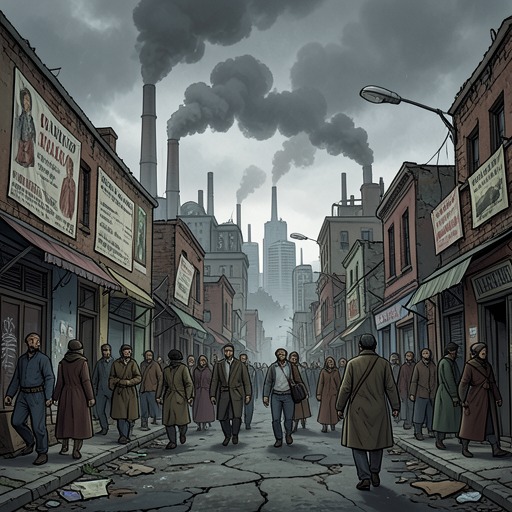
Newark, New Jersey
The Short and Tragic Life of Robert PeaceNewark, New Jersey, is the historical and social center of the world surrounding Rob Peace. It is presented as a city of industrial work and close-knit neighborhoods, but also as a place transformed by racial segregation, the 1967 riots, poverty, violence, and institutional decline. For the Peace family, Newark is both an inherited home and a persistent pressure: a place from which education may offer escape, yet whose history and relationships continue to follow Rob wherever he goes.
Industrial City and Neighboring Oranges
Newark’s influence reaches into Orange, where Jackie Peace and her family lived on Chapman Street. In the earlier period remembered by Jackie, the greater Newark economy was sustained by factories. Men left early for factory jobs, women raised children, and working families built lives around property, kinship, and neighborhood vigilance. Central Avenue linked downtown Newark to the townships farther west through Italian, Polish, and Jewish grocers, pharmacies, clothing stores, flower shops, funeral homes, and local banks. Orange Park provided an accessible communal center, and the proximity of social, domestic, and financial necessities allowed Orange to retain the feeling of a small town despite its dense urban surroundings.
The city’s industrial importance made families such as the Peaces feel connected to something larger than their own block. Newark’s history seemed to move through the workers and households of the surrounding Oranges. That sense of participation weakened as the regional economy and social order changed. Jackie remembered that the neighborhoods were increasingly defined not by the factories where people worked or the countries from which earlier generations had immigrated, but by racial categories—black, brown, and white.
Segregation, Riots, and Urban Decline
The Newark visible from Chapman Street carried the marks of a divided city. In the 1950s, the federal Department of Housing and Urban Development built sixteen high-rise projects to accommodate an influx of mostly poor, mostly black southern migrants seeking industrial work. The towers, described as “slums in the sky,” concentrated residents by race while also concentrating drugs, violence, and extreme poverty behind sheer walls and barred windows. Families like Jackie’s could drive around them with their windows up and doors locked, treating the projects as both a nearby reality and a zone from which they might remain separate.
The 1967 Newark riots permanently altered the city’s texture. The unrest followed the alleged police brutality inflicted on a black cabdriver and lasted five days, producing burning, looting, sniper fire, and rage. Twenty-six people died, more than seven hundred were injured, and fifteen hundred were arrested. Jackie and her girlfriends approached the city during one of those nights out of curiosity, as though they were approaching a spectacle they might regret missing, but National Guardsmen stopped them at a checkpoint. Her later memories included teenagers throwing stones at police cars, fistfights between white and black residents, and the bloody aftermath left on city streets.
By the period of Rob’s childhood, the consequences were measurable as well as visible. Newark had lost 130,000 residents since the riots, more than one in three residents lived below the poverty line, the public-school graduation rate remained below 60 percent, and violent crime was so persistent that a 1996 article in Time called Newark the most dangerous city in America. The Ironbound District, once a busy and ethnically diverse commercial center, had become a run of shuttered storefronts inhabited by squatters. Even established downtown companies such as Prudential Insurance considered leaving, while enclosed skyways allowed office workers to move between buildings without walking at street level. Newark’s decline was therefore not a single collapse but an accumulation of population loss, economic retreat, educational failure, insecurity, and defensive architecture.
Sharpe James and the Promise of Renewal
Newark’s political significance sharpened in 1986, when former alderman Sharpe James won the mayoralty by promising jobs, improved low-income housing, and the return of development money to downtown. He presented himself as a locally rooted public servant who had lived among the city’s residents, understood them individually, and could embody a different civic future. In a city that was 52 percent African American at the time, his election gave many Black residents a figure in whom political authority, neighborhood familiarity, and personal dignity seemed to converge. Jackie knew the practical force of that image: after an acquaintance asked James for work at one of his downtown rallies, she was hired a week later as a school crossing guard.
James’s administration pursued redevelopment while navigating the city’s entrenched difficulties. Its stated ambitions included demolishing the high-rise projects built during the 1950s and replacing them with smaller-scale public housing and middle-income units, as well as bringing a performing arts center and sports arena to downtown. The projects were presented as routes toward revitalization, even as Newark’s poverty, crime, educational shortcomings, population loss, and commercial decline persisted through his first term. The mayor also supplied something less measurable but equally important: a public symbol of Black achievement. He was a dignified man born and raised in Newark who had attended college, worked throughout his life, and entered public service in his early fifties.
To Rob, Sharpe James became more than a mayor. He became a surrogate father and a standard of what a Newark man might become. Although Orange and the other Oranges had their own governments and did not fall under James’s jurisdiction, Newark cast a long shadow over Chapman Street. Its towers, bridges over the Passaic River, and concentration of commerce, education, and possibility represented a larger world within reach. Rob began watching the news to hear James speak, wrote a biography of him in fifth grade, and asked Jackie to take him to speeches held when the mayor cleared land for office buildings or appropriated money for additional police officers. James’s appeal lay in the promise that political power could emerge from the same streets whose decline had constrained so many lives.
St. Benedict’s and Newark’s Institutional Bridge
The city also shaped the institutions through which young people attempted to cross its boundaries. In 1994, Rob entered St. Benedict’s Preparatory School during Summer Phase, joining 140 incoming fourteen-year-old boys from forty towns and sixty middle schools around Newark. The school gathered students from varied economic backgrounds, though most came from lower or lower-middle-class families, and placed them under a demanding collective discipline. Its locked entrance, security station, Gray Bee identity, and gymnasium known as the Hive made the institution feel both protected from the surrounding city and deliberately responsible to it. Above the lobby stood the school’s governing maxim, “Whatever Hurts My Brother Hurts Me,” turning Newark’s social divisions into an explicit ethic of shared obligation.
For Rob, St. Benedict’s was not simply an educational address but a mechanism for remaking identity. The boys had chosen the school through a rigorous application process and understood that the next four years offered no do-overs. Friar Edwin Leahy’s emphasis on trust and unity placed individual advancement inside a communal project: becoming men required learning how to depend on, compete with, and answer to one another. The school therefore formed a bridge between the neighborhood world of Newark and institutions that could carry Rob beyond it, without asking him to erase the city from which he came.
Newark as an Unfinished Horizon
That bridge never produced a clean separation. Newark remained the measure against which Rob judged places that offered greater safety, wealth, or prestige. At Yale, a dining-hall encounter with affluent crew-team students who left dirty trays behind became, for him, an experience of class contempt and racialized disregard. Their indifference recalled a social order in which certain people could treat others as invisible, while Rob, wearing a white uniform and hairnet, was expected to clean up after them. His anger extended beyond the immediate insult toward a desire to make such privileged students answerable outside the campus system that seemed to protect them.
Friends at Yale recognized that they could not fully enter the struggle carried from Newark into these encounters. Rob could describe the slight as minor in circumstance yet enormous in meaning, while others saw only a failure of etiquette. His anger was tied to the city’s history of unequal respect: the gap between the protected campus and the neighborhood streets, between inherited privilege and the labor that sustained it, and between the claim that individual effort determines success and the structures that continually assign different risks to different people. Newark thus traveled with him not merely as a birthplace but as an interpretive framework, making every new institution a test of whether education and mobility had truly altered the conditions from which he had escaped.
Newark as a Continuing Moral and Material Reference Point
Newark remained present in Rob’s adult life not only as memory but as a practical setting in which education, employment, family obligation, and illegal commerce repeatedly intersected. At an Elihu gathering, he spoke for four hours about his father, Robert “Skeet” Douglas, and described the Moore sisters’ murders, the trial, the prison visits, the successful appeal and reversal, and his continuing letters to appellate judges. His account placed the case within a larger Newark history of distrust between Black residents and official institutions. The city was therefore also the origin of a private legal mission: Rob’s understanding of his father’s imprisonment shaped his sense that personal advancement could not be separated from the unresolved injustices surrounding him.
That inheritance followed him into work and conflict. In the Yale dining hall, an apparently ordinary dispute over unbussed trays became, for Rob, a confrontation with the social hierarchy separating wealthy students from the workers who cleaned up after them. Later, after a supplier pointed a revolver at him during a failed marijuana negotiation in Newark, the city’s violence ceased to be an inherited atmosphere or political memory and became an immediate bodily threat. The experience narrowed his attention to the weapon’s muzzle, and he paid several hundred additional dollars before beginning his high-school teaching career and leaving the drug trade. Newark’s streets thus produced both the anger that made disrespect feel morally charged and the danger that briefly pushed him toward a different life.
The effort to build that different life remained unstable. After losing his airline job, Rob continued to be questioned by friends about what he was doing, and Nathan confronted his claim that having attended Yale meant he knew what he was doing. Around the same period, Rob and Tavarus were developing a real-estate vision, while Curtis urged restraint after conflict with Kamar threatened the project. Rob asked for three days to repair the situation, revealing how the city’s entrepreneurial hopes and its retaliatory pressures could occupy the same moment. Newark had recorded its first murder-free calendar month in more than forty years in March 2010, yet violent crime rose sharply in the first quarter of 2011. The contrast captured the city’s larger condition: improvement was possible, but it did not erase the forces that continued to pull people back toward fear, loyalty, improvisation, and risk.