Oakdale Elementary School
The Short and Tragic Life of Robert PeaceOakdale Elementary School is the neighborhood public school where Rob Peace begins formal education and where the book first makes education a battleground over class, masculinity, parental authority, and social mobility. Although the school appears orderly from the outside, its declining culture leaves Jackie Peace convinced that Rob is being supervised rather than taught. Oakdale therefore becomes more than a childhood setting: it is the institution against which Jackie’s later private-school decision is defined, and the place where Rob’s early intellectual identity collides with the neighborhood’s expectations of manhood.
Setting and Educational Decline
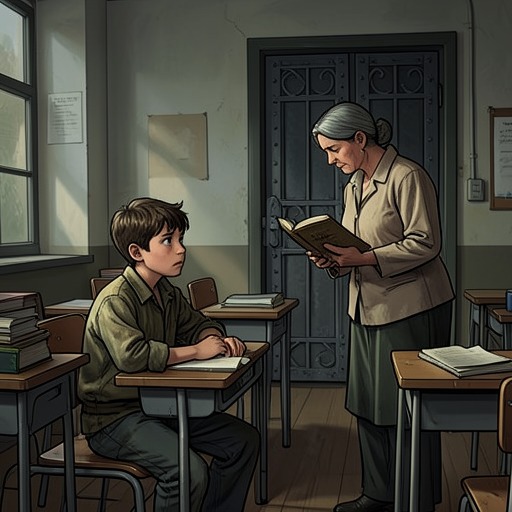
Oakdale Elementary School stood on Lincoln Avenue, only a few blocks from the Peace family home on Chapman Street. It was a redbrick, two-story public school shaped roughly like the Chevrolet logo, and at first glance it seemed an acceptable place for a six-year-old. Jackie remembered that the school had been suitable when her younger siblings attended it. By the time Rob entered kindergarten, however, she perceived a less visible deterioration. The interiors remained generally well maintained, and the curriculum formally followed federal guidelines, but the teachers seemed uninspired and the other parents appeared to accept a laissez-faire atmosphere. Jackie’s conclusion was severe: many children were being sent there to be watched for several hours, not genuinely taught.
The school’s limitations mattered because Rob was already displaying unusual concentration and ability. At three, before he ever entered Oakdale, a day-care worker had called him “The Professor” while he crouched intently over building blocks. The nickname identified a quality Jackie recognized in him: an absorption in problems and ideas that did not fit easily with the rougher expectations surrounding him. Oakdale did not erase that quality, but it provided too little institutional energy to develop it. The contrast between the child’s curiosity and the school’s diminished ambition became one of the book’s earliest examples of potential meeting structural neglect.
The Conflict Over What School Should Do
Jackie Peace considered private education soon after seeing what Oakdale had become, but her parents rejected the idea. They argued that Rob was only six, that kindergarten required simple letters and arithmetic rather than Shakespeare or advanced chemistry, and that her limited income should be spent on food, clothing, and shelter. Their position treated public education as a collective service already paid for through taxes. Jackie, by contrast, read the school’s atmosphere as a warning that formal provision was not the same as meaningful opportunity.
When Jackie raised the question with Sharpe Peace, he called her “uppity.” In the neighborhood, the label carried a social accusation: someone who believed he or she was better than local people, deserved more, and might leave without looking back. The word made Jackie doubt an impulse that seemed to her entirely parental rather than class-striving—the desire to give Rob the best education the family could afford. The dispute over Oakdale thus became a dispute over belonging. Jackie saw educational ambition as protection; Sharpe treated it as a possible rejection of the community.
Rob remained at Oakdale because Sharpe believed the school would teach him something more important than humanities or science: how not to be a mama’s boy, and how to become a man whom other men respected, listened to, and followed. That judgment established a direct opposition between two educational ideals. Jackie valued intellectual formation and future opportunity. Sharpe valued social authority, toughness, and recognition among men. Oakdale was the setting in which those competing ideals were imposed on the same child.
Rob’s Daily Life and the School’s Violence
The transition into school coincided with Sharpe’s intensified involvement in Rob’s masculine training. Sharpe began buying him clothes and music, including records by N.W.A., and brought a punching dummy into the room Rob shared with Jackie. He worked with the boy on combinations in which a wide swing could lead to an elbow strike. When Sharpe collected him from Chapman Street, Rob waited eagerly in the parlor, then charged into his father’s thighs and was carried upstairs on his shoulders before practicing on the punching bag. Their outings included visits to several men around town, experiences Rob remembered but kept largely private. Oakdale therefore stood between two forms of instruction: the weakly delivered academic routine inside the school and the vivid, personal lessons about male conduct that Sharpe provided outside it.
The pressure became visible during Rob’s first school year. One weekday morning in spring, he refused to get out of bed and complained of stomach pain despite having no fever. Jackie suspected that the illness might be an excuse, but she was tired and late for work, so she arranged for Frances Peace to watch him. The incident shows how the stresses surrounding Oakdale entered the home and how difficult it was for Jackie, working long hours while Sharpe was imprisoned, to monitor every change in Rob’s behavior.
In the winter of first grade, Rob had his first fistfight on the front steps outside Oakdale. Fights were common enough that the faculty did not treat them seriously, and the school called Jackie at work without requesting a disciplinary conference. She demanded one herself and walked to Lincoln Avenue. In her reconstruction of the scene, two seven-year-old boys in winter coats had tumbled down the concrete steps into dirty snow while students and young male passersby urged them on with profanity. The boys were, in her eyes, little children pretending to be men, reproducing the neighborhood’s masculine script in the school’s entranceway.
On the walk home, Jackie asked why Rob had thrown the first punch. He explained that the other boy had called him a nerd. The insult is important because it names the exact identity conflict that Oakdale exposed. Rob’s concentration and intelligence made him vulnerable to ridicule, while the school and surrounding environment offered few positive ways to convert intellectual distinction into status. The fight was not simply misbehavior; it was an early attempt to defend himself against a label that placed bookishness on the wrong side of the local hierarchy.
The School Under Family Crisis
Oakdale became especially consequential after Sharpe’s arrest for the murders of Charlene Moore and Estella Moore, two young women who lived near him in the Chestnut Street apartment building. Jackie learned that he had been arrested not for drug dealing but for two murders, and Sharpe remained in Essex County Jail while the case moved slowly toward trial. Rob continued attending school as if ordinary routines could be preserved, but his educational support system had changed. Sharpe had previously helped him bridge the gap between his motivation and Oakdale’s lack of inspiration; Jackie tried to assume that role while working in a kitchen and caring for the household.
The effort exhausted her. She often lacked the strength to supervise homework after work, and Rob began gaining weight, appearing lazy, and spending afternoons on the sofa with unopened books and junk television. Jackie recognized in this passivity the qualities she associated with the men around the neighborhood, yet she did not have the emotional reserve to push him forward as firmly as she wished. Oakdale’s institutional weakness was therefore compounded by the absence of Sharpe’s daily pressure, even though that pressure itself had been contradictory and sometimes violent.
Jackie eventually acted on the educational judgment first formed at Oakdale. She attended night school for six months to qualify as a kitchen supervisor, then obtained an administrative job at University Hospital with a $2,000 annual raise. She also swept hair from a salon floor, cut spending on clothes, food, and luxuries, and saved for two years. Rob sometimes wore outgrown clothes and ate yellow rice with black beans, often alone or with his grandparents, while Jackie accumulated enough money to pay for private school herself. In September 1990, as Sharpe’s murder trial began downtown, Rob entered fourth grade at a private Catholic school. The move marked Oakdale’s decisive consequence: it transformed Jackie’s private worry into a sustained economic sacrifice and a deliberate attempt to reroute her son’s life.
Narrative Significance
Oakdale Elementary School represents the first failed promise of education in Rob’s story. It is not depicted as an openly ruined institution; its buildings are maintained and its curriculum meets official standards. Its failure is more ambient and therefore more revealing, expressed through uninspired teachers, indifferent parents, weak expectations, and the normalization of fights. The school’s inadequacy is difficult to prove through a single catastrophe, but its cumulative effect is clear in Jackie’s perception that children are being contained rather than educated.
The setting also establishes the tension between Rob’s competing identities. At day care he is “The Professor,” a child whose concentration invites admiration. At Oakdale he is mocked as a nerd and responds with a fist. Sharpe’s ideal asks him to become respected and followed by men; Jackie’s ideal asks him to cultivate the abilities that might carry him beyond the neighborhood. Those demands do not simply alternate. They coexist, and the conflict between them remains part of the trajectory that eventually carries Rob from private Catholic schooling to St. Benedict’s Preparatory School, Yale University, and adult life divided between elite achievement and the world from which he came.
Oakdale’s lasting importance is thus structural rather than heroic. It gives Rob his first sustained encounter with an educational system that cannot match his capacity, while showing Jackie that aspiration requires money, endurance, and resistance to local shame. The school becomes the negative image against which later educational opportunities are measured. Its redbrick normality conceals a profound social divide: children may enter the same building, but they do not all receive the same expectation that their minds are worth developing.