Orange Park
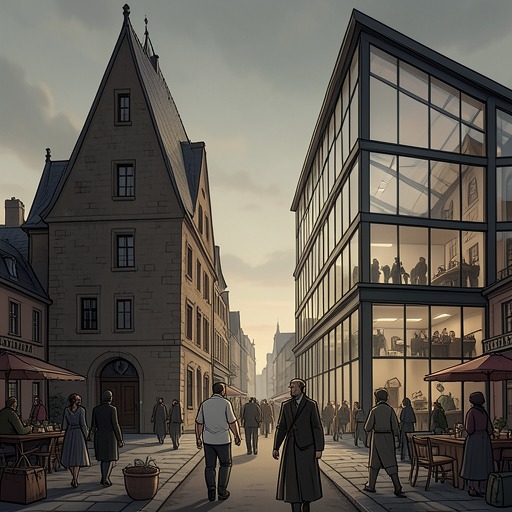
The Short and Tragic Life of Robert PeaceOrange Park is a ten-acre, arrow-shaped green space on the south side of Central Avenue in Orange, New Jersey. In the world of Rob Peace, it is never merely a park. It begins as a small-town commons where Jackie Peace spreads a blanket for her son, becomes a territory organized by crack dealers and neglected infrastructure, and later serves as a meeting place where Rob Peace and Victor Raymond confront imprisonment, grief, and uncertainty. Its changing uses make the park a compact map of the neighborhood’s social order: family life and childhood play exist beside drug commerce, police absence, and the durable friendships that survive both.
Setting and Early Social Life
Orange Park belongs to the older, close-knit landscape surrounding Chapman Street. Central Avenue connects downtown Newark with the townships farther west, passing Italian, Polish, and Jewish businesses, pharmacies, banks, funeral homes, and other services. The park’s ten rolling acres, bright with mothers and children, help make Orange feel less like an anonymous urban district than a small town in which domestic, social, and financial needs remain close at hand. For Jackie Peace, that proximity initially offers a usable form of community: she can take Rob there on warm weekends between night shifts and the physical demands of a six-day workweek.
The park’s apparent openness is qualified by the broader geography around it. From Central Avenue, Jackie can see the first of the federal housing projects known as “slums in the sky,” whose towers were built to contain poor, predominantly Black communities and the urban problems associated with drugs, violence, and extreme poverty. Orange Park therefore stands between two versions of public life: the accessible, communal green space where families gather and the segregated housing landscape whose residents and troubles are treated as something to be driven around, behind locked doors and raised windows.
Family Space Under Drug Control
By the 1980s, as crack spread through the neighborhood, Orange Park had become controlled by dealers. Men, women, and boys gathered around picnic tables with malt liquor in brown bags, appearing relaxed until a customer approached and the transaction acquired a different gravity. The enterprise was overseen by Day-Day, a smooth-faced man in his mid-thirties who continually walked the diagonal paths. He did not openly interact with the dealers; his authority operated through constant observation. He knew Rob’s father, Robert “Skeet” Douglas, and would pause beside Jackie and Rob’s blanket to remark that the child looked more like his father each day.
Day-Day’s management of the park was precise enough to preserve a limited division of territory. On Sundays, he moved his salesmen to the south side and gave the north side, where the playground stood, to parents and children. The arrangement did not make the park safe in any ordinary sense, but it allowed family use to coexist with the drug economy. Public space was not abandoned; it was informally administered by the people who had taken possession of it.
The playground itself records the cost of that arrangement. Its equipment is splintered and held together by loose, rusty nails, while fragments of glass from crack pipes and vials lie embedded in the dirt beneath the swings. The park is considered more secure for drug use after dark than many homes and apartments, not because it is protected by the authorities but because police do not patrol it regularly. Officers are more likely to enter a residential building in response to a 911 call about domestic abuse than to pass through the playground. The absence of routine policing leaves the park governed by local familiarity and dealer authority rather than by public institutions.
Jackie responds by turning every visit into an act of vigilance. She and Rob eat canned pears and ham on a blanket rather than on benches, which are used by stupefied addicts who sometimes urinate on themselves. She follows him over the jungle gym while scanning for nails, glass, and older children who have no business on a toddler playground. Her care does not remove danger; it creates a moving perimeter around him. Orange Park becomes the place where maternal protection must operate inside a public environment already shaped by neglect and illegal commerce.
Friendship, Neighborhood Memory, and Movement
The park also links Rob to the relationships that structure his childhood. Victor Raymond lives with his aunt in an apartment on Center Street adjacent to Orange Park, roughly a quarter mile from the Peace home. After losing both parents to illness within months of each other, Victor has been separated from his older brother, Big Steve, and moved north into an unfamiliar social world. At Mt. Carmel Elementary School, he notices Rob as the quiet student who makes the uniform look thuggish while scoring perfectly on every test. Rob takes Victor under his wing, invites him into his football games, helps him study, and offers him a tacit assurance that the upheaval surrounding his life can be survived.
That friendship gives Orange Park a second function. It is not only a controlled territory but also a familiar point in the neighborhood’s network of homes, school routes, dealers, and remembered families. Rob knows the young dealers by name because he has grown up with many of them, and that familiarity helps him and Victor smoke there without being disturbed. The same social knowledge that exposes the park to corruption also provides a limited form of protection. In Orange Park, belonging can shield a person temporarily, even though it cannot change the larger conditions that make the place dangerous.
The park is part of the seasonal rhythm of East Orange as well. During hot late summers, when the blacktop radiates heat and the streets fill with cookouts, cards, dice, games, stoop-sitters, and neighbors watching from windows, public presence makes the neighborhood feel safer. Rob and Robert “Skeet” Douglas often walk from Chapman Street to Taylor grocery, with Skeet buying Rob ice cream and cigarettes for himself, then continue eastward, stopping repeatedly to talk with people Skeet has known all his life or is meeting for the first time. Orange Park belongs to this wider culture of movement and recognition. It is one of the places where the neighborhood’s social memory is continually renewed through watching, talking, playing, and being known.
A Place for Grief and Unresolved Freedom
Years later, Orange Park becomes the setting for a markedly different kind of encounter. Near midnight, Rob and Victor sit on a bench beside a creaking swing set while sharing a joint. Rob is crying, something Victor has not seen in the eight years they have known each other. Victor recognizes that Rob, usually rough, guarded, and emotionally defended, has entered a crisis that belongs specifically to him. The park’s relative safety still rests on the same conditions as before: police do not regularly patrol it, and the two men know the young dealers who operate there.
The immediate crisis is Robert “Skeet” Douglas’s return to prison. After a postconviction ruling had briefly allowed him to leave, the State filed a counterappeal, and he was sent back while another verdict awaited. Orange Park thus becomes a holding place for an uncertain freedom. Rob’s tears mark the reversal not as an abstract legal development but as a personal collapse: his father’s possible release has again become incarceration, and the friend who usually expects hardness from him can only sit beside him in silence.
The contrast with the prison is deliberate. Trenton State Prison is a fortified complex whose walls, cell blocks, schedules, and population of nineteen hundred inmates reduce individual identity to institutional anonymity. Orange Park is open, improvised, and locally legible, yet it is also governed by forces outside formal law. Rob moves between these spaces throughout his life: the prison embodies the state’s power to contain his father, while the park embodies the neighborhood’s informal power to regulate movement, commerce, safety, and belonging. His emotional breakdown there reveals how closely those two systems have become connected in his imagination.
Narrative Significance
Orange Park functions as a recurring social instrument rather than a static backdrop. It introduces the contradiction at the heart of Rob Peace’s upbringing: childhood can be nurtured in the same place where public infrastructure decays and illegal markets flourish. The park offers mothers and children a designated northern side, but that protection is granted by a dealer’s territorial decision rather than guaranteed by the city. It offers Rob and Victor a familiar place to smoke, yet their safety depends on personal ties to the people running the drug economy. It holds memories of family outings, neighborhood recognition, friendship, and the fear that accompanies all three.
The park also concentrates the book’s larger movement between institutions and informal worlds. At St. Benedict’s Preparatory School, boys are kept busy, assigned to color groups, required to memorize names and songs, and trained through repetition and controlled time to avoid fights, theft, drugs, and dropping out. At Yale University, drug possession and distribution are defined as offenses punishable by expulsion under formal undergraduate regulations. At the airport, labor is organized by speed, stamina, and supervisory command. In Orange Park, by contrast, social order is produced through reputation, observation, territorial custom, and shared history. Rob learns to cross all of these environments, but the park remains the place where institutional rules are least visible and personal knowledge matters most.
Its recurrence gives the location an emotional architecture. As a child, Rob is watched over there by Jackie Peace, who searches the ground for glass and nails. As a teenager and young man, he shares the space with Victor Raymond, first within the neighborhood’s ordinary rhythms and later in a moment of tears over his father’s imprisonment. Orange Park is therefore both refuge and warning, commons and marketplace, playground and witness. It preserves the intimacy of the old neighborhood while displaying the violence and abandonment that threaten to consume it.