Orange, New Jersey
The Short and Tragic Life of Robert PeaceOrange, New Jersey, is the geographic and social ground of Robert DeShaun Peace’s story. The town first appears as the place where Jackie Peace brings her newborn son home to a crowded family house, but it gradually becomes a borderland: close enough to Newark and East Orange to absorb their poverty and violence, yet still marked by parks, schools, factories, and affluent enclaves. Orange therefore holds both the promise of rooted family life and the slow invasion of forces that make such stability increasingly difficult to preserve.
Setting and Family Home
Orange was the home of the Peace family at a crucial historical threshold. Jackie Peace had lived on Chapman Street since she was eleven, and the Peace house had passed into her father Horace Peace’s name after an uncle died of lung cancer. In the earlier period of her life, the block was occupied largely by middle-class European immigrants, especially Italian families, while the Peaces were one of only two Black families there. The neighborhood’s social order was organized less openly around race than around work, family, and property. Factory employees left early by bus or car pool, women raised children at home, and neighbors watched the houses beside them.
The physical neighborhood reinforced that sense of continuity. The houses were narrow clapboard structures with peaked roofs and fourth-floor attics filled with inherited photographs, records, and dishes. High ceilings, wide doorways, and long backyards shaded by willow oaks made the interiors feel larger than the closely packed homes suggested. Police officers patrolled regularly and were known by name. The Peace house itself remained open to relatives who needed shelter, a practice that made it more than a private residence: it was a family institution sustained by Horace’s employment and by the expectation that kin would be accommodated.
That domestic world is established on the night Jackie brings Robert DeShaun Peace home from St. Mary’s Hospital. He is a day and a half old, weighs eight pounds and ten ounces, and is carried from the dark street through the rusty fence, across the porch, and into a house crowded with relatives. Horace Peace, Camilla, Carol, Dante, and Garcia take turns holding the baby before Jackie carries him upstairs to be alone with him. The scene gives Orange a concrete human scale: the town is not merely a municipal boundary but the setting of a multigenerational household in which privacy is scarce and collective care is immediate.
A Town Between Stability and Decline
Orange’s location made it both protected and exposed. Central Avenue, one block south of Chapman Street, connected downtown Newark with the more pastoral townships to the west. Its stores included Italian, Polish, and Jewish grocers, pharmacies, clothing shops, flower shops, funeral homes, and local banks. Orange Park extended for ten green, rolling acres on the south side of the avenue, where mothers talked and children played. Despite its urban density, Orange could feel like a small town because social, domestic, and financial needs remained close at hand. The Peace family could imagine itself participating in the history of Newark through the factory economy while still living within a comprehensible local community.
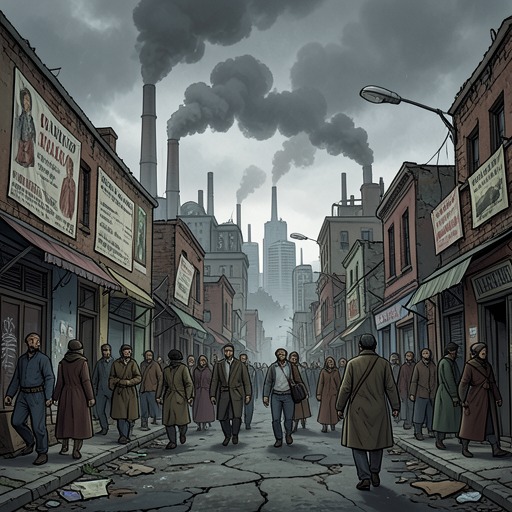
Yet the town’s apparent security depended on an industrial order already collapsing. Between 1970 and 1980, more than six hundred factories in and around Newark closed as manufacturing moved toward cheaper land, foreign goods displaced American production, and companies outsourced labor. The resulting layoffs intensified unemployment while public housing remained full. Economic damage that had first been concentrated in the towers of Newark’s segregated public housing began spreading into the vacant spaces left by the working class, moving through Newark’s northern and western wards and then into East Orange and Orange.
The change was gradual rather than singular. From Chapman Street, Jackie could see the first boxy brick towers known as “slums in the sky” rising in the direction of downtown Newark. Built by the federal Department of Housing and Urban Development in the 1950s to accommodate southern migrants seeking industrial work, the sixteen projects had been segregated by race and had also concentrated drugs, violence, and extreme poverty behind barred windows. At first, the Peace family could drive around them with their windows up and doors locked. Over time, however, the conditions they represented moved outward.
Orange’s town lines offered only partial protection. The Peace home stood just beyond the boundary separating Orange from the traditionally more dangerous East Orange. Half a mile west were Tuxedo Park and the Seton Hall campus, features that kept Orange, on paper, more diverse and desirable than the neighborhoods to the east. Those distinctions could not stop the deterioration. Ethnic grocers gave way to liquor stores and check-cashing centers; houses on Chapman Street were abandoned and boarded up; gunfire began interrupting dinner-table conversation. Blight moved through Chapman Street, South Essex Avenue, and Lincoln Avenue until the suburbs west of Scotland Road formed a more effective barrier than the municipal boundaries drawn at City Hall.
Orange and East Orange in the Peace Story
Although the family address was in Orange, Jackie Peace’s practical life was centered largely in East Orange. Her friends lived there, and she worked, shopped, and felt comfortable there. Skeet Douglas conducted his business there, and Robert DeShaun Peace’s early life was likewise organized across the boundary. Orange supplied the family home and the memory of an older civic order; East Orange supplied the streets, relationships, danger, and informal economy that increasingly shaped daily experience.
The contrast between neighboring municipalities was stark. During Robert’s childhood, East Orange had the second-highest concentration in the United States of African Americans living below the poverty line, behind East St. Louis. Its violent-crime rate was 3,500 incidents per 100,000 people, nearly six times the national rate of 600 and eight times the rate in adjacent South Orange, where the figure was 400. In practical terms, a person in East Orange faced roughly a one-in-thirty chance in a given year of being violently robbed, assaulted, raped, or killed, while the comparable risk in South Orange was less than one in two hundred. Orange occupied the unstable middle ground between these sharply different environments.
That borderland quality shaped how the family understood danger. The Peace house remained standing, and Horace Peace kept his job even as factories closed around him. The family continued to shelter relatives, preserving a form of security that was domestic rather than institutional. But the house could not isolate its residents from the neighboring economy of drugs, policing, incarceration, and violence. Orange’s relative desirability made it seem safe in comparison with East Orange, while its proximity ensured that the consequences of regional decline still entered its streets and homes.
The murder case against Skeet Douglas exposed that permeability. When Jackie Peace learned that Skeet had been arrested, the first assumption was that the arrest concerned drugs. Instead, she was told that he had been arrested for the murders of two young women who lived near him in an apartment building on Chestnut Street. The case moved through Essex County Jail, delayed pretrial proceedings, and eventually State of New Jersey v. Robert Douglas. The crime occurred outside the family house, but Orange was the place from which Jackie, Robert, and their relatives experienced the arrests, prison visits, legal uncertainty, and threat of the death penalty.
Institutions, Departures, and Return
Orange also serves as the starting point from which Robert moves through institutions that promise escape or transformation. In 1994, after a summer of football, stoop-hopping, drinking, and drug use in East Orange, he entered St. Benedict’s Preparatory School for Boys. The school’s Summer Phase gathered 140 fourteen-year-old boys from forty towns and sixty middle schools in and around Newark. Its routines of shared sleeping quarters, color groups, memorized names and songs, full academic days, sports, and unsecured belongings were designed to create discipline, loyalty, trust, and a shared identity.
The move to St. Benedict’s did not erase Orange; it turned the town into the social background against which Robert’s education acquired meaning. The school’s stated ethic, “Whatever Hurts My Brother Hurts Me,” answered the isolation and danger of the surrounding region with an organized ideal of mutual obligation. Robert was assigned to the maroon color group, and the school’s demanding structures attempted to keep students from reproducing the cliques and conflicts they brought from their separate neighborhoods. His later academic success, including the St. Benedict’s Presidential Award before graduation in 1998, made education appear to be a route beyond the limitations of Orange and East Orange.
That route required repeated departures. After receiving a blank personal check from Charles Cawley to cover his college expenses, Robert first favored Johns Hopkins University because its science program was strong, its student body seemed diverse, and its boundaries with lower-class neighborhoods felt less sharply drawn than those at some elite urban universities. He ultimately left Orange for Yale, taking a television, a canvas duffel bag, a backpack of books, and a side table in his grandparents’ car while Jackie watched over the packed vehicle from the porch. The family drove him ninety miles to New Haven, carrying not only his belongings but the expectations attached to a rare educational opportunity.
Even at Yale, Orange remained part of Robert’s identity and explanation of the world. During a four-hour presentation at the Elihu house, he described his mother, his childhood homework, the neighborhood, the Pierson Street fire, the Chestnut Street apartment, his father’s trial and imprisonment, and the failed effort to overturn the conviction. His account transformed the local places of Orange and East Orange into evidence in a broader argument about race, class, policing, and the treatment of Black defendants. The town was no longer simply the place he had left; it was the origin of the conflict he carried into elite institutions.
Aftermath and Narrative Significance
Robert’s later movements repeatedly returned to the social conditions represented by Orange. Skeet Douglas’s final appeal was denied on August 16, 2006, and Skeet died six days later after brain cancer caused his respiratory system to fail. Robert handled the funeral, which drew few attendees, and stood with Jackie at the grave in Rosedale Cemetery less than two miles northeast of Chapman Street. The death of Skeet closed one of the central legal and emotional histories attached to Orange, but it did not remove the history’s effects from Robert’s life.
Robert’s adult trajectory also shows how difficult it was to convert educational achievement into permanent security. After working for Continental Airlines, he was fired following an accident, supervisors’ criticism, and his refusal to provide a drug test or pursue the first appeal available through the union contract. The loss of that job brought him back toward the unstable economy that Orange had always represented. Later, while discussing a real-estate vision with Tavarus Hester and facing a crisis involving Kamar, Robert asked for three days to repair the situation. The plea connected ambitious plans for property and social advancement with the immediate dangers of the drug trade.
The final return is to 34 Smith Street, where Robert was found facedown in a basement after being shot. Curtis Gamble turned his body over, and Tavarus Hester cradled his head while East Orange police arrived. The scene lies outside the original Peace home, but it completes the geography established in Orange: a family rooted in a house that remains open, a young man moving repeatedly between education and danger, and a regional landscape in which municipal borders cannot contain economic abandonment or violence. Orange, New Jersey, is therefore both a place of origin and a measure of what Robert’s departures could not fully escape.