Oswaldo Gutierrez
The Short and Tragic Life of Robert PeaceOswaldo Gutierrez is one of the most consequential figures in Rob Peace’s life, not because he rescues Rob from the forces shaping him, but because he recognizes those forces with unusual precision. Born into Newark’s predominantly Puerto Rican North Ward, Oswaldo arrives at Yale carrying family disorder, financial obligation, and an acute awareness of the distance between his upbringing and the affluent world around him. He becomes Rob’s fellow interpreter of that distance: more guarded, less outwardly accommodating, and ultimately more willing to say that Rob’s intelligence and loyalty were being turned against his own future.
Identity and Background
Oswaldo grew up in a small, chaotic house owned by his grandparents and crowded with transient uncles and cousins. His slight physical presence and elusive personality were matched by an invisible emotional boundary; he was polite, but he held people at a distance. His tuition was paid by an uncle connected to a Colombian drug cartel, a fact that made his education inseparable from the unstable economy and violence of his family network. When that uncle was imprisoned and his assets were frozen, Oswaldo had to deal drugs himself, quietly and off campus, in small quantities sufficient to help meet his expenses.
This background made Oswaldo unusually alert to the difference between economic necessity and the campus mythology of illicit activity. Unlike classmates who treated Rob’s marijuana dealing as something fashionable or transgressive, Oswaldo understood dealing as a calculation for surviving shortfalls. He did not romanticize it, and he believed that anyone who entered that economy had to be disciplined: a careful dealer would not store marijuana in a Yale dorm room, carry it across campus, or make customers wait outside an open door. His practical judgment was rooted in experience rather than moral distance.
Yale Friendship and Shared Recognition
At Yale, Oswaldo became one of the people most intimate with Rob’s story. Rob talked with Raquel about family, with Daniella about classes, and with Oswaldo about home. Their conversations extended beyond immediate problems to the larger question of how a person could move from present circumstances toward a viable future. Both had reached Yale and discovered that admission was not the same as having escaped. Their degrees opened possibilities, but they also intensified the obligation to provide for relatives immediately after graduation.
The two friends formed a small science study group with several other students. Their weekly discussions considered medicine, doctoral study, laboratory work, and the financial consequences of each path. Medical school offered the greatest long-term potential but demanded mid-six-figure debt at a top institution. A PhD promised a teaching career but required years of modest living. These calculations were not abstract career planning for Oswaldo or Rob; each option had to be measured against family dependence and the pressure to generate income quickly.
Oswaldo also witnessed the anger Rob tried to contain. When Yale dining-hall workers left dirty trays and tables for Rob to clear, Rob’s courteous request was ignored. He bused the trays so his full-time coworkers would not have to, then punched a hole through the dish-room wall, injuring three knuckles. Oswaldo understood that the incident was not simply about cafeteria labor. The careless students represented a class that assumed service without gratitude, and Rob’s rage registered the humiliation of being treated as invisible while secretly belonging to the same institution as the people he served.
Counsel, Crisis, and Care
Oswaldo’s judgment was often harsher than Rob wanted, but it was also unusually accurate. He saw that Rob’s open-door dealing and casual campus operation were not merely risky habits but evidence that intelligence was being overridden by pride and improvisation. He eventually told Rob that he had never met anyone so smart but so fucking dumb. The judgment was not a dismissal of Rob’s ability; it was an indictment of the way Rob repeatedly converted ability into avoidable danger.
Oswaldo’s own mental health crisis gave their friendship a darker dimension. Under the pressure of his family’s instability in Newark, affluent classmates’ complaints, the debt required to remain at Yale, and the approaching demand to make his life financially upward, his mind began to collapse. Fantasies of shooting people around him became fantasies of shooting himself. He was eventually confined in Yale’s Psychiatric Institute.
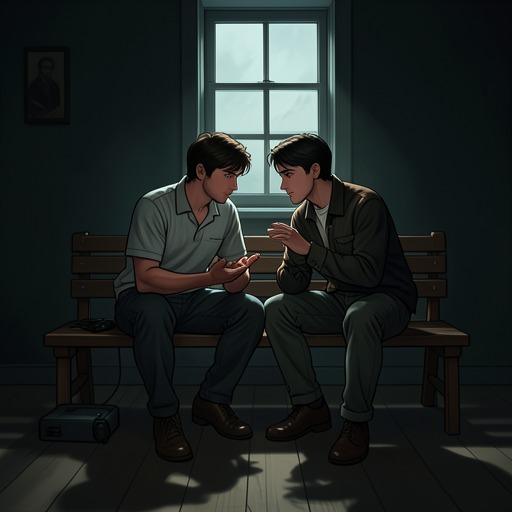
Rob visited him almost every day. In the monitored room, with security checkpoints, cameras, bolted doors, and the physical arrangement of a prison visit, Rob refused to treat Oswaldo as merely a psychiatric patient. He offered ordinary campus updates and told him, "Trust me, you’re not missing anything." The restraint mattered. Rob did not demand a performance of recovery or answer Oswaldo’s disordered speech with fear; he preserved their familiar relationship when the institution around them reduced Oswaldo to a case requiring supervision.
After graduation, Oswaldo returned to Newark and found himself unemployed at twenty-two, helping his father’s home-repair business while family members expected financial contributions. He and Rob remained connected through the same practical negotiations that had shaped their Yale conversations. Rob invited him to travel to Rio de Janeiro, but the invitation also carried an acknowledgment that Oswaldo could not simply detach from his family. Rob told him to come, asked whether he needed money, and imagined the trip as a temporary permission to leave before returning home for good.
Recovery, Work, and Diverging Paths
Oswaldo’s post-Yale trajectory briefly seemed to confirm his own analysis of what survival required. After a nervous breakdown and a dangerous incident in Orange Park, where guns were drawn after a friend provoked members of the Bloods, he drove to New Haven and sought help from Yale Career Services. He warned a counselor that without guidance he would probably be dead within a year. That intervention led to his admission to the Perelman School of Medicine at the University of Pennsylvania in 2005. By the time he was completing medical school, he was training in psychiatry and urging Rob to follow a comparable path.
Oswaldo believed Rob should study, pursue professional stability, and use the opportunities that Yale had placed within reach. Rob resisted because he understood following another person’s route as a betrayal of his own identity. To Oswaldo, that resistance became increasingly difficult to distinguish from a self-protective cliché. Rob’s hometown relationships remained decisive: he helped friends with rent, children’s clothes, transportation, car repairs, and other emergencies. In that community, friendship meant being present without requiring anyone to pretend that life was under control. Rob could therefore answer Oswaldo’s pressure with the assurance that he was handling things, even when his choices were drawing him back toward danger.
Oswaldo helped with Rob’s real-estate ambitions despite believing that the enterprise was probably doomed. He spent weekends with Rob hauling junk furniture up and down the Greenwood Avenue house, finding in the work a temporary reprieve from his own abandoned dream of becoming a doctor. Rob’s plan eventually took the form of Peace Realty. Curtis’s stepfather would assist with incorporation, Oswaldo’s father would perform renovations at a low rate, and Tavarus would conduct title research. Rob tried to convert every available family and friendship connection into part of a legitimate business structure, while Oswaldo contributed labor and expertise even as he remained skeptical of Rob’s direction.
The contrast sharpened after Rob’s success in real estate failed to provide the stability he wanted. By early 2009, Oswaldo noticed that Rob’s speech had become circular and his vision narrow. On Oswaldo’s sofa, Rob repeatedly complained about tenants, rent, Carl, women, work, money, and his mother. Oswaldo had nearly completed his medical training and could see a stable professional future ahead; Rob, despite having stood within reach of similar stability at Yale graduation, remained committed to becoming the Man on his own terms. Oswaldo concluded that Rob’s problems were self-inflicted and withdrew from the effort to understand them at close range.
Final Conflict and Legacy
The estrangement became explicit when Rob asked Oswaldo for money. Oswaldo offered the loan but warned that after Rob repaid him, they would never speak again. He understood that Rob had sacrificed considerable pride to ask for that amount and that Oswaldo was the only person among Rob’s many self-defined family members who could both understand the intended use of the money and afford to provide it. Rob had expected financial assistance, not the severing of their friendship. In their last meeting, his face was lowered toward the floor by Oswaldo’s feet, impassive and almost submissive.
The loan became connected to the chain of events surrounding Rob’s final drug operation and death. Oswaldo did not believe he was responsible: Rob would have found the money elsewhere, and his insistence on the same path would have continued. Yet Oswaldo still carried the knowledge that Rob died owing him $4,000, money that indirectly contributed to the circumstances of his death. At Rob’s memorial events, Oswaldo was conspicuously sober and grim. The repeated judgment he had once delivered to Rob remained in his mind: Rob was extraordinarily intelligent and extraordinarily foolish at once.
Oswaldo’s role extends beyond the plot as a surviving bridge between worlds. He guided the narrator through the physical and emotional landmarks of Newark and Yale, helping make visible the burden of inhabiting both places. His own life demonstrates that education can provide another route without erasing family obligation, mental illness, poverty, or the pull of old relationships. He is therefore neither a simple corrective to Rob nor a successful version of him. His achievement in reaching medical school coexists with breakdown, debt, and estrangement; Rob’s failure to convert Yale into stability coexists with generosity, loyalty, and a powerful refusal to abandon the people who formed him. Their friendship gives the book one of its clearest moral tensions: care can sustain a person, but it cannot always persuade him to choose safety.