Rio Carnival
The Short and Tragic Life of Robert PeaceRio Carnival is the ecstatic climax of Rob Peace’s 2003 journey to Rio de Janeiro, a public festival whose scale and sensory intensity temporarily release him from the obligations that ordinarily organize his life. For Rob, its significance lies not simply in spectacle but in the discovery of a moment apparently governed by presence alone: millions of people inhabit pleasure together, offering a vision of freedom that he does not want to surrender when the journey ends.
Setting and Anticipation
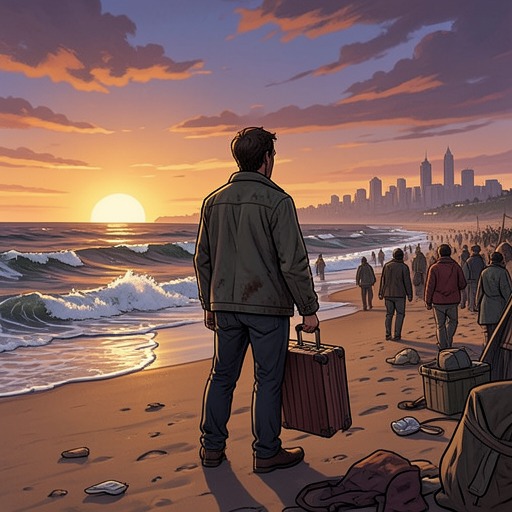
The festival follows Rob’s arrival in Rio de Janeiro, where he first encounters Copacabana’s white sand, green water, Sugarloaf Mountain, the Cristo Redentor statue, and the Vidigal favela rising into the rainforest. He has no place to stay when he reaches the beach, but the scene fulfills the picture he had imagined during the flight. As the sun sets over Vidigal, people applaud, and Rob experiences an unusual absence of responsibility: for the first time he can remember, he has nothing to do and no one to worry about.
That release is material as well as emotional. Rob finds an inexpensive studio in the South Zone, with French doors opening over Ipanema Beach. His days acquire a loose rhythm of coffee, Portuguese-language news, long walks beside the ocean, drinks, and people-watching. The beach and the city become a temporary environment outside the schedules, debts, family concerns, and self-imposed projects that usually define him. Carnival therefore arrives not as an isolated excursion but as the culmination of a period in which ordinary time has already begun to loosen.
The Festival
Carnival appears as a citywide gathering of ten million people. Micareta bands play from moving truck tops while crowds dance through the streets in minimal clothing, surrounded by spicy food, fruity drinks, masked faces, hair, glitter, and constantly moving bodies. The festival joins musicians, dancers, cooks, tourists, rich and poor people, young and old people, Carioca and Pardo participants in one immense public scene. Its abundance defeats the scale of Rob’s previous expectations; the celebration is not merely an event he attends but a whole urban world temporarily reorganized around collective pleasure.
The festival’s bodily imagery is deliberately expansive and mixed. Costume, flesh, color, food, music, and motion overlap until individual boundaries seem less important than participation in the crowd. The celebration contrasts sharply with the controlled institutions that have shaped Rob’s life, including the regimented sleeping arrangements and group identities of St. Benedict’s Preparatory School for Boys, the restrictive architecture of Trenton State Prison, and the disciplinary regulations of Yale University. In Rio, the body is not primarily monitored, classified, or confined. It becomes part of a mass movement whose energy makes hierarchy appear briefly irrelevant.
Rob’s Experience and Departure
Rob understands the festival through comparisons with celebrated American gatherings such as Woodstock, Burning Man, the Kentucky Derby, and Halloween in Greenwich Village, but he regards those comparisons as inadequate because none has given him the same direct experience. Carnival becomes the lived form of the foreign or utopian worlds that books had offered him as a child. Reading had been his passage into imagined elsewhere; the festival seems to place him on the far side of that passage, where millions of people can occupy the present with ease and, predominantly, bliss.
This experience produces a decisive reluctance to return. Rob does not want to go home after seeing the festival, because home means a return to Newark, to unfinished responsibilities, and to the conflicts that pleasure abroad has temporarily displaced. The return is nevertheless unavoidable. In April, his plane descends through overcast skies and Newark appears below as a gray continuum of developed land and freeways. Flowy collects him at Newark International Airport, and the visual and emotional movement from Rio back to Newark turns Carnival into a threshold between two incompatible forms of life rather than a self-contained holiday.
Contrasts and Consequences
Carnival’s apparent suspension of hierarchy is temporary. Rob’s return does not erase the obligations he had set aside, and the freedom represented by the festival cannot be converted into a permanent social condition. Later choices continue to place him between legitimate aspirations and illicit opportunities: he works at an airport, loses that job after refusing a post-accident drug test, and eventually undertakes a large-scale marijuana operation involving fifty pounds of cannabis and hundreds of hours of processing. The contrast makes the festival retrospectively more complicated. Rio offers an image of release, but it does not provide the economic or institutional means to sustain that release after Rob comes home.
The event therefore functions as both liberation and foreshadowing. In Rio, Rob can imagine a life organized around pleasure, possibility, and the immediate moment; afterward, he returns to a world in which freedom must be pursued through work, education, property schemes, or dangerous illegal ventures. Carnival gives temporary form to the life he desires, while the journey’s ending exposes how little protection he possesses against the pressures that make such freedom temporary. Its brilliance remains genuine, but so does the force of the return.