Rio de Janeiro
The Short and Tragic Life of Robert PeaceRio de Janeiro occupies a singular place in Rob Peace’s life and in the book’s geography of aspiration. It is at once a city he studies, inhabits, remembers, and repeatedly imagines as an alternative to Newark. His first extended stay there in 2003 widened his understanding of poverty and human possibility; later visits became associated with pleasure, romantic freedom, danger, and evasion. Rio therefore functions not merely as a travel destination but as a counterworld in which Rob repeatedly tries to discover what his life might become.
First Encounter and Transformation
Rob returned to Rio de Janeiro after graduating from Yale and continuing his laboratory work through February 2003. He secured an apartment, learned to communicate effectively in Portuguese, and confronted his fear of unfamiliar surroundings. The experience altered his understanding of both himself and the world. Seeing poverty in a developing country firsthand led him to reconsider the hardship of growing up in Orange, New Jersey: it was difficult, but not the worst starting point imaginable. More important, the trip gave him a sense that his journey had only begun and that formal education could wait while he experienced more of the world.
The city became part of the intellectual and moral language Rob used to explain his development. He connected the clarity he found abroad with the peace he had experienced in scientific research. In both settings, learning required persistence, attention, and a willingness to remain inside uncertainty. Rio was not presented as a simple escape from poverty; it made him see poverty from another perspective and thereby changed the scale against which he measured his own past.
An Imagined Alternative Life
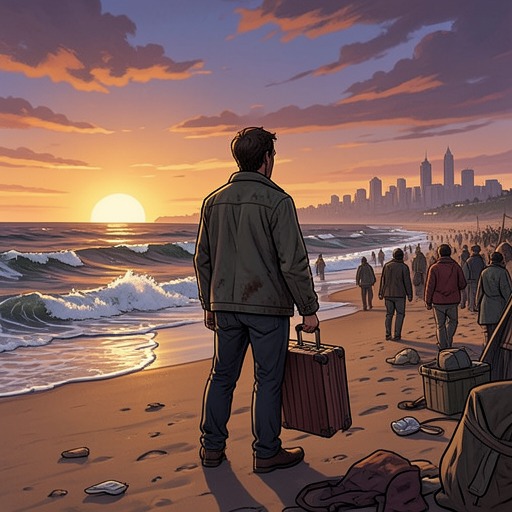
Rio continued to exert force after Rob returned to New Jersey. In conversations with Ina Sideros, he spoke frequently about his friends there, the attitudes he encountered, and the career opportunities he might have if he moved permanently. During visits to South Beach, the dark water and the reflections of beachfront hotel towers reminded him of Rio, turning the city into a visual and emotional reference point even when he was elsewhere. The comparison linked Miami, travel, and the possibility of a more mobile life in which his Newark origins would remain part of him without determining his future.
Rob’s attachment to Rio also reflected his attraction to movement itself. He traveled widely, including to Seoul, Croatia, and other international destinations, but Rio retained a special status. He had learned enough Portuguese to function there, had established personal connections, and could imagine a future organized around international experience rather than a single professional identity. The city offered him the promise of reinvention without requiring him to deny the social realities from which he came.
Pleasure, Vulnerability, and the Favela Incident
That promise was complicated by a later episode in which Rio became a site of profound vulnerability. In April, a month after Christopher’s birthday party, Rob awoke naked in a one-room corrugated-aluminum lean-to high in one of the city’s favelas. His wallet and clothes were gone, and he had no memory of the preceding night beyond meeting a woman and boarding a bus with her. With black-market organ transplantation in mind, he checked his abdomen for sutures to make sure his kidneys were still there. He found clothes, worked his way through the narrow alleyways toward the city proper, and was grateful that he had not carried his passport.
The episode forced an abrupt reversal in Rio’s meaning. The city that had represented discovery and possibility also contained exposure, disorientation, and the threat of bodily violation. Rob cut the trip short and returned home a few days later. To Jackie Peace, he said that he was going to get his life right and take care of her; the words sounded less like a settled promise than a plea directed toward both his mother and himself. Rio had offered freedom, but the freedom was unstable, and the danger he encountered revealed how little control he sometimes possessed within the life he imagined as liberated.
Recurrence and Narrative Significance
Rob continued to call the 2003 journey the best time of his life. A photograph placed him on the “stairway to heaven” beneath the Cristo Redentor statue, fixing Rio as an emblem of elevation and transcendence. Yet the same city also appears alongside his disappearances, his restlessness, and his difficulty sustaining ordinary commitments. He could vanish for weeks, travel through cities that friends could barely remember, and return peaceful before departure but uneasy afterward. Rio thus became both a cherished memory and a recurring destination through which the book measures the distance between Rob’s imagined future and his increasingly unstable present.
The city’s importance lies in this unresolved double meaning. It gave Rob genuine knowledge, new language, international perspective, and a temporary sense of focus. It also became part of a pattern in which travel postponed decisions about graduate school, work, relationships, and the responsibilities he repeatedly promised to assume. Even after he left St. Benedict’s and worked for Continental Airlines, travel made it easier to move across borders while leaving underlying conflicts unsettled. Rio remained the clearest image of an alternative life, but not a stable solution to the forces that kept drawing him back toward danger.
Contrast with Newark and the Unfinished Future
Rio’s contrast with Newark is never absolute. Rob carried Newark with him through every return: his memories of poverty, his sense of responsibility toward Jackie Peace, his friendships, his anger at social inequality, and his connections to illegal commerce. At the same time, Rio allowed him to imagine that those origins could be placed within a larger human and geographic field. His experience there helped him recognize that identity was not confined to one neighborhood, one institution, or one inherited narrative.
That possibility remained unfinished. Rob’s later conversations about Rio, his imagined career there, and his repeated travel all show a man who could perceive several futures without consolidating one of them. The city’s narrative role is therefore neither redemption nor downfall. It is the most vivid place where Rob experiences expanded possibility, and also the place that exposes the cost of treating movement as a substitute for resolution. Rio de Janeiro remains the book’s emblem of a life glimpsed clearly, entered intensely, and never fully secured.