Rio de Janeiro trip plan
The Short and Tragic Life of Robert PeaceRio de Janeiro trip plan is the extended project through which Rob Peace imagined a future beyond the competing claims of Yale, East Orange, family responsibility, and the drug economy. It began as a dream of movement and self-renewal after a solitary experience in Costa Rica, acquired practical form through Portuguese lessons and money set aside from marijuana sales, and ultimately became entangled with the limits of Rob’s post-Yale life. The trip was both an aspiration and a measure of the unresolved pressures he carried with him.
Origin in Solitude
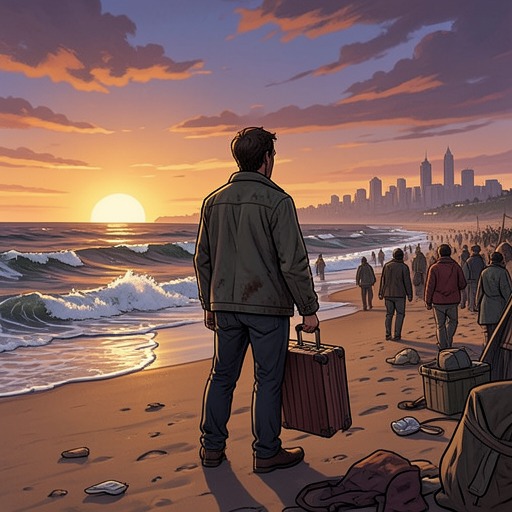
The plan took shape after Rob’s summer trip to Costa Rica, where he visited a Yale friend and experienced an unusual release from the anxiety that normally accompanied him. He described smoking marijuana alone on a black-sand Pacific beach after hiking three miles through jungle. The beach, volcanic sand, blue water, sky, and mountains formed an environment he experienced as intensely peaceful, and the solitude mattered as much as the scenery. The experience suggested that travel could offer him a temporary condition outside the demands of school, family, neighborhood, and institutional judgment.
That memory gave travel a durable place in Rob’s imagination. Rio de Janeiro seemed to him the ideal destination because it combined the urban, scenic, and cultural pleasures he wanted. The choice was not presented as a casual vacation. It became a postgraduation horizon, something he began preparing for two years in advance. The plan therefore converted a moment of private peace into a long-range objective, even though Rob’s later conduct showed that he did not possess a stable conventional path toward it.
Preparation and Financing
Rob began taking Portuguese classes so that he could speak the language in Rio. This detail gave the dream an unusual concreteness: he was not merely fantasizing about boarding a plane, but acquiring a skill that would let him enter the destination more fully. At the same time, his conversations about life after Yale increasingly returned to Rio rather than to medical school or another clearly defined career. He did not take the MCAT, although many science students kept it as an option, and he appeared to believe that he could arrive in Brazil and improvise the next stage from there.
The money behind the plan came from a hidden source. By senior year, Rob had earned just over $100,000 selling marijuana at Yale, a fact unknown even to his close friends, including Oswaldo Gutierrez. He had already given some of the proceeds to his mother in installments small enough to resemble legitimate wages from the dining-hall job he had left long before. He spent approximately $10,000 on school supplies and summer travel, reserved another $30,000 for his mother to receive once he had a legitimate job and could explain the money more plausibly, and designated the remaining $50,000 for Rio and for supporting himself during the year after graduation. The trip thus rested on a contradiction: it represented freedom and cultural discovery, but its financing depended on an illegal enterprise Rob kept compartmentalized from nearly everyone around him.
The Trip Against Yale and Home
Rob’s fixation on Rio also revealed his uncertainty about what should follow his degree. While his classmates treated examinations, applications, and professional training as the next logical steps, he redirected questions about his future toward the trip. Friends relied on the familiar assurance that Rob would figure things out, because he had repeatedly managed to turn intelligence and improvisation into results. Yet the plan was less a career strategy than a suspension of the need for one. It allowed him to imagine motion without deciding what destination, in the larger sense, would come afterward.
The trip also carried an imagined gift for his father, Robert “Skeet” Douglas, who was serving a life sentence at Trenton State Prison. Before leaving, Rob had planned to tell Skeet about Brazil’s women, favelas, Carnival, beaches, and other experiences that might give a prisoner a place to visit mentally. Rio seemed more accessible to Skeet’s imagination than Yale, whose world was closed to him by his conviction and imprisonment. Rob wanted the journey to become something they could share across prison walls, allowing his father to accompany him in thought even when he could not travel physically.
Return and Disillusionment
The trip did not produce the transformation Rob had imagined. After returning to New Jersey in 2003, he moved back into his mother’s house, had no job, had missed most graduate-school application deadlines while in Rio, and had suddenly lost the money that had made his independent plans possible. His visits with Skeet remained much as they had been before the journey, because he could no longer present Brazil as the shared imaginative gift he had intended. Instead of separating him from his family and neighborhood circumstances, Rio reaffirmed their power over him.
Even so, the failed transformation did not extinguish the desire to travel. Rio remained a symbol of the life Rob wanted to sample: mobile, culturally expansive, physically removed from the institutions and obligations that had defined his rise. Later, when his prospects narrowed, travel continued to serve as an alternative to settled employment. The plan’s importance therefore lay less in whether it solved Rob’s problems than in how clearly it exposed his recurring method—turning movement, money, and future possibility into temporary exits from an increasingly difficult present.
Narrative Significance
The Rio de Janeiro trip plan is a turning point in Rob’s trajectory because it joins aspiration to concealment. His education, language study, and international curiosity show genuine preparation and intellectual openness; the hidden marijuana proceeds show that the same plan depended on a criminal economy he treated as compatible with family provision and personal freedom. The trip was neither simply an escape nor simply a triumph. It was an unfinished attempt to create a life spacious enough to contain Yale, Newark, his mother, his imprisoned father, and his own appetite for experience.
Its ultimate irony is that travel widened Rob’s sense of possibility without giving him a durable structure for living afterward. Costa Rica supplied an image of peace, and Rio supplied a destination toward which he could organize desire, but neither could settle the unresolved conflict between his achievements and his obligations. The plan moved forward through language lessons, savings, and anticipation, yet its aftermath returned him to Chapman Street, to Skeet’s prison, and to the question he had been postponing: what would Rob do once the journey was over?