Rob Peace and the Burger Boyz’s friendship
The Short and Tragic Life of Robert PeaceRob Peace and the Burger Boyz’s friendship was one of the most enduring relationships in Rob’s life: a bond formed in adolescence, carried through years of shared struggle, and still powerful enough to organize the friends’ behavior after his death. The friendship joined affection to obligation. When Rob was killed at Curtis Gamble’s house at 34 Smith Street on May 18, 2011, the Burger Boyz lost not only a companion but the person around whom much of their collective history had been arranged. Their grief became a conflict over how to honor him, how to respond to violence, and how to remain connected to Jackie Peace, who had lost her son.
Formation and Long Memory
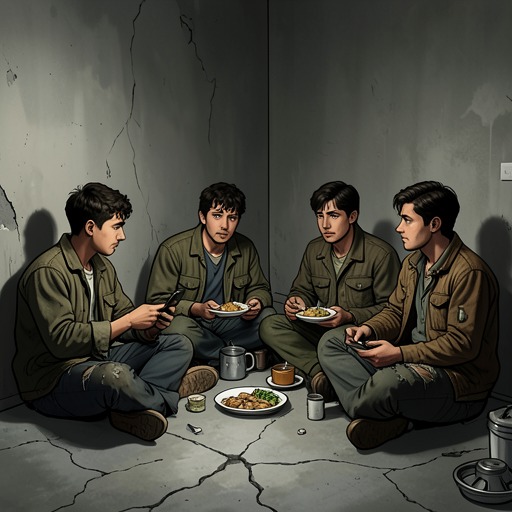
The Burger Boyz consisted of Curtis Gamble, Tavarus Hester, Drew Jemison, Julius “Flowy” Starkes, and the younger Christopher, among Rob’s closest hometown friends. Their friendship reached back to high school, when the group gathered around tables or in basements to work over ideas while eating Mrs. Gamble’s casseroles and drinking grape soda. Years later, the setting and refreshments changed, but the image remained recognizable: Rob, Curtis, Drew, and Flowy hunched over splayed papers marked in red pen, exhausted yet intensely focused on a goal. Even when the men doubted whether their latest endeavor could succeed, they allowed themselves to hope that at least two of the five might finally make something work. Their shared past therefore functioned less as nostalgia than as a standard against which adult disappointment was measured.
Rob’s connection to the group also formed part of the identity he carried between East Orange and more elite institutions. At Yale, he could be a student, researcher, marijuana dealer, roommate, and observer of class behavior; among the Burger Boyz, he remained tied to the neighborhood and to a history that preceded those roles. The friendship offered continuity across these separate worlds, even as Rob increasingly compartmentalized himself. His tendency to move between identities was part of what he called “Newark-proofing” himself: a method of surviving environments in which ambition and intellect could be misunderstood or made dangerous. The Burger Boyz represented the people and place from which that protective practice had emerged, and to which he repeatedly returned.
Loyalty Under Violence
The friendship was tested most fully on the night Rob was murdered. The intruders who entered the basement at 34 Smith Street created an immediate danger not only to Rob but also to Curtis, Tavarus, Darlene, and Christopher. The surviving friends could never establish exactly how the shooting unfolded. They believed that Curtis had been trying to intervene as a large intruder pursued him upstairs, while a second, smaller light-skinned man with dreadlocks may have turned toward Rob. They could not know whether Rob moved against the gunman, perhaps believing that his recent martial-arts training gave him an advantage. What Curtis did know was that Rob’s being shot had made the intruders flee; without that intervention, Curtis believed he might have been killed as well, and Tavarus, Darlene, and Christopher might also have remained exposed. The friends therefore told themselves that Rob had saved their lives, giving his death a final, terrible meaning within the group’s shared account.
That account did not remove uncertainty. No one remembered hearing the shots, and the Burger Boyz could not determine the precise actions that had separated survival from death. Curtis remained fixed on the moment when he had held and cradled Rob’s lifeless body. The others had to continue living in the house, eating and sleeping amid the aftermath of the police search, while the absence of Rob altered the rooms around them. Christopher rode the bicycle Rob had given him years earlier around the driveway; it had once been too large, but by then it fit him perfectly. The ordinary object became an intimate sign of the years Rob had invested in the group and its youngest member, as well as of the future Rob would not witness.
The Funeral Dispute
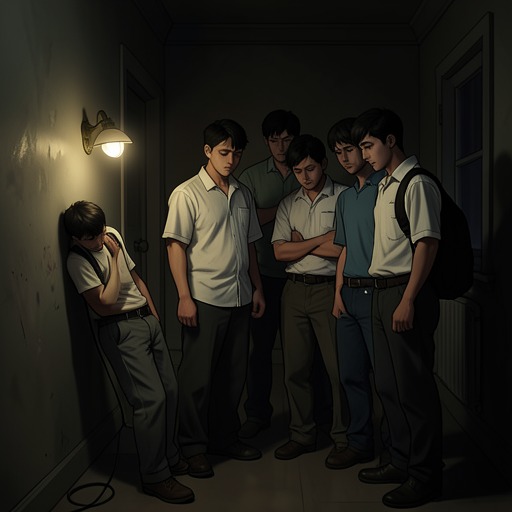
The friendship’s first posthumous crisis concerned whether the Burger Boyz would attend Rob’s funeral. Jackie Peace requested that they stay away, and Nathan conveyed her decision two days after Rob’s death. Drew Jemison and Julius “Flowy” Starkes were initially furious, particularly because the service was to be held at St. Benedict’s Preparatory School, a place that still mattered to them and whose absence might make them appear culpable in the eyes of their community. They planned to go despite the request. Tavarus Hester stopped them. The day before the funeral, he had gone downstairs with a sponge and bucket and scrubbed Rob’s blood from the textured floor; his authority came not from emotional distance but from having confronted the physical aftermath directly. When Flowy protested that he had seen Rob almost every day since they were fourteen and could not imagine losing him without attending the funeral, Tavarus answered that Jackie was a mother who had lost her son, that none of them possessed the answers she needed, and that honoring her wishes was therefore the group’s responsibility. Their loyalty to Rob had to be expressed through restraint toward Jackie, not through a public claim on the mourning rituals.
Separate Mourning and Collective Memory
The Burger Boyz ultimately did not attend the funeral or the festivities that followed. Instead, on the day of the service, they held a small ceremony in the backyard of 34 Smith Street, only a few yards from where Rob Peace had died. Police officers were still coming and going, the house remained only partly restored after the search, and charges against Curtis Gamble had not yet been filed, although the friends understood that charges were imminent. In that unsettled space, they shared a mournful blunt and raised a toast while trying to comprehend the vacancy Rob had left behind: the missing weight of his body, the silence where his voice had been, and the unbearable fact that ordinary life still required eating and sleeping in the same house. Their private ceremony did not replace the public funeral; it showed that the group’s relationship to Rob was rooted in the physical place where they had grown up together and where their shared history had ended.
Afterlife of the Friendship
The friendship continued after the funeral through efforts to preserve Rob’s memory and repair the rupture with Jackie Peace. Julius “Flowy” Starkes marked his loyalty with a tattoo reading “Real Peace Never Die BB4Life,” while the group recognized that retaliation would only extend the violence that had already taken Rob. Curtis Gamble briefly tried to recruit private attackers through Facebook, but Tavarus Hester, who had closed his restaurant and taken a telemarketing job after the killing, persuaded him to stop. Their shared conclusion was that violence could not undo Rob’s death. The harder task was to mend their break with Jackie, whom they had all called “Ma”; repeated calls were rebuffed by relatives answering her phone, and, as of the book’s publication, neither justice for the killers nor a restored relationship with Jackie had been achieved.
The group nevertheless created a final communal ritual at 34 Smith Street during what would have been Rob’s birthday celebration. While Jackie Peace and other relatives gathered at Passion, where guests drank blue Long Island iced teas and little beers in Rob’s honor, the Burger Boyz assembled in the backyard with paper lanterns. The first lanterns tore or caught fire, and the men joked that Rob would have been frustrated by their mechanical ineptitude; eventually they developed a two-person method that allowed the lanterns to rise. They sent them above the yard with liquor, marijuana, East Side gestures, birthday cries, and the declaration “You gonna live forever, Shawn Peace.” The lanterns drifted over East Orange, the highways, the Passaic River, Vailsburg, Irvington, and St. Benedict’s Preparatory School, tracing from above the landscape that had held the group’s nearly two decades together. Their disappearance beyond the neighboring roofs left the friends wondering where the flames would eventually fall, an image of memory that could rise, travel, and remain visible for a time without escaping uncertainty.
The book’s remembrance of the Burger Boyz places their friendship among the many relationships that made Rob’s life legible. The hometown friends who offered their memories included Curtis Gamble, Tavarus Hester, Drew Jemison, Julius “Flowy” Starkes, and Christopher, the youngest member, alongside a wider circle from Rob’s Newark years. Their testimony carried the joyful, funny, touching, and painful dimensions of a bond that had survived adolescence, adult failure, criminal risk, and the loss of its central figure. The friendship’s lasting significance lies not in a simple portrait of solidarity: it held affection, rivalry, obligation, fear, guilt, and disagreement at once. Rob’s death exposed the limits of what the friends could protect, but their mourning also preserved a collective history that neither the murder nor the unresolved aftermath could entirely erase.