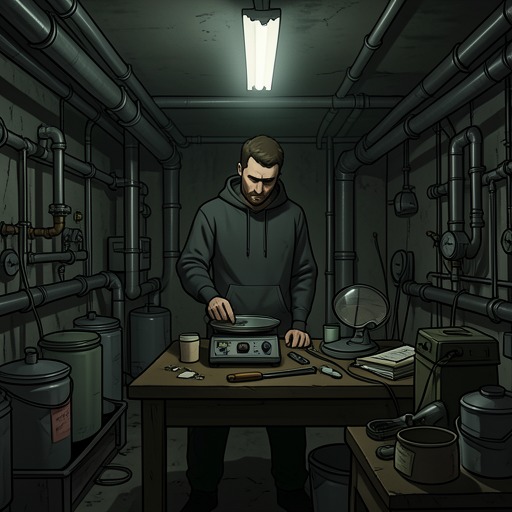
Rob’s Sour Diesel marijuana operation
The Short and Tragic Life of Robert PeaceRob’s Sour Diesel marijuana operation was an underground cultivation and processing enterprise that he developed in early 2006 in the basement of 34 Smith Street. It was not merely a retail drug business. Rob applied the habits of a laboratory researcher to cannabis production, engineered a product designed to produce a particular effect, and used the resulting income to meet family obligations, repay debts, assist friends, and pursue Peace Realty. The operation therefore joined scientific craftsmanship to an illicit economy and made his provider identity inseparable from the risks of drug dealing.
Origins in an Informal Economy
Rob’s involvement with marijuana distribution had begun earlier through the loose, replaceable connections of Newark’s drug trade. After the source originally introduced by Flowy disappeared, Rob obtained supply through Carl, who demanded to accompany each transaction. Rob drove Carl to a supplier in Ivy Hill, inspected the marijuana, negotiated the price down to $1,800 per pound, and returned Carl home with $200. The arrangement showed how the business depended on both market bargaining and personal obligation: Carl was treated as a relative, yet he also expected compensation and supervision.
Rob had already learned that dealing required a carefully maintained performance. He needed to remain available to buyers, negotiate without appearing weak, and project a manner that was simultaneously relaxed, tough, and imposing. His earlier refusal to sell directly to classmates at St. Benedict’s also distinguished him from a simple opportunist. When students asked whether they could buy marijuana from him, he directed them to Tavarus, who could obtain larger quantities through his older brother. Tavarus later gave Rob a twenty-dollar referral payment, and Rob changed the bill and left half of it for Jackie, as he habitually did with money he earned. The exchange established the pattern that would govern the later operation: illegal income was folded into household support and reciprocal relationships rather than understood by Rob as money for himself alone.
Designing Sour Diesel
The problem Rob confronted in the city was not merely obtaining marijuana but obtaining reliable, desirable marijuana. At Yale, students had generally smoked whatever was available and often lacked the knowledge or money to demand a consistent product. Newark buyers had more options and less disposable wealth, so Rob needed to become dependable within his small network. He distinguished between the lethargy of an indica body stone, or couch lock, and the energetic, more talkative and sometimes paranoid head high associated with sativa. Neither effect suited him completely. He preferred an intermediate state that allowed a person to function without feeling pulled down by the demands of the world.
That preference became a production objective. In Curtis Gamble’s basement at 34 Smith Street, once a place where the Burger Boyz had gathered to do homework over sodas and Mrs. Gamble’s cooking, Rob built a hydroponic system beneath LED lights. The planters consumed more than three-fourths of the floor space. Parent plants arrived from California’s Emerald Triangle, wrapped in layers of cellophane to contain their scent and disguised in kitchen-appliance boxes that appeared to have been purchased through eBay.
Rob worked by trial and error, using simple biology to fuse different genotypes at the seedling stage. The process resembled the experimental discipline of his earlier laboratory work, but its object was now a commercial cannabis product. Over several months in early 2006, he perfected the indica-sativa hybrid widely known as Sour Diesel. The basement was too small for mass production, yet it generated enough of the custom strain to blend with less selective marijuana bought from his suppliers.
He also processed the plant’s otherwise discarded stalks and leaves. Using butane’s low boiling point, he distilled hash oil and dripped it into smokable buds, intensifying the high while increasing the product’s profitability. The procedure was repetitive, laborious, and dangerous. Police patrols posed one threat, while poisonous butane fumes posed another; Rob wore a gas mask as he worked. During the winter of 2006, much of his free time passed in this basement, alone, making designer marijuana.
Money, Care, and Control
To his friends, the arrangement initially seemed absurd: a Yale graduate and high-school teacher operating a marijuana lab in Illtown. When they asked why he did it, Rob usually shrugged and treated the explanation as his private business. They supplied the practical answer themselves: he needed money, and this was work he knew how to do. The operation offered a form of competence that teaching did not. Teaching produced results inside the self-contained world of teenage boys, whereas the basement gave Rob a physical process he could control, improve, and convert directly into cash.
That sense of control mattered because his responsibilities had multiplied. His work at St. Benedict’s demanded energy, his mother Jackie needed support, his father Skeet Douglas was gravely ill, and Rob was sleeping very little. The illegal enterprise added the pressure of operating in a gang-dominated environment, but it also gave him pride. He had made something with his own hands, and the thing he had made was generating income. The basement became a place where exhaustion and responsibility were temporarily reorganized into a system whose inputs and outputs he understood.
The money circulated through a moral economy of family and friendship. Rob gave money to people who needed rent or children’s clothing, offered rides when cars broke down, and responded when friends needed company. Flowy drove an hour each way to help him replace a blown tire on the Merritt Parkway; Drew used his presence to pressure tenants into paying rent on the Greenwood Avenue property; other friends remained part of the network through mutual assistance. Rob’s dealing therefore served both personal ambition and a provider ethic. He wanted to be the Man among his peers, but being the Man meant being available, generous, and responsible for people whose lives had not followed the stable route promised by education.
From Cultivation to Distribution
Sour Diesel was only one part of a larger effort to make the drug business more efficient. Rob continued to buy ordinary marijuana from his connections, cut it with the product from the basement, and use the hash oil to improve its effect. He also organized a distribution network whose participants were kept away from the full structure of the enterprise. By mid-April, four young men between eighteen and twenty-two were working for him for $400 a week, gas money, and commissions. One new worker fell to his knees and wept because the job might keep him from becoming homeless.
Rob managed these couriers in the style of an older brother rather than a conventional boss. He joked with them, offered small kickbacks, and avoided giving orders in a way that might provoke resentment. He was strict about practical safeguards: their vehicles had to be registered, their taillights had to work, and they had to obey traffic laws. He presented the work as a path toward advancement, suggesting that disciplined conduct could bring them to the position he occupied. Yet the separation was deliberate. The couriers operated in parks, parking lots, and side streets; they never saw the Smith Street basement and did not know the enterprise’s details.
For three weeks, the system functioned well. The couriers moved almost a pound a day, although the new overhead—about $8,000 a month—reduced the profits below Rob’s original calculations. The first proceeds went to Curtis Gamble, Tavarus Hester, Drew Jemison, and Julius “Flowy” Starkes to repay their initial investments. Rob used his own share for back mortgage payments on Greenwood Avenue, contributions to Jackie, radiator repairs at the Chapman Street house, and Frances Peace’s medical expenses. Frances was undergoing dialysis for kidney disease in addition to suffering from emphysema, and the family had accumulated credit-card debt to pay for her care. He also resumed helping friends with rent, car repairs, and marijuana. At the existing sales rate, he expected to clear the inventory by midsummer and then prepare for an application to Johnson & Johnson.
Contradiction and Consequence
Rob’s operation cannot be reduced to greed, but neither can its charitable uses make it benign. The same network that allowed him to pay family bills and support vulnerable friends required concealment, constant availability, negotiation, and exposure to a violent market. Oswaldo Gutierrez saw the contradiction clearly. Rob once said that he wanted to succeed while carrying roughly five pounds of marijuana in a trunk on a drive toward Boston. Oswaldo answered that Rob wanted to succeed in a distorted way—as both a businessman and a dealer—and that he had to choose one. Rob cared too much about people to become a truly ruthless drug kingpin, yet that very care kept drawing him back into an enterprise whose risks he could not fully control.
The operation also followed the larger pattern of Rob’s life. Education had given him exceptional skills but had not stabilized his obligations or erased the claims of Newark. His father’s final appeal was denied on August 16, 2006, and Skeet died six days later after brain cancer had left him weak and heavily sedated in the prison infirmary. After the funeral, Rob turned toward Peace Realty, imagining legitimate real estate as a cleaner version of the same provider mission: acquire undervalued houses, renovate them, create shelter and security, and earn money through work he could call fundamentally honest. The Sour Diesel operation helped finance that transition, but it also made the transition precarious.
By the time Rob’s distribution network expanded, the distinction between care and danger had become unstable. He could use profits to protect Jackie, pay for Frances’s treatment, restore the Greenwood property, repay partners, and keep young workers from homelessness. He could also find himself required to “handle” Kamar, a conflict that threatened the entire enterprise. When Curtis and Tavarus urged caution, Rob asked for three days to fix the situation, insisting that no one would act in that short interval. His plea revealed the narrowing space in which he was operating: the business was still imagined as a bridge to real estate and legitimate employment, but its immediate problems could no longer be solved by bookkeeping, chemistry, or generosity alone.
Sour Diesel thus stands as a concentrated image of Rob’s divided adulthood. In one sense, it was an impressive technical achievement, built through observation, experimentation, and patient refinement. In another, it was a survival strategy assembled from unstable connections and carried by the needs of family and friends. The operation gave Rob agency when other institutions offered little security, yet it also bound his scientific intelligence and provider ethic to an illegal market shaped by violence. Its deepest significance lies in that unresolved mixture: the basement was simultaneously a laboratory, a workplace, a source of pride, a means of care, and a threshold beyond which control became increasingly difficult to maintain.