Sharpe James administration
The Short and Tragic Life of Robert PeaceThe Sharpe James administration was the municipal government led by Sharpe James after his election as Newark mayor in 1986. In the narrative, it embodies both the promise and the limits of Newark’s political renewal: James presented himself as a locally rooted Black leader who understood residents personally, while the city remained burdened by poverty, high crime, population loss, failing institutions, and economic disinvestment. For Rob Peace, the administration also became an imaginative structure of hope, with James serving as a surrogate father and Newark’s redevelopment as a visible sign that education, public authority, and communal investment might produce a different future.
Formation and Political Promise
The administration began with James’s campaign platform of jobs, improved low-income housing, and the return of development money to downtown Newark. A former alderman, James cultivated an image sharply distinct from that of remote or technocratic officials. He had been born and raised in Newark, wore jogging suits in public, and claimed an individual familiarity with the people he governed. At the time of his election, Newark was 52 percent African American, and much of the city’s African American community strongly admired him. Skeet Douglas, during the eight months between James’s inauguration and his own arrest, was among those residents who treated the mayor as a regular subject of neighborhood conversation.
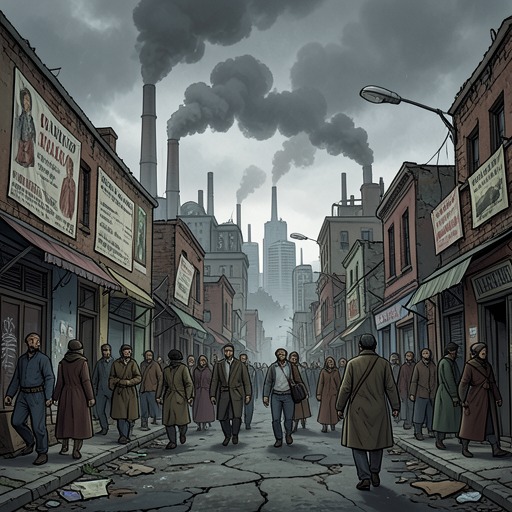
The administration’s appeal was intensified by the city’s material crisis. More than one in three Newark residents lived below the poverty line; the violent-crime rate was so persistent that a 1996 Time article called Newark the most dangerous city in America; and the public-high-school graduation rate remained below 60 percent. Newark had lost 130,000 residents since the 1967 riots. The Ironbound District, once a busy and ethnically diverse commercial center, had deteriorated into shuttered storefronts and squatters, while companies such as Prudential Insurance considered leaving downtown because attracting workers had become difficult. The city even constructed enclosed skyways above street level so downtown employees could move between buildings without entering the streets below.
Revitalization and Contradiction
During James’s first term, the administration pursued a difficult redevelopment program. Its central goals included demolishing the project towers constructed under Mayor Addonizio in the 1950s and replacing them with smaller-scale public housing and middle-income units. It also sought to bring a performing-arts center and a sports arena to downtown Newark. These projects were presented as practical steps toward rebuilding the city and as evidence that Newark could again become a place where commerce, culture, and public life converged.
The administration’s public meaning exceeded the projects themselves. James offered residents the image of a dignified Black man, educated, locally rooted, publicly committed, and now serving in his early fifties. His political presence suggested that civic authority did not have to belong to outsiders or to people who had abandoned the city. Jackie Peace encountered this promise in a direct, almost startling form: after an acquaintance asked James for a job at one of his downtown rallies, the woman was hired a week later as a school crossing guard.
Yet the administration was compromised even as it presented itself as an instrument of renewal. While James worked through the difficult political and financial pathways of redevelopment, he also committed the first of more than fifty fraudulent acts that would eventually lead to his indictment in 2007. The narrative therefore places public hope beside private corruption from the beginning. James’s administration could symbolize opportunity and still participate in the failures of the political order it claimed to repair.
Influence on Rob Peace
Rob encountered the administration not as an abstract municipal structure but through the figure of Sharpe James. He heard stories about the mayor and, as a ten-year-old, began to worship him. His face brightened whenever James was mentioned by Horace or by the nuns at Mt. Carmel. Although Orange and East Orange had their own township governments and did not fall under James’s jurisdiction, Newark remained a powerful presence in Rob’s world. From Chapman Street, the cluster of earth-toned towers a mile and a half to the east, the bridges spanning the Passaic River, and the city’s concentration of commerce, education, and possibility formed a beacon. James became its standard-bearer.
Rob’s interest became active rather than merely admiring. Jackie was surprised when he began watching the news specifically to hear the mayor speak. In fifth grade, he wrote a biography of James and asked his mother to take him to downtown speeches held when the mayor cleared land for office buildings or appropriated money to hire more police officers. Years later, Jackie would accept the description of James as Rob’s first surrogate father, even though she had not initially understood the term. The administration thus filled part of the paternal and civic space left open by Skeet’s imprisonment.
James’s example also helped define Rob’s early conception of advancement. The mayor represented someone who had emerged from Newark, acquired education and authority, and returned to govern the community. That model resonated with Rob’s later movement through St. Benedict’s, Yale, scientific research, teaching, and real-estate ambitions. But the administration’s unresolved contradictions foreshadowed the instability of those later pathways: public recognition could generate genuine possibility without eliminating the structural conditions that made survival and progress precarious.
Institutional Order and Urban Constraint
The administration’s work unfolded within a city shaped by institutions that could protect, discipline, or exclude. Rob’s family repeatedly traveled through Newark’s surrounding systems, from Mt. Carmel to the courthouse and the prisons where Skeet was held. Trenton State Prison, reached by the New Jersey Turnpike and the I-295 spur, appeared as a fortress whose walls, turrets, cell blocks, and population of nineteen hundred inmates converted individual lives into anonymity. Against that scale of confinement, James’s promises of housing, jobs, and public investment represented a civic alternative, but one that had to operate within the same landscape of poverty and violence.
The administration’s redevelopment ambitions also contrasted with the dense, highly managed environments through which Rob later moved. St. Benedict’s kept students occupied through full academic days, sports, group activities, memorization, color teams, unsecured belongings, and tightly controlled schedules, explicitly attempting to prevent fights, theft, drug use, emotional abuse, and dropping out. Yale regulated drug possession and distribution through rules that could lead to expulsion. At the airport, labor was organized by dispatchers, schedules, stamina, and the relentless demand to move luggage quickly. These institutions offered different forms of structure, but none permanently resolved the pressures surrounding Rob’s life.
Legacy and Limits
The Sharpe James administration remains significant because it joined civic aspiration to the city’s damaged social reality. James’s election gave Newark residents a locally recognizable political figure and gave Rob a model of Black achievement tied to public service. His administration pursued housing replacement, downtown development, cultural facilities, and police expansion while Newark continued to face poverty, violence, depopulation, weak educational outcomes, and economic decline.
Its legacy is therefore double. James’s government made political representation emotionally tangible for residents who saw themselves reflected in the mayor, and it supplied Rob with a language of possibility powerful enough to shape his ambitions. At the same time, the administration’s later corruption exposed the fragility of a politics in which symbolic representation could coexist with fraud and incomplete revitalization. Newark’s hope was not false, but neither was it sufficient. The administration’s central tension mirrors Rob’s own trajectory: education, authority, and public promise could open doors, yet the surrounding conditions continued to determine which gains could endure.