Sour Diesel
The Short and Tragic Life of Robert PeaceSour Diesel is the marijuana strain Rob Peace invents, cultivates, and distributes as the most concentrated expression of his scientific intelligence, entrepreneurial drive, and increasingly dangerous return to the drug trade. It begins as an experiment in control: Rob wants to engineer a cannabis high that occupies the space between lethargic “body stone” and overstimulating “head high.” It ends as the commodity around which he organizes labor, debt, loyalty, family support, and risk. The strain gives him pride because he has made something distinctive, but it also turns the basement where he once found refuge into an exhausting and hazardous workplace.
Definition and Development
Sour Diesel emerges from Rob’s effort to produce a reliable product for buyers who have more options and less disposable income than the students at Yale. He understands the difference between indica and sativa effects: indica produces “couch lock,” marked by lethargy and withdrawal, while sativa produces an energetic “head high,” with heightened senses, talkativeness, laughter, and possible paranoia. Rob prefers neither extreme. He wants a hybrid effect that lets a person remain functional and engaged with the world while feeling unburdened by it. The strain is therefore not merely a market label; it is the result of Rob applying biological reasoning to his own desired state of mind.
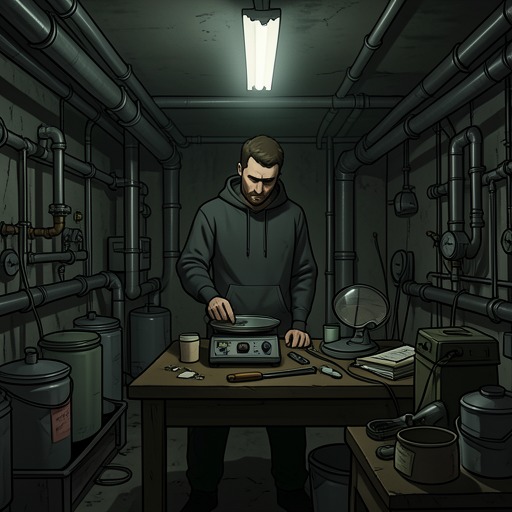
In the basement of 34 Smith Street, where Curtis now lives alone, Rob constructs a hydroponic growing system beneath LED lights. The planters occupy more than three-fourths of the floor, transforming a former Burger Boyz gathering place—once associated with homework, sodas, and Mrs. Gamble’s cooking—into a private laboratory. Parent plants arrive from California’s Emerald Triangle, wrapped in layers of cellophane to contain their scent and disguised in kitchen-appliance boxes as if they were ordinary eBay purchases. Rob then uses trial and error, echoing the experimental habits of his legitimate laboratory work, to fuse different genotypes during the seedling stage.
By early 2006, after months of experimentation, he has perfected the strain. The basement cannot produce enough Sour Diesel for mass production, so Rob uses his own crop to improve less distinctive marijuana purchased from his suppliers. He also distills hash oil from discarded stalks and leaves by exploiting butane’s low boiling point, then drips the oil into smokable buds to intensify the high and increase the profit. The process is repetitive, laborious, and dangerous: poisonous fumes require a gas mask, while the work takes place under the pressure of neighborhood policing and illegal commerce.
A Laboratory and a Livelihood
Friends repeatedly ask Rob why a Yale graduate and high-school teacher is operating a marijuana laboratory in his best friend’s basement in Illtown. His outward answer is a shrug and an expression that marks the matter as his own business. Their answer for him is more practical: he needs money, and this is work he knows how to do. Yet the strain offers more than income. As teaching drains him, family demands accumulate, and the illegal enterprise exposes him to gang-dominated dangers, Rob increasingly experiences the basement as a place where he can still impose order. He has created something, the work earns money, and the combination gives him pride.
That pride is bound to Rob’s larger struggle with authenticity and social roles. He has spent his life moving between incompatible settings and “Newark-proofing” himself, walling off parts of his identity so that ambition and intellect will not make him vulnerable in environments where they carry little currency. At Yale, he condemns “fronting,” the practice of appearing tougher, poorer, richer, or less intelligent than one really is. Sour Diesel becomes a paradoxical form of authenticity: it is a product he genuinely designed and understands, but it also forces his scientific abilities into an illicit economy. The strain allows him to be effective without having to pretend that the legal institutions around him will reward his education in proportion to his skill.
The strain also links Rob’s public identities in uneasy ways. To Truman Fox, Rob is a water-polo coach who speaks about honor, curiosity, respect for women, and responsibility toward one’s people. To Isabella Peretzian, he appears fundamentally “real,” someone who has not tried to become a different person simply because he has earned a Yale degree. To friends who see the basement operation, he is the high-school teacher running a drug laboratory. Sour Diesel makes these identities coexist rather than resolve them: the teacher, scientist, neighborhood businessman, caregiver, and dealer all remain present in the same person.
Conflict and Expansion
Sour Diesel becomes dangerous when its reputation spreads. Rob hears that Boobie, a forceful member of the Double II Sets, resents him because the strain is “off the hook” and because Rob has supplied some of Boobie’s customers. Rob has not deliberately poached clients; he has served as an alternative supplier when Boobie was unavailable. Even so, the quality and novelty of Sour Diesel alter Rob’s position in the local market. In the Smith Street basement, while wearing a gas mask and filtering hash oil through a fine sieve beneath the harsh white LED lights, Rob learns that the product’s success has made his presence visible to people with stronger territorial claims.
The strain later becomes the basis of Rob’s employment under Amin. After Rob no longer has enough money to finance his own marijuana supply, his reputation for making Sour Diesel gives him leverage. In December 2010, he works for Amin, a Puerto Rican middleman in his thirties who operates through small business fronts in Weequahic. For $800 a month, Rob converts several pounds of Amin’s marijuana into the hybrid and delivers it to one of Amin’s supply outposts. This arrangement preserves the value of Rob’s specialized knowledge while removing his control over the broader enterprise.
That loss of control changes the meaning of the work. Previously, Rob could start and stop his dealing, decide how much to operate, and keep the money under his own direction. Under Amin, a phone call can interrupt time with Christopher, his grandmother, or friends; a conversion deadline must be met, or financial consequences and a more ominous form of pressure may follow. Rob begins pulling all-nighters in the Smith Street basement, sometimes two or three in succession. Sour Diesel is no longer simply his creation or a flexible source of income. It has become an obligation owed to a superior within a hierarchy that exposes low-level workers to the greatest danger.
The Fifty-Pound Operation
The largest expansion of the Sour Diesel enterprise begins when Rob obtains fifty pounds of marijuana from a bulk supplier at a fire-sale price because the supplier’s “block got hot.” Once the shipment reaches the basement, the volume is visually deceptive: the entire cache occupies roughly twenty-five gallons and could fit inside the glass walls of Rob’s former snake tank. A few dozen plastic bags do not look like the nearly half a million dollars Rob expects to make. They look like potting soil in Curtis’s garden, not freedom.
Rob prepares the basement by insulating the exterior door and the passage into the laundry area with tarps. The concentrated smell becomes so powerful that his eyes sting and water. The Burger Boyz briefly recover the atmosphere of their old refuge, smoking the new product, talking, and laughing beneath the haze. The moment of camaraderie is immediately overturned by the labor the stash demands. Because the equipment is small, Rob must process the marijuana a fraction of an ounce at a time through a cylindrical sieve smaller than a bicycle pump. A larger apparatus would allow butane fumes to rise into the house and make the air dangerous for Christopher.
Each pound requires approximately ten to fifteen hours of work, making fifty pounds more than five hundred hours of processing. Rob is also still converting two to five pounds a week for Amin. He initially treats the long schedule as an advantage because it will force him to sell gradually and avoid attracting attention, but the calculation becomes a form of confinement. He disappears into the basement for whole days, climbing the back stairs only to eat or use the bathroom, and wears the gas mask while the work proceeds. He keeps himself moving by talking about eventual profits, laundering the proceeds, and the possibilities those profits might open. As in his earlier hopes for college and other ventures, the present becomes a punishing passage toward a future that remains just beyond the work.
Distribution proves harder than production. Each pound yields approximately 450 dime bags, so the fifty-pound cache represents about 22,500 units. Tavarus cannot drive because of his prior possession record, while Curtis and Drew are unwilling to serve as mules. Only Rob and Flowy can make deliveries, and two people cannot move that volume without attracting attention. Rob limits each of them to ten drop-offs a night, refuses to sell in East Orange, and worries that Amin will interpret the additional commerce as theft from his supply. Friends who had once been happy to smoke with him hesitate to help broaden the network, perhaps because they have grown wiser or because they recognize that Rob’s repeated promises to leave the drug trade have not held.
For three weeks, the plan functions. The group moves nearly a pound a day, although overhead of about $8,000 a month reduces the profits. The first money repays Curtis, Tavarus, Drew, and Flowy for their initial investments. Rob directs his own share toward back mortgage payments on the Greenwood Avenue house, financial help for Jackie, radiator repairs at the Chapman Street home, and credit-card debts created by Frances’s dialysis and emphysema. He also resumes helping friends with rent, car repairs, and marijuana. The operation is therefore organized as both business and redistribution: Sour Diesel generates personal profit, but its proceeds are immediately absorbed by family obligations and reciprocal ties.
Consequences and Significance
Sour Diesel is significant because it converts Rob’s legitimate scientific habits into an illegal production system without erasing the intelligence that made his academic success possible. The hydroponic planters, genotype experiments, careful extraction process, and concern with reliable effects all reveal continuity between his laboratory training and his drug work. What changes is the institutional setting and the distribution of risk. In the basement, scientific competence cannot protect him from territorial conflict, legal exposure, unsafe fumes, exhaustion, or the demands of employers and couriers.
The strain also embodies Rob’s attempt to turn blocked opportunity into self-directed enterprise. His education has brought distinction, but not stable employment or a secure way to support everyone whose needs he feels responsible for. Sour Diesel offers immediate evidence that his knowledge can produce value. It lets him act as inventor, manufacturer, manager, and provider at once. Yet the very qualities that make the product valuable—its novelty, potency, and reliability—draw attention to him and increase the number of people who want access to it, profit from it, or control its circulation.
Its material presence carries a further irony. The fifty-pound cache looks small enough to fit in a snake tank, yet it represents more than five hundred hours of dangerous labor and nearly half a million dollars in projected revenue. The visible object is unimpressive; the network of debts, hopes, and threats attached to it is immense. Sour Diesel promises freedom but requires Rob to give up sleep, privacy, autonomy, and eventually the ability to keep his different worlds separate. In that sense, the strain is not a path out of his divided life. It is the substance through which those divisions become physically, financially, and morally entangled.