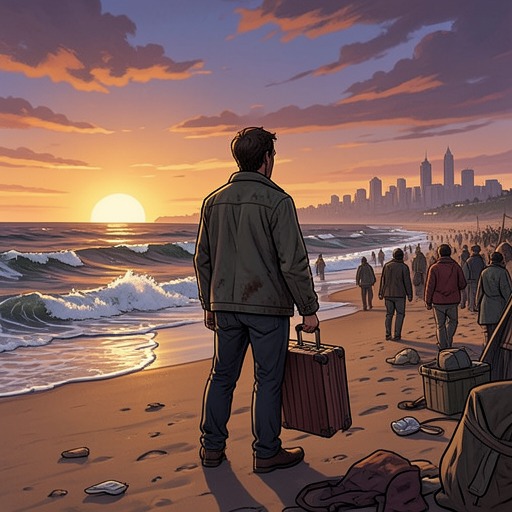
The theft of Rob’s black trunk
The Short and Tragic Life of Robert PeaceThe theft of Rob’s black trunk is the material and emotional rupture that follows Rob’s return from Rio de Janeiro in 2003. The trunk contains the savings he had amassed through years of concealed marijuana dealing at Yale, money intended to support Jackie Peace and finance a year of freedom. Its empty interior converts a carefully imagined future into immediate uncertainty, forcing Rob back toward work, family dependence, and the unresolved pressures that had shaped his life.
Return from Rio de Janeiro
Rob comes back to Newark International Airport at dusk after a trip he had imagined as an escape and an opening. Rio de Janeiro had offered a world of movement, color, and possibility, culminating in Carnival, where millions of people filled the streets with music, food, costumes, and collective exhilaration. He does not want to return home, but Flowy drives him through the Oranges after Rob gives instructions that carry him past his mother’s house and toward Carl’s building.
The decision to go directly to Carl is prompted by warning rather than convenience. Rob had sensed an edge in Carl’s voice during a phone call several days earlier, and the feeling was strong enough that he bought an earlier return ticket. The trip’s remaining weeks become less important than protecting the money he has left behind. When Flowy asks whether Rob wants to stop at his mother’s first, Rob declines. The choice places the stolen savings, rather than reunion or rest, at the center of his return.
Discovery of the Empty Trunk
Carl opens the door looking edgy and asks about Rio and Rob’s early arrival. He offers Rob a drink and a smoke, but Rob asks only for his trunk. Carl leads him to a closet where the black trunk has been pushed into the back and covered with clothes. Rob immediately sees that the lock has been pried off and then clumsily reattached. Before opening it, he already understands what the damaged lock means; the trunk’s contents are no longer secure, and the cash is almost certainly gone.
The discovery confirms that both his savings and the labor behind them have disappeared. Rob had earned the money through four years of Metro-North train rides, bulk drug transactions in dangerous inner-city homes, postponed schoolwork, and the repeated movement of customers through his Yale room. The theft therefore takes more than currency. It erases the time, risk, and self-discipline that the money had been meant to redeem. The missing cash also removes the year he had planned to devote to Jackie, turning an economic loss into a failure of a family promise.
Rob’s anger is complicated by self-accusation. He had chosen to keep the money in cash rather than in a checking account; he had left the country for an extended period; and he had entrusted the trunk to a man capable of opening it. Carl mutters about debts, hardship, and an intention to repay him, but Rob does not listen or turn around. The scene offers no clean division between innocent victim and guilty thief. Rob is furious at Carl, yet he also regards the loss as the consequence of his own decisions.
The Trunk as a Burden
Rob lifts the damaged trunk and carries it upright against his chest because the broken lock has left the lid loose. Empty pipes and bongs, including ornate pieces with sentimental value, clatter hollowly inside. The sound makes the object a physical record of absence: what remains is not the wealth Rob had stored but the paraphernalia associated with the activity that produced it.
He carries the trunk past men loitering outside beneath a flickering light, no longer caring whether they might rob him again. His clenched fists loosen, but his refusal to face Carl preserves the force of the confrontation. The trunk becomes both evidence and burden, an object that must be removed even though it contains almost nothing of practical value. Rob’s mind has already moved toward a future that no longer possesses the freedom he had promised himself.
Consequences for Rob’s Trajectory
The theft leaves Rob without a job, graduate-school plans, or money during the uncertain summer of 2003. Most graduate applications had already been due while he was in Rio, and he returns to Jackie’s house, eating her food and waiting for her to come home from work. The loss makes him feel like relatives who had attempted independence, failed, and been forced back to Chapman Street. His education remains intact, but the resources that might have allowed him to convert it into a stable next stage have vanished.
The stolen money had been tied to Rob’s larger effort to transform illegal income into care and mobility. At Yale, his academic achievements and a 1510 SAT score had opened doors that seemed unimaginable from East Orange, yet he still turned to marijuana dealing and accumulated just over $100,000. He gave some of the money to Jackie in installments small enough to resemble wages from the dining-hall job he had already quit, spent roughly $10,000 on school supplies and travel, and reserved about $30,000 for Jackie’s future support. The remaining amount, described by Rob as “fifty large,” was meant to pay for Rio and carry him through the following year. The trunk theft destroys this improvised financial architecture at once.
The loss also changes the meaning of Rio. Rob had hoped to bring back stories and images that might give Skeet Douglas, imprisoned in Trenton State Prison, a way to imagine the beaches, favelas, and Carnival he could never visit. Instead, the trip becomes a reaffirmation of the family and neighborhood conditions Rob had hoped to transcend. He still wants to return to Brazil, but he must work first. Soon afterward, a drug supplier pulls a revolver on him during a failed negotiation; Rob pays several hundred dollars more than demanded and then begins teaching at St. Benedict’s, leaving the drug business.
From Lost Savings to Blocked Futures
The theft exposes a recurring gap between Rob’s qualifications and the opportunities available to him. Jackie questions why a Yale-trained scientist and teacher is carrying luggage at Continental Airlines, while Rob insists that he needs to make ends meet and values the wages, benefits, and mental relief of manual labor. Later, when he seeks other employment, his résumé appears incoherent: laboratory research, high-school teaching, airport labor, and a controversial firing. His lived sequence of deliberate choices is reduced to disconnected bullet points that employers cannot understand, while Rob himself struggles to appear interested in jobs he does not want.
The same pattern affects his real-estate ambitions. Rob imagines using work and travel benefits to build Peace Realty, but the 2007 housing bubble burst and the collapse of subprime lending leave the company with only the property at 122 Greenwood Avenue. In retrospect, the stolen trunk is an early version of the same structural reversal: Rob possesses intelligence, education, and entrepreneurial energy, but the bridge between those resources and legitimate security repeatedly collapses. The theft is therefore not merely a private crime. It is the moment when savings meant to purchase independence disappear, leaving Rob to improvise once more among family obligations, precarious employment, and dangerous economies.