Yale marijuana dealing
The Short and Tragic Life of Robert PeaceYale marijuana dealing is the illicit enterprise Rob Peace develops during his Yale years, first as an improvised way to cover expenses and help his mother, then as a concealed but increasingly visible business. Its significance lies in the contradiction it creates: Rob is an exceptional student who gains access to elite education, yet he also finds money, social connection, and a recognizable form of competence in the drug economy. The dealing does not replace his intellectual life; it runs beside it, forcing him to divide his identities and making Yale both a place of opportunity and a market for the product he brings from Newark.
Origins and Opportunity
The enterprise begins in conversation rather than in a dramatic decision. Rob asks Julius “Flowy” Starkes how he manages food, rent, and other college expenses. Flowy answers that he is “Hustling on the side, a little bit,” and Rob asks whether he has a reliable supplier, or “connect.” When Flowy points out that students at Yale must smoke marijuana, Rob confirms that they do, and the possibility of a business takes shape between them. The exchange frames dealing as an economic opportunity produced by unequal resources: both men are trying to remain in college, but the institution does not make their financial problems disappear.
Rob has particular reasons to consider the opportunity. Charles Cawley’s support covers his tuition directly, but books and laboratory equipment still cost nearly as much as Rob’s entire high-school tuition. Jackie Peace is exhausted, poor, and alone, and Rob says that he could use money without presenting the need as a crisis. His previous habits of working, budgeting, and assuming responsibility for his household make the proposed trade feel to him less like reckless experimentation than another form of income. The business therefore grows out of a gap between educational access and everyday solvency.
Sherman Feerick, a junior and the leaseholder of the Weed Shack, becomes an early bridge between Rob’s Yale life and the marijuana market. Sherman recognizes Rob as the new poor African American student from Newark and is drawn to their shared knowledge of life outside Yale. After Rob explains his financial circumstances, Sherman redirects some business toward him rather than treating him as a competitor. He also teaches Rob how to avoid the university’s attention, a task that seems easy so long as the dealer does not behave foolishly. The knowledge is practical and local: Rob enters an existing network, but he adapts it to the particular customer base and surveillance environment of Yale.
Campus Business and Concealment
During Thanksgiving vacation, Rob plans to meet Flowy’s supplier in Newark and return with several ounces of marijuana, which he will divide into eighths for classmates during the weeks before final examinations. The plan is deliberately quiet. He keeps the product away from his living space and tries to remain invisible to his roommates, preserving the appearance of the academically driven Yale student while beginning to serve his classmates as customers.
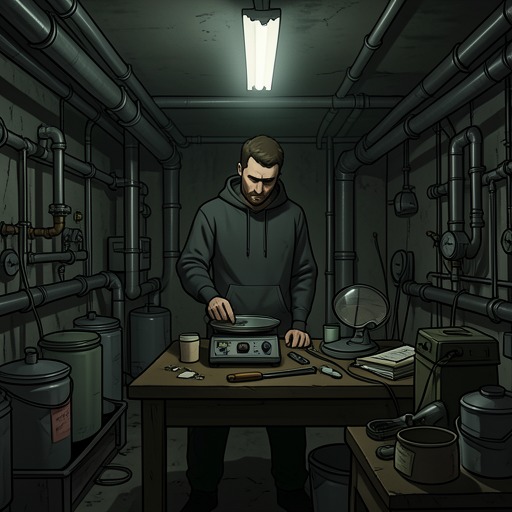
By the middle of his second year, the concealment has weakened. Rob has become one of the leading drug dealers on campus, and transactions take place openly enough in his room that his roommate can observe them. Several times a night, a student knocks, enters, and completes the purchase through the lower-right drawer of Rob’s desk. Friends may stay to smoke with him, and some evenings four or five people crowd onto his bed, stacks of textbooks, and the black trunk where he keeps his bongs, marijuana, and ledgers. He uses cash for his purchases, though the extent of his income remains uncertain to those around him.
The room becomes more than a point of sale. It gathers classmates, town residents, graduate students, professors, athletes, artists, and students from different racial and social backgrounds. The same circles that come for marijuana also use the room as a place to speak candidly about Yale and the Yale Experience. In this setting, Rob’s dealing gives him a form of social centrality that his formal status as a scholarship-supported student does not necessarily provide. His room becomes a space where people who rarely mix elsewhere on campus can sit together, smoke, joke, and criticize the institution that has brought them into contact.
Rob’s judgment of campus performance sharpens the contrast. He is deeply hostile to “fronting,” the act of pretending to be tougher, poorer, wealthier, or less intelligent than one really is. He sees role-playing throughout college life, including the manufactured politeness with which some students treat Jacinta Johnson in the dining hall. Marijuana dealing places him in another kind of performance: he is a Yale student in classrooms and laboratories, a Newark-connected supplier in private commerce, and a provider of an experience that many of his customers want but cannot openly acknowledge. His skill lies partly in keeping these roles from colliding.
Scale, Method, and Networks
Rob’s business expands steadily. Every other weekend he travels to Newark, sometimes only for the day, and returns with two gallon-size ziplock bags of marijuana in his backpack. The supply lasts until the next trip, and he is consistently cheerful when he comes back, as though the journey has restored rather than depleted him. Yale customers pay whatever price he sets without haggling. He sells not only to classmates but also to town residents, graduate students, and professors, extending his reach across the university’s social hierarchy.
He treats the enterprise with the same administrative care he once applied to ordinary jobs. Each night he spends roughly fifteen minutes with his ledger, recording money already earned, money expected, and money that must be spent. The ledger turns an illegal activity into a system of accounts, schedules, inventory, and projected obligations. His customers see the ease of availability; Rob sees the labor behind it, including procurement trips, cash management, and the constant need to remain below institutional notice.
The scale of the operation helps explain why Rob wants to move out of the gates of Pierson College during his junior year. He persuades his friends to rent a two-bedroom apartment in a building across the street from Pierson, university housing still paid for through tuition but technically off campus. The new location offers more separation from Yale’s formal residential system and more room for the enterprise to grow. At the same time, the move makes his two lives harder to distinguish: the apartment is both a student home and a base for business.
Oswaldo Gutierrez is one of the few people willing to challenge Rob’s methods. Unlike customers who find the dealing exciting or “thug,” Oswaldo understands it as an economic response to financial shortfalls, a practical activity that requires discipline. From that perspective, Rob is too exposed. He carries large quantities across campus, works from his dorm room, and even leaves the entryway open so customers do not have to wait. Oswaldo’s criticism identifies the danger in Rob’s confidence: the same intelligence that allows him to calculate a profitable operation also encourages him to believe that careful observation and personal capability can control every risk.
Education, Identity, and Consequences
The dealing becomes one expression of Rob’s broader strategy of “Newark-proofing” himself. He has learned to move between worlds by walling off whichever identity is not useful in the moment. At Yale he can be a brilliant student, a water polo player, a laboratory researcher, a friend, and a drug dealer; in Newark he remains tied to the people and obligations that formed him. Marijuana acts as a bridge between the two settings, linking the money and language of the neighborhood with the resources and demand of the university.
This bridge is also a measure of the limits of social mobility. Rob earns straight A’s in advanced calculus, upper-level physics, and religious studies, and later works in the Yale Medical School laboratory, where promptness and curiosity allow him to move from cleaning equipment and recording data to conducting his own crystal-diffraction experiments. Yet the legal institutions surrounding him do not fully answer the financial pressures he feels, while the illegal market rewards his competence immediately. Yale supplies education, housing, and eventual credentials; the marijuana business supplies cash, autonomy, and a role in which his knowledge of both Newark and Yale is directly valuable.
The enterprise does not end with a single exposure or a neat moral reversal. It becomes part of the divided life that others only partially understand. Friends speculate about whether Rob earns hundreds or thousands of dollars each month, assumes he is sending money home or saving for graduate school, and tells itself that he knows exactly what he is doing. Those assumptions reveal both his effectiveness and his isolation. He can make the business appear orderly while keeping its purposes and profits inaccessible to the people closest to him.
The later course of Rob’s life shows that Yale marijuana dealing was not an isolated youthful episode but one strand in a continuing attempt to turn intelligence, networks, and risk into security. After graduation, he still carries the consequences of a world in which legitimate status does not reliably produce stable work or sufficient income. The business’s deepest importance is therefore structural rather than sensational: it records the moment when an elite education and an underground economy become interdependent in Rob’s life, each offering resources the other cannot provide, while neither resolves the pressures that ultimately govern his choices.