the black trunk
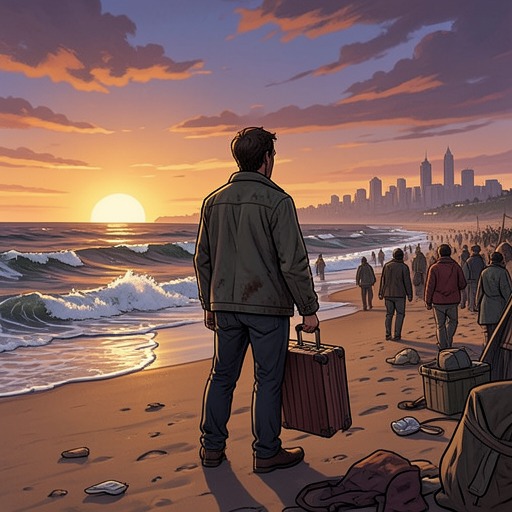
The Short and Tragic Life of Robert Peacethe black trunk is one of the book’s most important recurring objects because it makes Rob Peace’s divided existence physically visible. It holds the cash and paraphernalia of his drug business, travels between New Haven and Newark, shelters a python tank, and finally returns to him empty after Carl’s betrayal. More than a container, it becomes a portable boundary between Rob’s academic life, his neighborhood identity, and the future he hopes money can purchase.
Appearance and Yale Setting
the black trunk first appears as part of the cluttered material world Rob leaves behind at Yale. After graduation, his roommate finds Dio, Rob’s python, coiled in a glass tank atop the trunk, still digesting a vermin eaten several days earlier. Textbooks wait to be sold, duffel bags are half packed, and photographs of the Burger Boyz at 34 Smith Street and Jackie Peace at St. Benedict’s graduation have been removed from the walls. The trunk therefore stands among the objects that remain when a Yale room is being dismantled, linking Rob’s domestic life, his friendships, his family, and his animal companion in a single crowded scene.
The trunk also belongs to the economic afterlife of Rob’s education. During the three-week custodial stint after graduation, Rob and the other members of the six-person team sold abandoned textbooks and other valuables collected from Yale residences. He earned almost $1,000, enough to cover the summer’s rent in New Haven, though that amount was small beside the money he had already saved. The trunk’s presence in this period helps place Rob between institutions: he is a graduate of Yale, but he is still cleaning its rooms and converting the leftovers of student privilege into immediate cash.
Concealment and Double Life
After returning to drug dealing, Rob used the black trunk as a concealed storehouse. He drove marijuana from pickups back to New Haven and buried the stash beneath Dio’s python tank. The arrangement placed a laboratory researcher studying proteins in a cancerous environment beside a hidden stock of drugs: the same person could move from illicit cargo to high-definition scientific images without treating either world as a complete replacement for the other.
The trunk also contained roughly $60,000 in cash that Rob wanted to launder. He had no obvious financial need to clean the money slowly or through elaborate business fronts, but he felt compelled to make the earnings legitimate. The cash represented more than profit. It was tied to the possibility of controlling an uncontrollable life, protecting Jackie Peace, and proving that he could manipulate the system rather than remain trapped beneath it. In this sense, the trunk held both money and an argument Rob was making about himself.
The object’s secrecy depended on Rob’s practice of “Newark-proofing” himself. In Newark, his Yale education could make him suspect to suppliers and customers, so he concealed the pedigree and performed the role of a desperate, struggling, not-too-bright hustler. Carl served as a beard who helped legitimize that image. The trunk similarly allowed incompatible identities to occupy the same physical space without meeting in public: the dealer’s cash and paraphernalia stayed hidden while the scientist returned to his research.
Rio, Custody, and Betrayal
When Rob left for Rio on Valentine’s Day 2003, he moved the trunk to Carl’s care. He left most of his belongings at Raquel’s, including marijuana hidden in jars of formaldehyde, but he did not want the trunk and its contents to remain in the apartment while he was abroad. Heavily padlocked, it contained his cash and drug paraphernalia, and Carl agreed to hide it without asking questions. Rob chose him partly because Carl was an old friend and colleague of Skeet Douglas, an uncle by affection if not by blood, and a person accustomed to being entrusted with questionable containers.
The arrangement made the trunk a test of kinship and trust. Rob’s one-way ticket to Rio expressed his willingness to leave ordinary safeguards behind, while the locked trunk represented the financial reserve that would support whatever came next. Rob had hoped to devote a year to Jackie Peace, and the money was part of the freedom he intended to buy for that purpose. The trunk thus carried a future plan as well as illicit wealth.
Rob returned early after sensing unease in Carl’s voice during a phone call. He had no interest in spending several more weeks in Rio once he believed that his money was endangered. At Carl’s apartment, he asked only for the trunk. Carl led him to a closet where it was wedged behind clothes. Rob immediately saw that the lock had been pried off and then sloppily reattached. Before opening it, he already understood what the broken lock meant.
Inside, the savings were gone. The loss erased four years of Metro-North rides, bulk transactions in dangerous homes, neglected schoolwork, nightly visitors to his room, close calls, and strained friendships. It also erased the year he had intended to buy for Jackie Peace. The trunk’s failure was therefore not merely financial. It collapsed the time Rob had tried to manufacture for his mother and exposed the vulnerability of the entire strategy by which he had converted danger into security.
Material Failure and Consequences
Carl mumbled about debts, difficult circumstances, and an intention to repay the money, but Rob did not listen. His anger loosened into a more devastating recognition: he had kept the money in cash, left the country, and entrusted the trunk to someone capable of opening it. He assigned the fault to himself. The trunk made that self-accusation tangible because its broken lock showed exactly where judgment, trust, and material security had failed.
Rob carried the damaged trunk out upright, holding it against his chest because the loose lid and broken lock made any other position impossible. The empty pipes and bongs inside clattered hollowly, some ornate and sentimental. Men outside might have taken the trunk from him, but he no longer cared. The object that had once concealed abundance now announced absence through its sound and weight. Its physical awkwardness externalized the future Rob could no longer carry in the form he had promised himself.
The theft forms one of the book’s sharpest reversals. At Yale, the trunk helped Rob maintain separation between his research and his drug operation; after the theft, it reveals that neither money nor concealment can guarantee control. The trunk’s movement from New Haven to Carl’s apartment and back again traces a circuit of ambition, family loyalty, illicit commerce, and betrayal. Its final significance lies in that transformation: what had seemed to protect Rob’s freedom becomes the object that proves how precarious his freedom always was.