“Life in a Dollhouse”
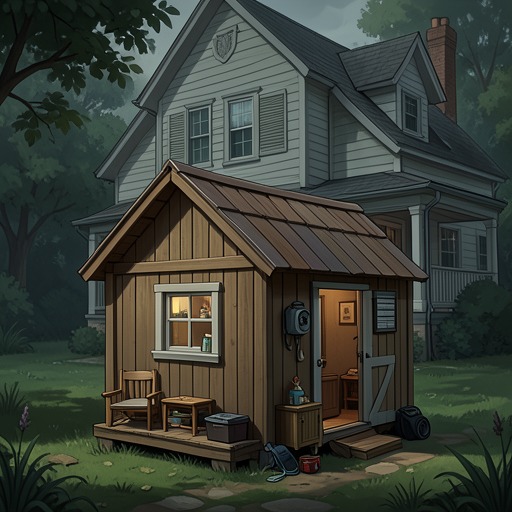
The Shrinking Man“Life in a Dollhouse” is the title of the last chapter Scott Carey writes and the name of a new, sharply limited domestic life: at ten inches tall, he moves into a dollhouse Louise Carey brings home for him. The house gives him walls, a bed, and a place apart from ordinary household traffic, yet its painted and hollow furnishings cannot supply the basic functions of a real home. Its careful resemblance to domestic life makes the difference between appearance and use impossible to ignore.
The title and its circumstances
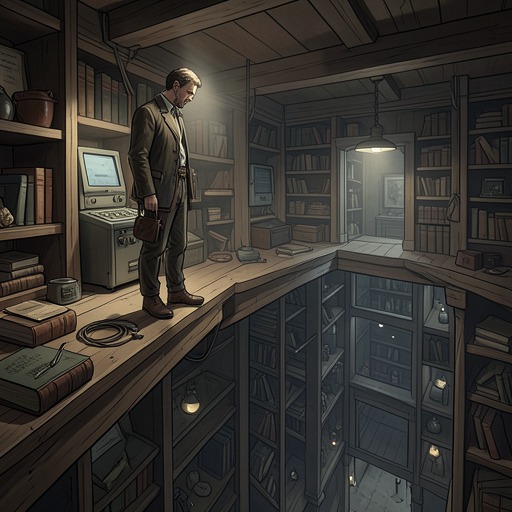
Scott had finished the chapter and realized he could write no more. Even the smallest pencil had become as large as a baseball bat. He considered getting a tape recorder, but before that could happen he was beyond communication. The narrative then turns to an earlier stage of his shrinking: he is ten inches tall when Louise arrives with the dollhouse. The title thus joins an act of writing that has reached its limit to the material arrangement that temporarily follows it.
Scott is resting on a cushion beneath the couch, where Beth Carey will not accidentally step on him. He crawls out as Louise sets down the house, and she kneels to bring her ear near his mouth. When he asks why she got it, she says softly that she thought he would like it. Scott is about to say that he does not like it at all, but looks at her profile and instead tells her it is very nice. The exchange makes the gift an act of care while also showing that his response is shaped by Louise’s consideration and by how difficult ordinary conversation has become.
A shelter made to measure
The house is deluxe, affordable because of the sales and resales of Scott’s book. He approaches it across the floor, climbs onto its porch, and rests his hand on the tiny wrought-iron railing. Standing there recalls the night he stood on the steps of Clarice's trailer. He opens the front door and enters a large living room with hardwood floors, fluffy white curtains, a window seat, candle brackets, and a fireplace made of false bricks. The room is attractive, but one wall is missing; from that open side Louise peers in with a gentle half-smile.
By noon, the furniture is in place. Scott has Louise push the house against the wall behind the couch, where it can offer both privacy and protection. Beth is under strict orders not to approach him, though the House cat sometimes gets inside and poses a danger. Louise also runs an extension cord into the house so Scott can use a small Christmas-tree bulb for light. In her enthusiasm, she had forgotten that he would need illumination; plumbing, by contrast, is impossible. The arrangement is therefore neither merely decorative nor fully independent: it is a protected space whose usefulness depends on the larger household and on Louise’s practical help.
Rooms without working functions
The miniature furnishings look like the equipment of a home but frustrate ordinary use. The chairs, including those in the living room, are straight-backed and cushionless; the bed has neither springs nor a mattress. Louise sews cotton padding into a piece of sheet so Scott can sleep on the hard bed. Even comfort has to be improvised around the scale and design of the objects.
The rest of the house sharpens the contrast between a thing’s appearance and its operation. The glossy grand piano has painted keys and a hollow interior. The refrigerator is all one piece, its door unavailable when Scott looks for a snack; the stove’s knobs turn, but it cannot meaningfully heat a pot of water. The tiny sink faucets produce no water, and clothes placed in the washer would remain dirty and dry. A fireplace can hold scraps of wood, but lighting them would smoke Scott out because the house has no chimney. Each object reproduces the outline of a domestic function while withholding the function itself. Scott can enter the rooms and handle their fittings, but the house cannot become a self-sufficient home.
Privacy, dependence, and the closing gesture
The dollhouse does provide walls behind which Scott can retreat, and Louise helps adapt it with a light and padding. At the same time, its safety is conditional: it must be positioned by the couch, Beth must keep away, and the House cat’s occasional entry turns the miniature rooms into a place of danger. The title’s idea of a life inside a dollhouse therefore includes both refuge and exposure. The house creates a separate interior, but it remains embedded in a much larger household whose inhabitants and movements determine what Scott can safely do.
Scott’s wedding ring, which he has been wearing on a string around his neck, eventually becomes too heavy. He carries it upstairs to the dollhouse bedroom, pulls open the bottom drawer of the little dresser, puts the ring inside, and shuts the drawer. The ring’s placement among the miniature furnishings brings the passage’s scale problem into intimate focus: an object once worn as part of ordinary life has become a burden to carry. The title names more than a small dwelling; it frames a home-shaped environment in which familiar possessions, comforts, and routines survive chiefly as forms that must be reassessed against Scott’s changing body.