Beth Carey
The Shrinking ManBeth Carey, the daughter of Scott Carey and Louise Carey, is central to the intimate cost of Scott’s shrinking. The change is not only that her father grows physically smaller: the difference in scale alters his authority, her understanding of who he is, and finally the practical safety of their contact. Through Beth, the story traces a painful division between a child’s inability to comprehend an inexplicable affliction and a father’s insistence that bodily change has not erased their bond.
Identity and Early Bond
Beth’s birth is remembered in unusually precise detail. After Louise’s long labor, Scott waits through the night, unable to settle himself; at seven-one in the morning, Elizabeth Louise is born. A doctor tells him he has a daughter, and Scott sees a dark-haired infant yawning in a nurse’s arms. His memory of brushing away tears makes the scene a measure of the tenderness that precedes their later estrangement. The full name Elizabeth Louise anchors the child Beth will become in this foundational memory of Scott’s fatherhood.
Scott later recalls that he sometimes held Beth on his lap to read her a story or stood beside her bed at night to look down at her. Those moments did not prevent the distance that followed. While doctors examined and hospitalized him, his illness consumed his attention; after he returned home, dread and the deterioration of his marriage further narrowed his capacity to notice what was changing between father and daughter. The separation began in circumstance and distraction before it became a difference of scale.
A Father Becoming Unrecognizable
As Scott shrinks, he becomes less sure of his authority and of Beth’s respect. The loss is gradual: he first reaches her height and then falls below it, while his voice loses its familiar depth and becomes high-pitched and ineffective. Scott understands that Beth has no experience that could help her make sense of a father who is literally changing. In her view, a father should remain constant and dependable; because Scott is changing, she cannot treat him as she did before.
The change is intensified by Scott’s temper. His nerves send him into outbursts, but Beth is too young to interpret them as expressions of an adult’s fear and frustration. She sees what is physically before her: a very small figure who screams and rants in a strange voice. Scott’s anguished declaration, “I’m still her father, damn it!” insists on a relationship that his altered body and behavior can no longer make self-evident to her. The line exposes the difference between his continuing sense of himself as her father and her increasingly bewildered response to him.
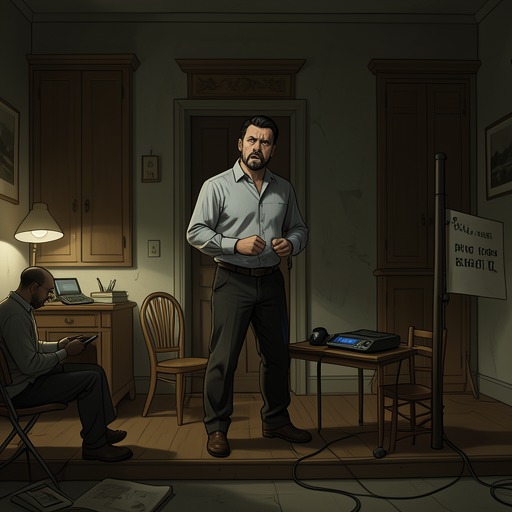
The repeated pattern of his outbursts makes the domestic conflict visible. Scott rushes to the cellar, leans against the refrigerator, and stands breathing hard with clenched teeth and hands. Meanwhile, clothes are altered for his smaller body, furniture becomes harder for him to manage, and the household’s financial worries grow. Beth and Louise appear larger to him as his own scale diminishes. The relationship is therefore altered inside a home where both material arrangements and family roles are shifting around Scott.
Secrecy, Scale, and Physical Risk
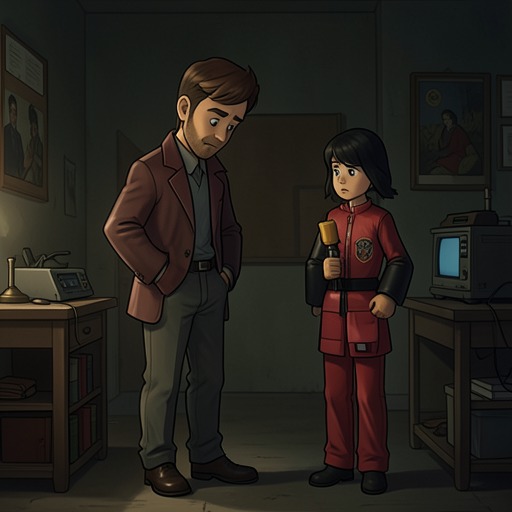
Beth is present during a strained supper when Scott begins to ask how the family will manage the cost of treatment. He stops when he notices her staring at him, her meal forgotten; Louise tells the child to eat. The moment shows Beth registering the distress around her without being given an explanation. Later, Louise tells her not to say a word about Daddy and asks her to repeat the instruction. Beth answers yes and nods. The exchange establishes that Scott’s presence has become something the adults manage in relation to her, while offering no evidence that Beth understands the circumstances behind the secrecy.
By the time Scott is small enough to be mistaken for something that can be picked up, the imbalance becomes dangerous. Beth takes hold of him with terrible force, apparently to make sure she will not drop him. Scott suffers pain in his rib cage and difficulty breathing, though he finds no broken bones. When he later sees Beth beside the immense figure of her uncle Marty, she offers to carry the small one. Her offer is a child’s practical response to the difference in scale, but it also recalls the danger of her strength relative to Scott’s fragile body. Nothing in these actions suggests that she intends harm; the threat lies in how completely ordinary handling has changed its consequences.
Estrangement and Narrative Significance
Scott distinguishes Beth’s separation from him from the clearer loss of his marriage. Their estrangement is harder to recognize because it unfolds while he is absorbed in illness, treatment, anxiety, and the failing relationship with Louise. He remembers affectionate acts, but also admits that he was often too occupied with his own condition to see the relationship slipping away. His retrospective account gives the loss a double cause: his shrinking changes how Beth perceives him, while his own preoccupation limits his awareness of her response.
Eventually, Scott concludes that the loss is irreparable and final in practical terms: Beth has become a physical menace to him, like the cat, and must be kept away. Louise reminds him that Beth did not mean to hurt him. Scott agrees that she does not understand, but insists that she must stay away because she does not realize how frail he is. His metaphor of being handled like an indestructible doll captures the cruel mismatch between Beth’s presumed idea of his vulnerability and the actual danger. Beth is not cast as a deliberate adversary; her significance lies in the way an innocent child can become perilous when a father’s body has crossed beyond the scale of ordinary family care. Through her, shrinking turns fatherhood from a stable social identity into a bond Scott still claims but can no longer safely enact.