Carey's cellar
The Shrinking ManCarey's cellar becomes Scott Carey’s world in miniature, but never a world scaled to him: as he shrinks, the ordinary room grows into a hazardous terrain of cliffs, towers, deserts, and inaccessible stores. Its familiar household contents offer shelter and the possibility of survival, yet the same objects impose distances and dangers he can scarcely overcome. The cellar’s defining force is this double transformation: it remains a domestic room to the people who enter it at normal size, while for Scott it becomes an immense, isolating landscape.
Setting and Physical Layout
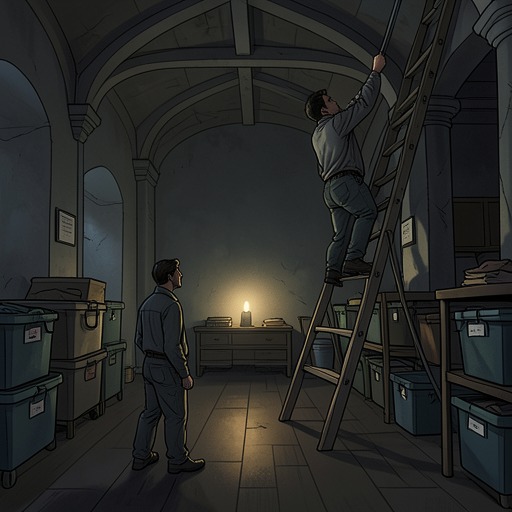
Carey's cellar is a concrete-floored room beneath the house, with closed doors at the top of steps and grime-streaked windows that admit the last daylight. Its contents include a log pile, a fuel-oil tank, an oil burner, a garden hose, croquet equipment, paint cans, and two wooden lawn chairs stacked together. A clothes tree stands near the water heater, and an electric pump and tank occupy another part of the room. These are not distant features in an expansive wilderness but household fixtures packed into a cellar whose boundaries Scott cannot easily cross.
The objects acquire a second, bodily scale in his experience. The oil burner becomes a tower; the coiled hose resembles a sleeping serpent; the wall beside the burner rises like a cliff; and the sand on the floor forms a desert through which a Black widow spider hunts. The lawn chairs make an immense orange structure, while a wicket caught in a groove on the upper chair is an object Scott once tried and failed to seize while fleeing. The room’s arrangement therefore records more than its furnishings: it determines routes, obstacles, refuges, and missed chances.
Scale, Perception, and Threat
The cellar’s apparent enormity is tied to Scott’s changing body. He recognizes that the hose and burner are household objects, but at his scale their ordinary identities cannot cancel their physical effects. His shrinking makes the room feel as if it is enlarging, and hours themselves seem magnified for someone smaller. The cellar thus becomes a setting where perspective is not merely a way of describing reality; it is a condition of survival. What counts as a nearby fixture or a manageable stretch of floor depends on the body trying to cross it.
Threats emerge from that mismatch. The Black widow spider, initially small in ordinary terms, is nearly as tall as Scott and moves across a wall that functions like a sheer face. Scott has to take refuge in the narrow, splinter-edged passage between logs while it is near. When the scratching stops, he backs out cautiously, sees the spider climbing toward the edge, and only then begins to return to his sleeping place. A sudden visit by a giant descending the cellar steps creates a different shock: the approaching shoes rise above Scott’s head and strike the floor with enough force to shake it. The cellar is therefore dangerous both when its inhabitants are small enough to hunt him and when a person of ordinary size enters it.
Water, Food, and Shelter
The cellar contains water, but only because Scott finds a way to collect a leak. A tank beside the electric pump drips into a Thimble he has carried from a sewing box stored in a cardboard carton beneath the fuel-oil tank. The tiny vessel overflows with well water, turning an inconspicuous leak into a dependable source of drinking water. That supply does not solve the more urgent problem of food. Scott has lived on a quarter loaf of stale bread for five weeks; when he eats the last crunchy scraps, the only food he knows remains is an open box of crackers on top of the Refrigerator.
The food is visible but not yet attainable. Scott had left the cracker box there before he became trapped, and he now studies the Refrigerator’s sheer side, trying to work out how to climb to it. The bulb offers another example of need made unreachable: the pull-string hangs, from his perspective, a hundred feet overhead. As daylight fades through the cellar windows, broad gray bars of light fall across the concrete, and the room becomes a cold, dark pit. His sleeping place is beneath the Water heater, whose warmth offers limited protection; when the electric pump starts, its wheezing and sighing make the nearby machinery seem alive. Shelter, light, water, and food all depend on Scott’s ability to use objects designed for someone vastly larger.
Imprisonment and Narrative Significance
Carey's cellar is not simply a refuge from the outside world. Scott has been imprisoned there, and its closed door repeatedly marks the boundary between effort and escape. After a prolonged attempt through tunnels and over heaps of rocks, he emerges from a cave to find the door shut and the room otherwise restored to its familiar arrangement. The failed escape leaves him weak and in pain; even the few drops left in the overturned Thimble must be sucked from its cup-like indentations. The ordinary room does not register his struggle, but its scale converts exhaustion and minor accidents into bodily crises.
The confinement continues long enough for injury and shrinking to compound one another. After nearly three months in the cellar, Scott wakes beneath the Water heater with a scraped, dry throat, a lacerated temple, a painful back, and a swollen, throbbing knee. He calculates that three days remain before the end he anticipates, as his shrinking approaches disappearance. The cellar makes that abstract prospect concrete: its distances keep increasing in practical difficulty even while its walls and furnishings stay physically unchanged. In this setting, the home’s familiar contents become an indifferent environment, and survival depends on reading their scale anew, finding water and shelter among them, and continuing to face a door that remains shut.