Christmas Season
The Shrinking ManChristmas Season is the setting for one of Scott Carey’s most precarious encounters with the ordinary world. Beneath the Christmas tree, an artificial stable and its nativity figures briefly seem alive to him; outside it, wind, snow, and the animals of the household make the familiar home a place of immediate danger. The season’s images of shelter and domestic warmth sharpen the contrast with Scott’s exposure, culminating in his forced return to the cellar and the family’s search for him.
The Nativity Beneath the Tree
Scott stands stooped in a hay-strewn stable, looking at Mary, Joseph, and the Wise Men gathered around the infant Jesus. In the quiet, the figures seem almost alive: Mary appears to smile, the Wise Men to waver in reverence, and the infant’s faint gurgling joins the sounds and smells of the stable. The scene offers a moment of imaginative stillness, but it is fragile. A cold wind passes over Scott and makes him shudder, breaking the apparent warmth of the miniature tableau.
The holiday setting is materially present as well as imagined. Scott’s tiny homemade shoes crunch across the artificial snow beneath the Christmas tree, while a draft blows powdery snowflakes across the kitchen floor through a door left slightly open. He waits for Louise Carey to shut it, then hears that she is taking a shower. The domestic scene is not arranged around his needs: Beth Carey is outside playing, Louise is elsewhere in the house, and the open door leaves Scott to face the cold himself.
From the House to the Snow
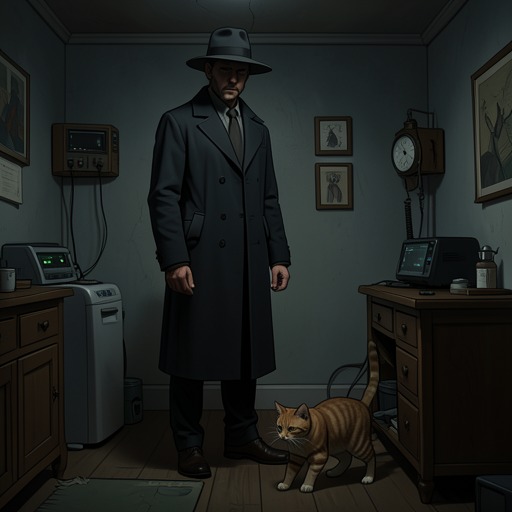
Scott runs toward the kitchen door, hoping he can close it. Before reaching it, he hears a rumble and turns to see the House cat by the sink, its coat wet and disheveled after drinking from a dish of milk. Scott tells it to leave, first quietly and then more loudly; the cat growls and slides a clawed paw toward him. With the icy draft at his back and snowflakes striking him, Scott backs away from the animal and is driven into an increasingly desperate struggle for safety.
He kicks and pounds at the door, calling for Beth Carey, but cannot get inside. The storm outside is no manageable inconvenience at his scale: the yard is buried in snow, the trees rise like enormous white columns, and the fence becomes a barrier of exposed pickets under the wind. Scott recognizes that prolonged exposure could freeze him to death. Yet returning to the house is not straightforward. The cellar windows are locked from the inside, its doors are too heavy for him to lift, and shelter beneath the porch would be no warmer. He considers climbing the front-porch railing to reach the bell, but hesitates at the sight of the deep snow.
The Sparrow and the Forced Return
Scott’s attempt to move through the snow becomes a repeated contest with the Sparrow. When it dives at him, he falls to his knees and flings snow into its eyes, buying only enough time to struggle forward a few more inches. It attacks again, beating wet wings against his head; Scott strikes at its beak and drives it off briefly, then must repeat the defense. The actions that might be trivial at ordinary scale—throwing snow, turning, advancing a few inches—become the measures of his survival.
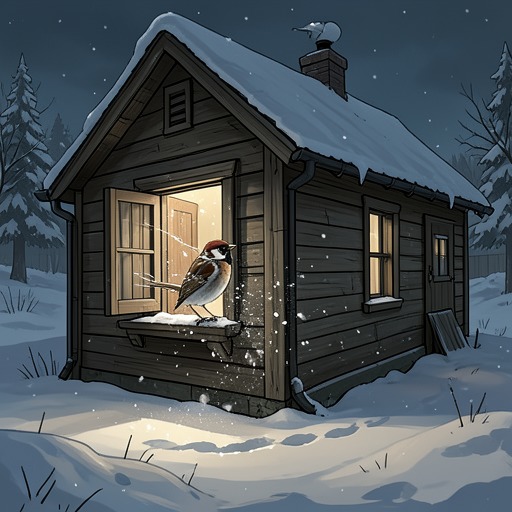
At last Scott reaches the cellar window, still trying to make the Sparrow give up rather than jump back into the cellar that has imprisoned him. The bird continues to dive. Its beak strikes his skull, slashes his skin, and knocks him against the house; disoriented, Scott misses when he throws snow. With the attack still beating at his face, he turns and leaps through the open window. He lands on the sand below, twisting his leg so badly that it will not support his weight. The cellar is shelter from the bird and storm, but it is also the confinement he had been trying to avoid: the choice that saves him from the immediate attack returns him to the place of imprisonment.
Family Search and Seasonal Contrast
Ten minutes later, Scott hears footsteps above him as the back door opens and shuts. Louise Carey and Beth Carey walk around the house and through the snow-covered yard, calling his name repeatedly. They continue after darkness falls, while Scott lies injured below the cellar window. The Christmas setting thus closes not with the nativity scene’s apparent calm but with separation: the family is searching overhead, unable to find him, and Scott remains trapped and hurt beneath the winter landscape.
The episode’s seasonal imagery works through contrast rather than comfort. Artificial snow under the tree first belongs to a miniature holiday scene; real snow outside becomes a vast terrain that can freeze Scott and conceal him from his family. The nativity’s still figures, the open kitchen door, the cat’s predatory advance, and the Sparrow’s repeated dives trace a sharp shift from quiet spectacle to bodily danger. Christmas Season makes the house recognizable as home while showing how little that familiarity can protect someone whose size has made ordinary spaces and creatures overwhelming.