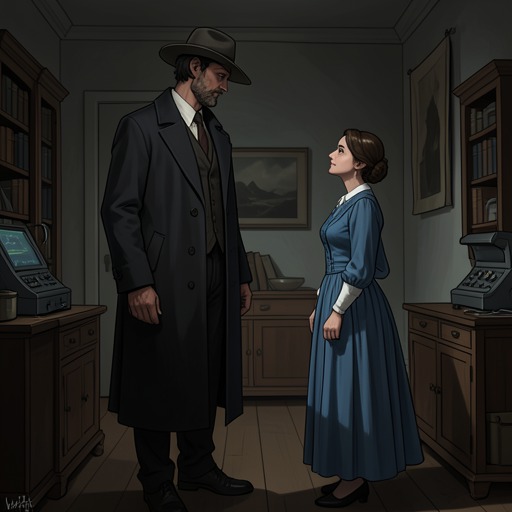
Clarice's trailer
The Shrinking ManClarice's trailer is a small carnival dwelling where Scott Carey briefly encounters a world arranged at a scale he can inhabit. Its chairs, couch, tables, and lamps offer a striking contrast to the oversized environment that has made ordinary domestic life inaccessible to him. The trailer becomes both a physical refuge and the setting for an intimate connection with Clarice, but the comfort it affords also intensifies Scott's uncertainty about leaving Louise Carey.
Setting and Scale
The trailer stands behind a tent. When a man calls after Scott, Scott runs to hide behind one of its thick-tired wheels, crouching and peering around the edge. The man appears at the tent corner about fifteen yards away, looks around with his fists on his hips, grunts, and leaves. Scott steps out of the trailer's shadow, then pauses when he hears singing overhead.
The voice comes from a white-curtained window glowing with light. Scott listens to Clarice singing, “If I loved you,” and stays beside the trailer until the song ends, even as screams from the Loop-the-Loop interrupt his reverie. He walks around the trailer, looking up at its windows and wondering why he feels drawn to the voice. The scene makes the trailer a place he approaches first through sound: before he knows who is inside, its song has already pulled him away from the carnival's other commotion.
Entry and Recognition
The trailer's steps and door are almost exactly the right height for Scott. He grips the waist-high railing, climbs slowly, and stops before the door. Painted words beneath the window are too difficult for him to read from outside. His bodily response is immediate: the scene describes strange, electric pricklings across his skin as he moves up the final steps and stands at the entrance.
Inside, the furniture changes the meaning of his altered size. Scott sees chairs and a couch he could sit on without being engulfed, tables he could stand beside and reach across rather than walk under, and lamps he could switch on and off instead of standing futilely beneath them. He recognizes the room as a place in which ordinary actions might again be possible. Clarice enters and finds him there; when they look at one another, he explains that he heard her singing. She invites him in, and he steps inside without hesitation.
The sign on the door identifies the trailer as “Mrs. Tom Thumb.” That name gives the dwelling a public label, but for Scott its immediate significance is private and practical: its interior offers furniture scaled so that he can use it. The contrast is not that Scott has regained his former size, but that the room briefly makes his present body less disabling. The trailer's domestic objects, rather than any change in him, allow him to sit, reach, and move among them.
A Shared Interior
Clarice's welcome turns the room from a hiding place into a shared one. She closes the door and tells Scott that his arrival surprised her. Their first exchange gives way to physical tenderness: she steps close and lays her cheek against his, and he puts his arms around her. They cling to each other in silence, both crying. Scott's longing to be a man again is tied directly to the act of holding her; Clarice answers that she wants him to hold her and says it has been a long time.
After a few minutes, Clarice leads him to the couch. They sit holding hands and smiling at one another. The couch that Scott had imagined as something he could use becomes the center of an encounter in which he is not merely measuring furniture against his body. Clarice says she feels close to him despite never having seen him before. Scott attributes their closeness to their shared pity. The room's scale permits ordinary contact, while their recognition of a shared condition gives that contact an emotional basis.
The trailer offers no solution to Scott's shrinking, and the scene does not present their intimacy as a settled future. Instead, the room holds a temporary possibility: a place where Scott can be physically near another person and where his body does not make every piece of furniture an obstacle. Its comfort is inseparable from the pressures beyond it, including his marriage and the possibility of leaving Clarice.
Departure and Afterimage
Scott asks Clarice to wait for him, squeezing her hand until she winces. After she promises that she will, she runs down the trailer steps. Scott remains inside, listening to the faint clacking of her high heels, then walks around the small room and touches its furniture. The sequence shifts from their shared closeness to his solitary attention to the objects that made the room feel habitable. Their departure does not erase the experience; the furniture remains within reach, but Clarice is gone.
He goes into the other room, hesitates, sits on her bed, and picks up her yellow silk robe. He feels its smooth fabric and smells her scent, then buries his face in its folds. The robe makes Clarice's absence tangible in the very room that had offered Scott a sense of welcome. His attention turns from the intimacy he has just experienced to the question of why he asked her to wait.
Thinking of Louise, Scott believes there is nothing left between them and wonders whether he could simply stay with Clarice. He assumes Louise would be glad to be rid of him, but this is his own conjecture, not a decision established between them in the trailer. The room therefore marks a point of emotional conflict rather than a resolution: it gives Scott a compelling alternative to his marriage, while his thoughts reveal how uncertain and self-justifying that alternative remains.
Narrative Significance
The trailer's importance comes from the conjunction of physical fit and emotional exposure. At first, its wheel gives Scott cover from a searching man; the singing draws him from that shadow toward the lit window, and the steps lead him into a room where he can finally use domestic objects without being overwhelmed by them. Each change in his relation to the space accompanies a change in his situation, from concealment to attention, then welcome and intimacy, and finally solitude.
The episode also makes the trailer's scale relative rather than absolute. Its furnishings are not presented as having changed; Scott's experience of them changes because they are accessible to him. That temporary accommodation allows tenderness but cannot settle the larger choices pressing on him. After Clarice leaves, the furniture and robe preserve the pull of the encounter, while Scott's thoughts return him to the unresolved distance between himself and Louise.