Disappearance into Nothingness
The Shrinking ManDisappearance into Nothingness is the name for the fate Scott Carey anticipates as his progressive shrinking approaches zero inches: an end not by death, but by disappearance. Its force comes from a double impossibility. Scott believes the process can be measured with exact regularity, yet he cannot imagine what it would mean for reality to continue at a scale where he no longer exists. The concept turns shrinking from a bodily condition into a limit on what he can know, and makes his continued efforts to live both apparently irrational and impossible to abandon.
Definition and Scale
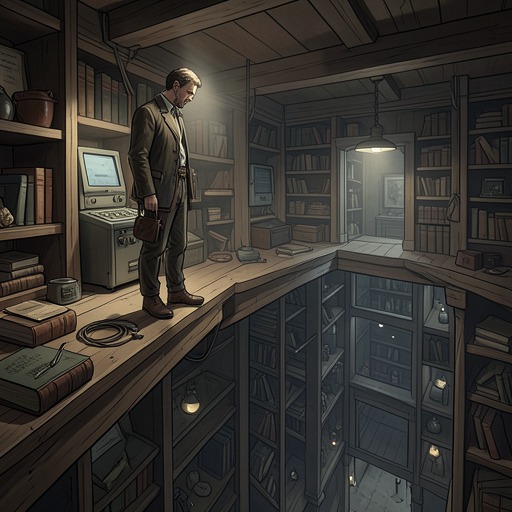
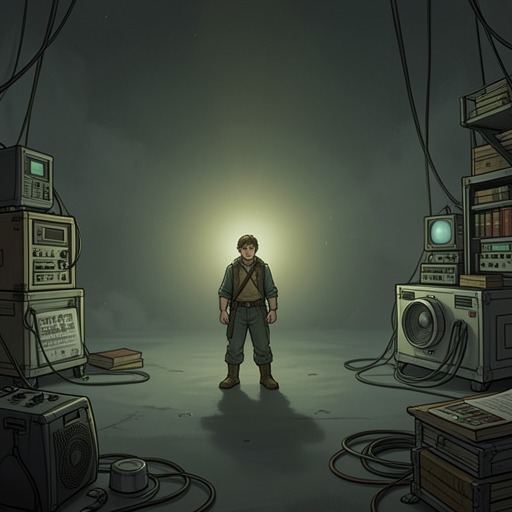
Scott’s sense of disappearance arises from a change in scale that unsettles the distinction between himself and the world around him. He recognizes that he is susceptible to illusions: sometimes it seems that he is not shrinking and the world is growing; sometimes it seems that objects are what ordinary observers think them to be only when viewed by someone of ordinary size. These impressions do not erase the physical process, but they reveal how profoundly shrinking has altered his access to reality. The oil burner appears as a tower with a roaring flame in its depths, its hose as a sleeping viper, and the three-quarter wall as a cliff. Even the sand becomes a hostile landscape, with a spider transformed in his perception into a monster nearly as tall as he is.
Against these shifts in perspective, Scott arrives at the idea that reality is relative. His body’s diminishing makes ordinary measures seem less like universal truths than human conventions. Inches can describe the process as it affects him, but the idea of reaching zero inches exposes the limits of that description: he can picture a smaller body, but cannot establish what reality would be for him after its disappearance. The approaching endpoint is therefore not merely a final measurement. It is the point at which his own way of measuring and experiencing the world can no longer supply an answer.
The Countdown and Its Certainty
The prospect acquires urgency because Scott does not regard the shrinking as an unpredictable danger that might simply stop. He recalls that it has never faltered: he has lost a seventh of an inch every day, with the consistency of clockwork. The regularity lets him construct a mathematical account of his descent, but that apparent precision offers no reassurance. Instead, it makes the deadline harder to evade. He calculates that in six days his reality will be blotted out, and elsewhere dreads what will happen between Saturday night and Sunday morning. The countdown gives an otherwise unimaginable end a near and specific horizon.
That certainty bears directly on his attempts to escape the cellar. While building a route upward from stones, bark, and a piece of straw, Scott realizes that the effort may be futile if he is already doomed to vanish within days. The question unsettles him because his work depends on behaving as though a future remains possible, while his arithmetic seems to deny that possibility. He cannot find evidence that the process will stop: its one-seventh-inch daily rhythm has held throughout. Yet he also recognizes that dwelling on the endpoint weakens him. As despair rises, he deliberately turns back to the practical work, trying to lose himself in the task rather than let the thought finish him before the shrinking does.
Difference from Death
Scott’s fear of disappearance is sharpened by his inability to understand it as he understands death. After gathering cracker pieces and marking the passage of days, he reaches a blank in his mental calendar: after Saturday, nothing. In the darkness he compares the fate to death but finds it worse, because death remains a concept and, however unknown, belongs to life. He has no comparable human precedent for shrinking into nothingness. The problem is not only that he expects an end; it is that the expected end seems to fall outside the categories through which he could prepare for or comprehend one.
This distinction gives the idea its existential pressure without making it abstract from Scott’s circumstances. The anticipated disappearance accompanies immediate shortages and dangers: food will run out, reaching water will grow harder, his clothes will need further alteration, and escape from the cellar remains out of reach. Even if the Black widow spider does not attack again, it may still be waiting near the water heater. The future limit and the present threats press on him at once. His fear of what will happen by Sunday is bound to the everyday labor of staying alive before then.
Persistence and the Meaning of Survival
Scott’s response does not resolve the contradiction between his expectation of disappearance and his behavior. After the spider retreats, he is briefly overcome by relief and exhaustion, but the knowledge that it is still alive soon undermines his sense of safety. He wonders what he has achieved when he cannot carry the pin everywhere, may soon be unable to carry it at all, and still faces the loss of food and water. The episode forces the larger question of whether survival is merely instinctive or whether it makes him a separate, meaningful person. His continued struggle cannot prove that the disappearance will not occur; it shows instead that the prospect has not extinguished his capacity to act.
The same conflict shapes his conduct on the makeshift climbing structure. Scott sees that the work is dangerous and that a delay could leave him stranded, but he refuses to admit an alternative to escape. When the possibility of impending nothingness makes the effort seem pointless, he treats the thought itself as dangerous and returns to the work. His actions do not rest on a demonstrated belief that the shrinking will cease. They arise alongside his recognition that it has been constant, and expose a gap between what he can calculate and what he can bring himself to surrender.
The concept also gathers meaning from Scott’s isolation. In his shelter he longs to tell someone what he feels and imagines the comfort of seeing or touching Louise Carey, even without her knowing he is there. He is alone with an end that cannot be communicated through an established human experience. Earlier, becoming a newspaper spectacle had driven him into fury and prompted him to break his contract; public attention could make his shrinking visible to others, but it could not make his eventual disappearance intelligible. Disappearance into Nothingness thus names both a physical limit and a crisis of recognition: Scott faces an ending for which he can find no precedent, while continuing to insist, through the small tasks of survival, on the significance of being here now.