Dollhouse
The Shrinking ManThe Dollhouse is a miniature home given to Scott Carey when he is ten inches tall, at a point when his shrinking has made ordinary communication and writing nearly impossible. It offers a measure of shelter and privacy, but its false domestic comforts expose the widening gap between a scaled-down representation of life and the bodily needs it cannot meet. Within its rooms, Scott finds a place to live, a setting for his daughter’s visit, and finally a drawer in which he puts away his wedding ring.
Acquisition and design
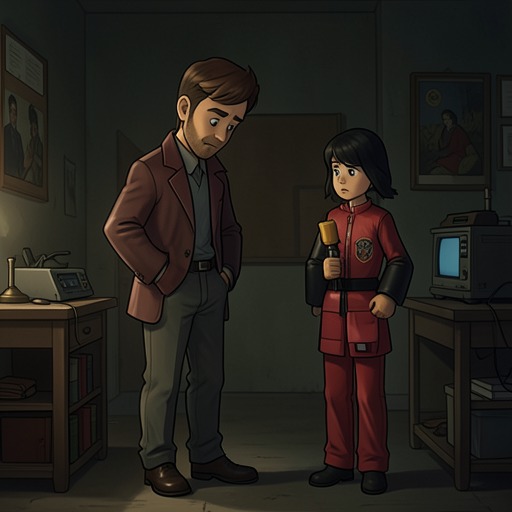
The house arrives as the subject of the last chapter Scott Carey can write, titled “Life in a Dollhouse.” Even the smallest pencil has become as large as a baseball bat; he considers using a tape recorder, but before he can do so he will be beyond communication. In the meantime, Louise Carey brings him a giant dollhouse. He has been resting beneath the couch, where Beth Carey will not accidentally step on him. When Louise sets the house down, he crawls out to look at it. She kneels and brings her ear near his mouth to hear him, then answers softly because a louder voice would hurt his ears. Though he is about to say that he does not like the gift, he studies her profile and tells her it is very nice.
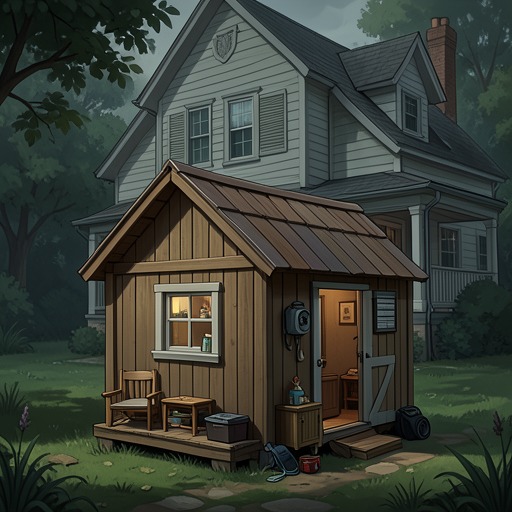
The house is deluxe, purchased with money from the sales and resales of Scott’s book. Its miniature living room has hardwood floors, fluffy white curtains, a window seat, candle brackets, and a fireplace made of false bricks. It is attractive, but one wall is missing, leaving the room open to Louise’s view. When she asks whether he likes it, he turns back toward the room rather than offering an immediate answer. The open side makes visible an imbalance built into the gift: Louise can look into his new home, while he is its tiny occupant.
A dwelling scaled against its inhabitant
Scott walks onto the porch and rests a hand on its tiny wrought-iron railing. The sensation recalls the night he stood on the steps of Clarice’s trailer, linking the doll-sized threshold to an earlier encounter with a place scaled for a person outside ordinary proportions. He pushes open the front door, enters, and closes it behind him. Though the room is large by dollhouse standards, its missing wall initially leaves him exposed to the people watching from outside.
Louise goes to fetch the furniture from the car. Scott hears and feels her cross the full-sized living-room floor, its tremor passing through the surface beneath him; the outer door thuds shut after she leaves. By noon the furnishings are in place. He has Louise push the house against the wall behind the couch, using the surrounding room to give himself both privacy and protection. The gesture adapts the toy’s open architecture to his needs: what the dollhouse itself cannot enclose, the full-sized wall helps supply.
The arrangement remains precarious. Beth is under strict orders not to approach Scott, but the cat sometimes gets into the house, turning the miniature home into a place of danger. Louise runs an extension cord inside so Scott can use a small Christmas-tree bulb for light; she had not initially remembered that he would need illumination. Plumbing, which he would also have liked, is impossible. Privacy, protection, light, and water thus depend on improvised arrangements or remain incomplete, rather than arriving as functions naturally provided by the house.
Domestic appearance and material limits
Scott moves into the Dollhouse, but its furniture is designed to look domestic rather than to support a person living there. Even the living-room chairs are straight-backed and uncomfortable because they have no cushions. The bed has neither springs nor mattress, so Louise sews cotton padding into a piece of sheet for him to sleep on. The adjustment makes the hard bed usable, but only through work performed outside the miniature object’s design.
Other furnishings are similarly convincing at a glance and useless in practice. The glossy grand piano has painted-on keys and a hollow interior. The refrigerator is a single solid piece, so Scott cannot open it to find food. The stove knobs turn, but the stove cannot properly heat a pot of water. He can twist the sink faucets without producing a drop, and clothes placed in the little washer would remain dirty and dry. The fireplace presents another domestic promise without the means to fulfill it: burning scraps of wood would smoke him out because there is no chimney. Each object preserves the appearance of an ordinary household action while withholding the mechanism that would make that action possible.
These failures make the Dollhouse more than a convenient miniature shelter. Its furnishings repeatedly bring Scott up against the difference between an image of a home and a functioning home. The surrounding full-sized world supplies the vulnerabilities—noise, vibration, and the cat—that its delicate rooms cannot control; the miniature appliances, meanwhile, reproduce ordinary domestic life without providing its necessities. Its value is real but limited: it can offer a bounded place to sleep and withdraw, not a self-sufficient household.
The ring and the final domestic scene
One night, Scott takes off his wedding ring, which he has been wearing on a string around his neck. It has become too heavy, like carrying a great gold loop. He carries it upstairs in the Dollhouse, pulls open the bottom drawer of the little dresser, places the ring inside, and shuts the drawer. The house thereby becomes the container for an object whose weight has become physically burdensome and whose meaning has become decisive. Scott thinks of the ring as the roots of his marriage, now pulled up and lying still and dead in the drawer; by putting it away, he formally ends the marriage.
The Dollhouse also becomes the setting for a small, uneasy encounter with Beth’s doll. Beth has left the doll on the porch, and Scott ignores it through the day. On an impulse, he goes downstairs, picks it up from the top step, and asks whether it is cold. The doll, dressed in a blue sunsuit, cannot answer. He carries it upstairs and lays it on the bed; when its eyes fall shut, he tells it not to go to sleep and bends its body so it will sit upright. Its hard, inflexible legs and unblinking, jewel-like eyes repeat the dollhouse’s contrast between human domestic gestures and inert objects. Scott can furnish a room, sleep in it with Louise’s help, and place a doll on its bed, but the miniature world cannot restore the ordinary reciprocity or practical ease those gestures suggest.