Lawn chair
The Shrinking ManThe Lawn chair is a household object transformed by Scott Carey’s shrinking into a major feature of the cellar’s terrain. Leaning against the wall, the chairs rise to a daunting height; their boards and slats become a potential route upward, but reaching them requires tools, planning, and repeated adjustments. The climb makes the chair both an obstacle and a structure that Scott can learn to use, showing how radically the practical meaning of an ordinary object changes with his scale.
Position in the Cellar
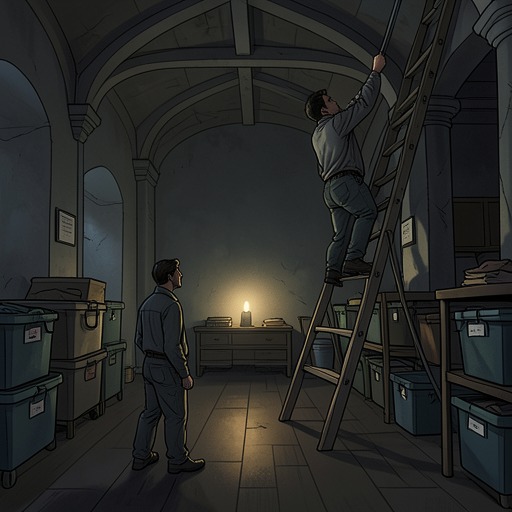
The lawn chairs belong to a crowded cellar landscape of furniture, boxes, and household equipment. From Scott’s diminished perspective, the surrounding objects no longer function at their ordinary scale: even a twelve-inch step elsewhere in the cellar seems equivalent to a 150-foot descent for a normally sized man. Against that enlarged world, the chairs lean beside the wall like a high ascent rather than a place to sit. Their height first registers as a challenge, not an immediately usable path.
The chair is also one possibility within a wider landscape of possible routes. When considering how to reach the top of the refrigerator, Scott surveys several alternatives: a route involving the fuel-oil tank, boxes, Louise Carey’s suitcase, and a hanging rope; another using a red table and cartons; or a wicker table and the rope. This inventory establishes the cellar as a field of difficult but potentially useful connections. The lawn chairs have a different importance in the later climb: they provide a structure against which Scott can work his way upward toward the chair arm and the wall.
From Furniture to Climbing Apparatus
Scott approaches the ascent as a problem of equipment as well as strength. He recognizes that the wall is too difficult to climb unaided and reasons that, since it is a cliff to him, he must think like a mountaineer. Cleated shoes and alpenstocks are impractical at his size, but he sees a workable substitute in a bent pin fashioned into a hook and attached to a long thread. He plans to cast the hook through openings in the chairs and climb the thread when it catches. The chair’s open construction, initially part of its formidable scale, can therefore also provide places to anchor his improvised gear.
The plan does not erase the danger or difficulty. Looking up at the chairs as they tower against the wall, Scott doubts whether he can climb so high. From his position, the chair arm is about fifty feet above him, and there is no suitable place to catch the hook at that level. He must therefore go up the back of the chair instead. The dimensions and arrangement of the structure dictate the method: the hook is useful only where a slat offers something to catch, so progress depends on finding and reaching each available support.
The Climb and Its Changing Route
The chair’s parts form a sequence of distinct challenges. A shelf beneath the seat slopes downward alongside it and nearly touches the floor. Scott can catch the hook on one of its lower slats, then climb the shelf as if ascending a moderately steep incline, using the hook and thread to bridge the gaps between slats. The difficult transition is the vertical climb from that sloping shelf to the seat. Once there, he has gained height, but the chair’s back still rises above him.
Scott adapts his technique rather than relying on a single uninterrupted climb. After jumping over to retrieve the spear, he lands on his good leg and pulls in the thread and hook. He then maneuvers across the sloping seat of the orange chair until he reaches its back, where he pauses and studies the next section. A croquet wicket protrudes above him and offers another possible point of support. After resting and taking a little water, he prepares to climb toward the arm of the upper chair. Its back consists of three boards joined by bracing slats; he intends to throw the hook over one slat, climb to it, and repeat the process with the next. The chair’s construction becomes a ladder only through this patient, incremental use.
Narrative Significance
The Lawn chair’s importance lies in the contrast between its familiar identity and Scott’s practical experience of it. To an ordinary observer it is furniture; to Scott it is a high structure whose shelf, seat, back, and bracing slats determine what he can attempt. The object does not change, but its affordances do: its height blocks a direct ascent, its openings invite a hook, and its sloping surfaces offer a partial route. Each feature matters only in relation to Scott’s body, available equipment, and immediate goal.
The climb also makes ingenuity visible without making it a simple triumph of will. Scott must recognize the limits of unaided climbing, devise apparatus, assess the chair’s geometry, and revise his route when the hook cannot be used at the chair arm. The lawn chairs thus give material form to the book’s shifting scale: a domestic furnishing becomes a cliff, then a system of shelves and supports that can be negotiated one section at a time. The available evidence follows him onto the chair and toward its upper arm; it does not establish that this ascent by itself completes his escape.