Louise Carey
The Shrinking ManLouise Carey is Scott Carey’s wife and Beth Carey’s mother, a central figure in the family life that Scott’s progressive shrinking steadily disrupts. She responds to his illness with concern and practical care, but the crisis also exposes how much their marriage and household depend on his health, work, and physical presence. As those foundations fail, Louise must adjust the family’s plans while Scott struggles to understand what place he can still occupy in her world.
Identity and Family Life
Louise is introduced through her relationships with Scott and their daughter, Beth. At the beginning of Scott’s illness, he thinks of Louise and Beth as his family, yet fears that his shrinking may eventually remove him from their sphere: at a size Beth could accidentally crush, he wonders whether he can still belong to their world. This is Scott’s fear rather than evidence that Louise has ceased to regard him as her husband, but it establishes the bodily separation that comes to shape their family life.
Their earlier household plans had been organized around security. Scott had intended to work for his brother Marty, seek a veterans’ loan to become a business partner, and build up insurance, savings, a car, and eventually a house for the family. Louise is part of this projected future, which the illness threatens to undo. The collapse is not only emotional: Scott worries that hospitalization will take him away from work for at least a month and that the cost will add to the strain on the household. Louise insists that his health comes first, while he sees every bill as another burden. Their disagreement registers different responses to the same danger—her effort to prioritize treatment, his fear that the family’s material security cannot survive it.
Illness and the Strain on the Marriage
Louise’s dread develops alongside the medical uncertainty. When Scott’s first examination considers explanations such as weight loss after travel and a new environment, his doctor initially sets aside the possibility that he is losing height. The uncertainty continues through repeat visits, X-rays, blood tests, a bone survey, and investigations for bone loss, a pituitary tumor, and cancer. Louise has been living with the accumulating suspicion for weeks when the possibility of a shrinking condition is finally spoken aloud. Her first response is to resist the conclusion: she tells Scott that the doctor could be wrong, though the evidence in the X-rays makes it difficult for him to dismiss.
The medical process also becomes a point of marital conflict. Scott leaves before testing is complete, and Louise reminds him that the doctors said the investigation might take months. He counters that he is tired of tests and feels treated as an object of fascination; he lists procedures ranging from metabolic and protein tests to radioactive substances, X-rays, blood cultures, and repeated monitoring. He also objects to the expense and says that the doctors have found no cause. Louise’s position does not erase his experience, but their exchange shows how the illness divides them over the meaning of continued treatment: for her, the unfinished investigation leaves open a possibility of help; for him, it extends an exhausting ordeal without an answer. Later, ACTH proves ineffective, further underscoring the failure of attempted medical intervention to halt the process.
The physical change also alters the ordinary signs through which the couple recognizes one another. Scott’s wedding ring has become too loose as his finger thins, and he has taken it off nearly two weeks before a moment of renewed affection between them. He notices Louise’s hand on his cheek and wonders whether her gentle manner reflects a changed perception of him. That uncertainty sits beside the fact of their continuing closeness: after he tells her when he removed the ring, she responds with affection, and they share a night of intimacy and temporary peace. The scene offers a reprieve, not a cure; its importance lies in showing that tenderness remains possible even as Scott fears that his shrinking has changed the terms of their relationship.
Work, Care, and Changing Household Roles
When the summer ends, the young woman who had worked at the lake grocery store returns to school, and Louise takes the opening she had applied for a month earlier. She had vaguely expected Scott to look after Beth while she worked, but his reduced size and his refusal to try make clear that he cannot take on that responsibility. Louise arranges for a neighborhood girl who has left high school to care for Beth. She recognizes that paying for childcare will leave the family with little money, but sees no alternative. The decision shows her converting a deteriorating domestic situation into a workable arrangement, even as Scott withdraws from the role she had expected him to fill.
The family’s adjustments are painful for Scott. He objects to being treated as a boy and insists that he is still Beth’s father; Louise’s efforts to explain the situation to Beth cannot make the unprecedented change comprehensible to her. Scott’s physical authority has diminished along with his height and the depth of his voice, and he experiences Beth’s waning respect as a loss of fatherhood. His account of that change is not simply a record of Louise’s conduct: it reveals how the illness transforms relationships through visible difference, while placing the burden of managing daily care increasingly on her.
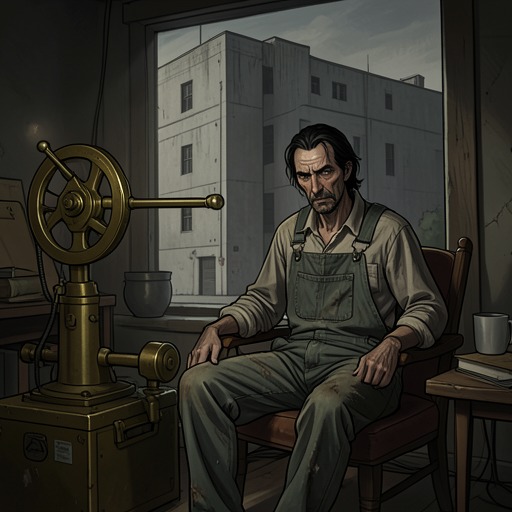
Louise also becomes the person who carries out a daily routine of care under increasingly isolating conditions. Scott is left in the cellar with food and coffee while she goes upstairs, and the door is locked behind her. He experiences the lock as imprisonment and imagines himself a secret the family must hide. That experience is focalized through Scott, but it marks the material limits surrounding Louise’s choices as well: she has work and a child to care for, while Scott’s smallness makes ordinary supervision and inclusion difficult. The routine turns separation into something repeated—food left behind, a farewell, the door closing—rather than a single decision to abandon him.
Separation, Attachment, and Permission
Even amid that distance, Scott continues to understand his bond with Louise as real. In the cellar, after considering a life reduced to immediate survival, he recognizes that he still loves her. For him, love becomes a measure of attachment independent of what either person can provide. This insight contrasts with his earlier emphasis on the family’s financial structure and his fear that his diminished body has made him useless within it.
The contrast sharpens when Scott tells Louise that he wants to spend a night with Clarice. He argues that his shrinking has left him increasingly isolated, that Louise can still have companionship in the future, and that he cannot expect anyone else to understand his condition. He presents the requested night as a chance for affection and a brief return to ordinary dignity, including the ability to sit in furniture made for his size. His appeal is not evidence that Louise feels no pain: she struggles to speak, trembles, and weeps before agreeing that it would be pointless and cruel to stop him. She promises to return in the morning. Her consent is therefore shown as a painful recognition of the gulf between them, not as indifference to their marriage.
Change and Narrative Significance
Later, during the family’s move, Louise stands in the cellar while Marty carries a box upstairs. Scott sees her but decides not to reveal that he is alive. He believes that she is now beyond his reach and that attracting her attention would change nothing, while reopening a wound that might have begun to close. This is Scott’s conclusion in that moment; the scene does not show Louise knowingly rejecting him. The distinction matters: the final separation in this encounter is produced by the scale between them and by Scott’s decision to remain unseen.
Louise’s role in the story is consequently defined by care under pressure rather than by a simple choice between devotion and abandonment. She tries to secure medical attention, insists that Scott’s health matters, finds childcare when his shrinking prevents him from looking after Beth, and continues to share moments of affection with him. At the same time, the household’s routines increasingly exclude him, and Scott’s changing body makes his husbandly and paternal roles harder for him to inhabit. Through Louise’s changing work and caregiving responsibilities, the marriage becomes a measure of how illness reorganizes a family’s practical life as well as its emotional bonds. Their attachment persists, but it cannot restore the shared scale and ordinary domestic future they once expected.