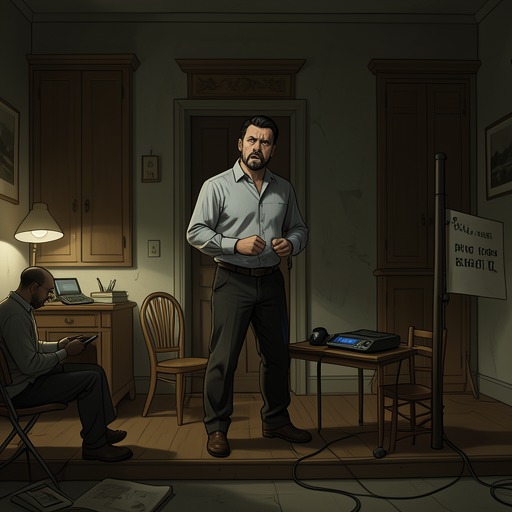
Marty
The Shrinking ManMarty, Scott Carey’s brother and employer, is a source of practical support whose help is constrained by the fortunes of his business. He keeps Scott on salary when Scott can no longer work, but illness and business losses steadily narrow what he can provide.
Identity and Role
Marty appears in both family and workplace contexts. Scott’s concern about the expense of a month’s hospitalization is bound up with the fear that Marty, who pays his salary, will be upset by the cost and absence from work. Their relationship is therefore not only that of brothers: Scott’s livelihood also depends on Marty’s decisions as an employer.
Early in the crisis, Scott calls for Marty aboard the boat and receives no answer. The moment establishes that Marty is part of Scott’s immediate world, but does not explain why he fails to respond or what he is doing at the time.
Keeping Scott Employed
As Scott’s shrinking makes work increasingly difficult, Marty summons him to the office and suggests that he stay home until he is treated. He frames the decision as a response to Scott’s inability to concentrate, rather than as a dismissal. Marty says Scott will remain on salary, though at a reduced amount, and that the lower payment should still support Scott and Louise Carey. He also expects the arrangement to be temporary and points to an anticipated GI loan as a further source of relief.
Marty’s offer gives Scott some financial security while acknowledging that the business cannot continue paying his full salary. The support is real, but conditional on the resources available to Marty; it cannot resolve either Scott’s illness or the wider uncertainty facing the household.
Business Loss and Further Assistance
After Scott has turned away from publicity and appearance offers that might have brought in money, Marty reports that he has lost his contract with Fairchild and must reduce operations almost entirely. The checks to Scott will have to stop. Marty gives him $100, but makes clear that this is the final payment he can manage.
The consequences are immediate for Scott: he has $70 in the bank and the $100 Marty has just given him, with no further salary expected. Marty’s business setback thus turns an already fragile arrangement into a fixed limit on support.
Character and Narrative Significance
Marty is presented through concrete acts of employment and assistance rather than through an extended account of his private life. His decisions combine sympathy with financial restraint: he tries to keep Scott provided for, reduces rather than abruptly ends his pay when work becomes impossible, and gives what he can after his own contract is lost. His role makes the economic consequences of Scott’s condition visible within the family, where care depends not only on affection but also on wages, contracts, and the capacity of a small business to endure.