Pin hook
The Shrinking ManThe Pin hook is an improvised tool Scott Carey makes from a bent pin and thread to negotiate surfaces and obstacles far beyond his diminished reach. Its importance lies not in any single successful use but in its adaptability: Scott devises it as mountaineering equipment, plans to use it on the lawn chairs, turns it into a defensive tether against a spider, and finally tries to attach himself to Marty’s trousers. Each change in purpose reflects the same practical problem: at his scale, familiar surroundings have become a landscape requiring specialized gear.
Construction and Design
Scott reasons that the climb before him is too difficult to attempt unaided. Since the obstacle is like a cliff, he approaches it as a mountaineer would, considering equipment and rejecting options he cannot use. Cleated shoes and alpenstocks are unsuitable; a grappling hook, however, seems achievable. He decides to bend another pin into a semicircle and attach it to a long thread, creating a hook that can catch on openings in the lawn chairs while he climbs the line.
He takes a pin from the rubber cork, unrolls about twenty feet of thread by his own scale, and carries both out of the box. To get the supplies into position, he climbs out using the cork and drags them up the hill, throwing them onto the floor. This sequence makes the hook a piece of planned equipment rather than a found object: Scott identifies a limitation, imagines a tool suited to it, and gathers the materials needed to make that tool usable.
The design depends on the combination of two simple parts. The pin supplies a rigid point that can catch or penetrate; the thread gives Scott reach while keeping a connection to the hook. That connection is essential to the tool’s intended operation, but it also makes the hook capable of transferring force back to him. Across its uses, the same line that lets him climb or restrain another creature can leave him attached to something moving at a scale he cannot control.
Planned Use on the Lawn Chairs
The Pin hook is first conceived as climbing apparatus. Scott imagines throwing it into an opening in a lawn chair, securing it, and climbing the thread. Later, while preparing to reach the arm of the top lawn chair, he studies the chair’s three back boards and their bracing slats. His plan is to catch the hook over one slat, climb to it, and repeat the process at the next. The chair’s construction, ordinary at human scale, offers a series of potential holds at his scale.
The episode distinguishes the tool’s intended function from a completed climb. The evidence establishes Scott’s method and his readiness to use it for the next stage, not that this sequence of slat-to-slat climbing succeeds. The hook therefore represents a practical possibility rather than a guaranteed solution. Scott must judge the spacing, throw accurately, and trust that the pin will hold; the strategy converts a broad, difficult ascent into a series of smaller tasks, but it cannot remove the uncertainty of each attachment.
A Tether in Danger
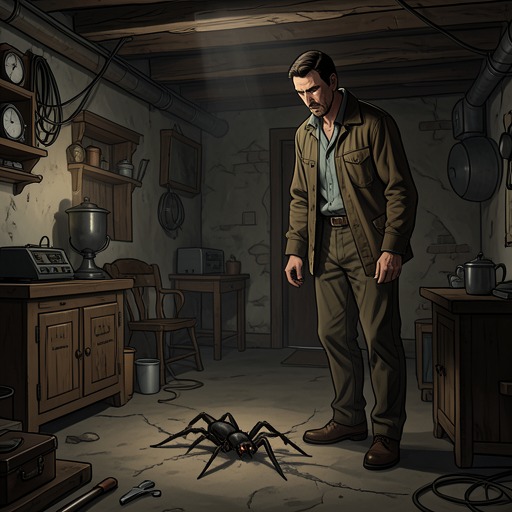
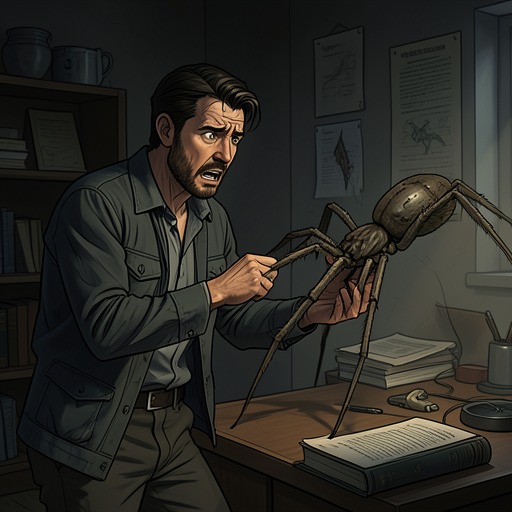
The hook acquires another function when Scott confronts a spider. He swings it around his head on six feet of thread, using its point to strike the spider and then the line to connect the creature to a heavy scrap of wood. As he retreats, he loops the thread around the wood until it is secured. The hook and thread thus serve not as a ladder but as a means of creating distance and holding the threat back. The scene makes the tool’s two-part construction newly significant: the pin can make contact, while the line allows Scott to act without remaining beside the object he has struck.
That defensive use does not make the arrangement safe. The spider rushes toward Scott while attached to the hook, and the thread’s tension becomes part of the danger. Scott has to get clear of it before he can retreat. The tool has helped him resist a larger creature, but it has not given him command of the encounter; its effectiveness depends on the line staying anchored and on Scott being able to move beyond the creature’s reach.
The Attempt to Catch Marty
Later, Scott sees a possible escape use for the same basic device. He realizes that thread might fasten his improvised clothing to him and could also be caught in Marty’s trouser cuff. He considers getting another pin, bending it, and tying it to a length of thread so that he can hook onto the trousers and remain attached while Marty goes upstairs. Remembering a piece of thread left after his fall the previous night, he runs to look for it rather than return to the carton beneath the fuel tank.
The attempt unfolds before he can put that plan into practice. Marty’s shoe is already coming down as Scott rushes into the open. Scott flings the hook at the moving trouser leg and catches it, but the attachment sends him into an uncontrolled swing through the cellar. The intended ride upstairs becomes a perilous movement dictated by Marty’s motion and the taut line; the available passage ends while Scott is still being swung, so it does not establish how the attempt concludes.
Significance
The Pin hook binds ingenuity to risk. It begins as a reasoned answer to a problem of scale: Scott cannot climb unaided, so he adapts a pin and thread to the structures around him. The lawn-chair slats become possible footholds, the scrap of wood becomes an anchor, and Marty’s cuff becomes a hoped-for route upward. In each case, the tool’s usefulness depends on recognizing how ordinary materials might function in Scott’s changed surroundings.
Its recurring weakness is the same as its strength. The thread extends Scott’s reach and connects him to distant surfaces, but connection also exposes him to forces transmitted through the line. The hook can support a careful sequence of planned movements, help keep a threat at a distance, or turn an attempted escape into a sudden loss of control. Rather than restoring the scale and security of Scott’s former world, it offers a limited means of acting within a world where every grip, anchor, and movement must be reconsidered.