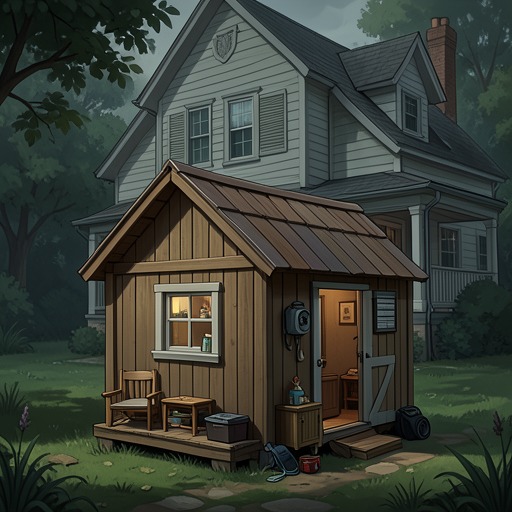
Reality Relative to Scale
The Shrinking ManReality Relative to Scale is the principle that the physical world does not present itself as the same practical or meaningful place to every observer: Scott Carey’s shrinking makes familiar things seem vast, perilous, and nearly independent of their ordinary uses. As his body diminishes, scale becomes both a material condition he must negotiate and a crisis in how he understands the world. The concept reaches its sharpest edge in the possibility that his shrinking will continue beyond any human measure, until even the idea of a measurable size no longer applies to him.
Perception and the Enlarging World
Scott Carey recognizes that his altered surroundings produce illusions. He may feel that he is not shrinking and that the world is growing, or that an object is what people think it is only when regarded by someone of ordinary size. The error is not simply a failure to see clearly: it arises because his changing body makes the customary human viewpoint increasingly unreliable. What once served as a stable measure of distance and importance cannot be assumed to describe his experience.
The cellar makes this shift concrete. The oil burner no longer functions in his perception merely as a household heating device; it becomes a tower with a flame roaring within it. A hose appears as a dormant viper coiled on the ground. The wall becomes a cliff, and the sandy floor a desert across which a spider seems like a venomous monster almost as tall as he is. These transformations retain their material basis, but their scale and immediate meaning have changed. Familiar domestic objects are not literally replaced by another world; their new proportions make them behave, for Scott Carey, like features of one.
This altered perspective is also practical. Near the refrigerator, Scott Carey considers how to reach the remaining crackers, which sit beside the coils atop its old-fashioned cylindrical enclosure. Elsewhere, the last step of a climb to a tabletop requires him to press his arms and hands against a smooth surface so friction will hold him while he reaches the edge. The table’s ordinary portability for a normal-sized person contrasts with the lethal difficulty of climbing it at his size. Scale is therefore not an abstract visual effect: it determines which surfaces can be crossed, which food can be reached, and which ordinary tasks become dangerous undertakings.
The Limits of Human Measurement
The idea becomes existential when Scott Carey considers the endpoint of his shrinking. He anticipates that in six days his reality will be blotted out, not through death but through disappearance, and asks what reality could mean at zero inches. The question exposes a limit in the measuring system: inches are human units, while his continuing reduction seems capable of carrying him beyond the point at which those units can describe him. The feared endpoint is not simply a smaller version of ordinary life. It is a condition for which ordinary life’s scale offers no adequate account.
Yet the forecast does not immediately end his effort. He continues to scan the refrigerator’s sheer face and consider a route to the crackers. The contrast matters: the thought that reality may cease to be intelligible exists alongside the immediate work of finding food. His awareness of an ultimate limit does not erase the demands of survival at the scale he inhabits now. The narrative keeps these registers together, placing a six-day horizon beside the concrete problem of climbing.
The Body as Measure and Recognition
A later encounter with his reflection in water complicates the notion that shrinking has made him an entirely different person. Scott Carey uses a pin to climb to the lip of a thimble and looks at his face in the water. Though reduced to a tiny fraction of his former size, he recognizes the same eyes, hair, nose, jaw, ears, lips, and teeth. The reflected image offers continuity of features within radical physical change: size has altered what his body can do and how others might understand it, but it has not erased the lineaments by which he recognizes himself.
That continuity does not make appearance an enduring source of social meaning. Alone in the cellar, he concludes that being called handsome seems irrelevant when there is no one to please or impress. His reflection can still confirm likeness, but it cannot restore the social setting in which attractiveness mattered. The episode distinguishes bodily identity from the judgments attached to it: the face remains recognizable while the value once assigned to it falls away.
Survival, Social Scale, and Love
Looking at his calm expression, Scott Carey considers how cellar life differs from society. He imagines the reduced demands of a world organized around basic survival, without political maneuvering, financial struggles, or competition for social advancement. The change in scale thus carries a change in attention. Immediate physical danger remains, but many pressures that once structured ordinary social existence no longer reach him in the same way. This is not presented as the disappearance of all hardship; it is a contrast between the cellar’s concentrated demands and the complex measures by which people compete in society.
That simplification has limits. Scott Carey dismisses the importance of his face and the possibility of pleasing others, then retains one relationship as a final standard: he still loves Louise Carey. He understands the feeling as love precisely because he can expect nothing in return from her. The thought gives the concept a measure not based on bodily size, social usefulness, or physical access. In a world where customary measures have lost their authority, attachment remains meaningful to him even in separation.
Reality Relative to Scale therefore joins shifting perception to a question of value. A refrigerator becomes a climb, a tabletop a life-threatening obstacle, and a face both a proof of continuity and an object whose old social significance has faded. Beyond those changes lies the prospect that Scott Carey may shrink past the point at which human measurements can say what or where he is. The idea does not resolve that prospect; it shows how he continues to act and recognize what matters while the scale that once organized his reality slips away.