Relative Scale and Perspective
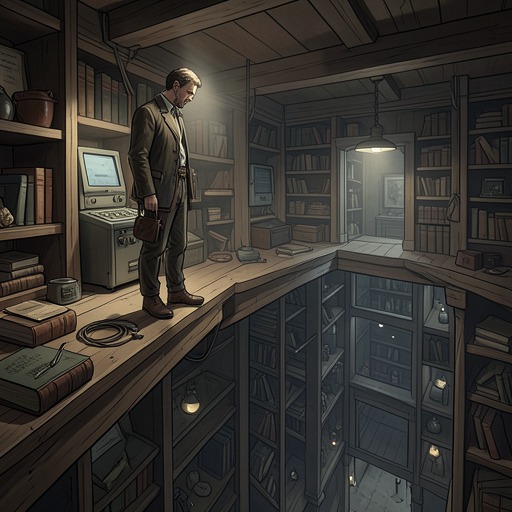
The Shrinking ManRelative Scale and Perspective shapes Scott Carey’s changing experience of the world and gives his shrinking a meaning beyond bodily reduction. As his size alters his relation to familiar objects, people, and landscapes, the novel unsettles the assumption that human importance or physical danger can be measured from a single, stable vantage. Scale can make a carnival look like a world built for giants, a bed restore a sense of adult identity, a fall prove less dangerous than expected, and the earth seem small beside the stars.
Definition and Shifting Viewpoint
The concept emerges through contrasts between what Scott Carey once experienced at ordinary human size and what he can perceive after shrinking. The physical environment does not simply become a collection of larger obstacles: its apparent scale changes according to his position, while his understanding of that environment changes with it. Familiar attractions and domestic circumstances acquire unfamiliar meanings when he can no longer participate in them on ordinary terms.
This shifting viewpoint also exposes the limits of treating bodily size as a measure of personal worth. Scott’s changing scale affects what he can do and how he understands his circumstances, but it does not erase his mind or his individuality. The contrast between physical vulnerability and continuing inner life becomes central to the concept: perspective can be distorted by bodily circumstance, then altered again by experience.
The Carnival as a World of Scale
At the Carnival Grounds, the attractions appear from Scott’s position as a giant’s toy. The Ferris wheel turns like a great gear against the October sky; the Loop-the-Loop’s scarlet-lit cages streak across the darkness, and the merry-go-round’s horses rise and fall in an endless mechanical rhythm. Little cars, trains, and trolleys circle with children aboard, while crowds gather at booths and concessions. The scene’s abundance makes the fair seem less like a familiar place than a self-contained world operating at a scale beyond Scott’s reach.
That altered view carries personal force because Scott watches Louise Carey and Beth Carey enter the crowded grounds without him. From the car, he follows the turning Ferris wheel, the flashing arms of the Loop-the-Loop, and the merry-go-round’s distant mechanical music. He recognizes the scene as another world, but memory briefly restores his former position within it: as a boy, he had ridden the Ferris wheel clutching its safety bar, driven toy cars, turned through the Loop-the-Loop, and walked among the attractions with delight. The same entertainments thus hold two scales of experience at once. They are immense and inaccessible to the shrinking Scott, yet they remain recognizable as the ordinary wonders of his childhood.
The scene also connects physical scale to shame and exclusion. Scott knows he cannot accompany Louise Carey and Beth Carey into the fair, and he watches for them until the crowd absorbs them from sight. His view is not merely a spectacle of oversized machinery; it is a perspective shaped by separation from his family and from an activity he once enjoyed. The carnival magnifies the distance between seeing and participating.
Scale, Intimacy, and Human Worth
A contrasting perspective appears in Scott’s encounter with Clarice. Sitting together and holding hands, they speak from a shared sense of pity in their lives. For Scott, their closeness is made concrete by an ordinary bodily detail: his feet touch the floor while he sits beside her. What would ordinarily go unnoticed has become a striking measure of how long his changed body has excluded him from familiar forms of comfort. The smallness of the detail makes the change in perspective visible without requiring a grand event.
The night with Clarice leads Scott to reconsider what his shrinking has made him believe about himself. Lying beside her, he recognizes that the degrading burden of his affliction, his sense of inadequacy in his marriage, and his disappointment in his achievements have narrowed his estimate of his own life. The bodily change has, in his understanding, reduced the scale of his thoughts as well as his body. Yet lying in a bed where he feels full-sized, with a woman held in his arms, gives him a different point of comparison. He concludes that he remains a man, still possesses his mind, and is still unique; size has changed nothing essential in that respect.
The episode does not make physical difference disappear. Instead, it shows how a changed setting and relationship can unsettle the judgments Scott has drawn from it. His sense of himself is relative to the conditions under which he measures his life: isolation and inadequacy have made him feel diminished, while intimacy lets him apprehend qualities that shrinking has not taken away.
Physical Scale and the Meaning of Danger
Scott’s fall supplies a more literal correction to his assumptions about scale. After landing on a flower-patterned cushion, he checks his body in disbelief: despite a drop he understands as hundreds of feet, he is alive and only slightly bruised. His initial expectation had been based on imagining that a fall would affect him as it would at his former size and weight. He realizes that this comparison is mistaken. At his reduced weight, the fall does not have the consequences he had projected, and he recalls that an ant can fall from a great height and walk away.
The episode makes scale a practical condition rather than an abstract metaphor. Scott’s body is small enough for weight to change the outcome of an apparently enormous fall. Once he understands this, he carries a piece of bread back to the sponge, drinks from the hose, and eats supper. The discovery changes his assessment of immediate danger and permits him to rest: that night, he sleeps in utter peace. His new perspective comes not from denying the danger he faces, but from revising an assumption that had made the danger seem absolute.
The Edge of the World and the Stars
After reaching the open window and getting outside, Scott stands at what he perceives as the edge of the world. The phrase marks a threshold in viewpoint: the outside is no longer a remote prospect but a place he has physically entered. He finds shelter beneath the house, lies among dry leaves, drinks from a dish of water, and looks up at the stars. The immediate facts of warmth, food, and water coexist with the immense darkness of the sky.
The stars offer continuity where Scott’s surroundings have become strange. He sees them as any man sees them, and that shared view brings contentment. His smallness does not make the earth the ultimate measure of scale; beside the stars, the earth itself seems small. This enlarged perspective helps explain the ending’s calm. Although Scott knows that his life is near its end, he feels glad to be alive and does not experience terror in that moment. He understands his composure as courage that needs neither an audience nor praise. Relative scale therefore culminates not in a final measurement of Scott’s body, but in a changed relation between his finite life and a universe that exceeds it. The world remains vast, yet he can still find a place within his view of it.