Scott Carey
The Shrinking ManScott Carey’s progressive shrinking transforms his body into a measure of how unstable human ideas of size, importance, and survival can be. The change first appears as a medical mystery and then becomes a daily contest with a cellar too large for him to master. Yet Scott’s decisive struggle is not only physical: he must decide whether consciousness is a burden, whether survival alone is enough, and whether a life approaching its apparent end can still be understood and chosen.
Identity and Diagnosis
The possibility that Scott is losing height emerges amid a month of mounting dread. At his first visit, Dr. Branson considers his weight loss a consequence of travel and a new environment, and initially dismisses the possibility that Scott’s height is changing too. Later visits, X-rays, blood tests, a survey of his bones, and searches for a pituitary tumour and cancer fail to settle the matter quickly. The testing makes the fear more concrete even as the cause remains unknown: each new examination measures the condition without yet explaining it.
The eventual explanation is an unlikely conjunction of circumstances. An insect spray altered by radiation has left a toxin in Scott’s system; the radiation itself has dissipated. The poison does not destroy his pituitary gland, but progressively undermines its ability to maintain growth. It also disrupts the body’s handling of nitrogen and minerals, leaving material to be excreted and decalcifying his bones so that they can shrink. Hormone extracts cannot counter the process because the toxin provokes an opposing antihormone response. Identifying the poison clarifies what is happening, but does not supply the necessary antitoxin. Scott is sent home while one is sought, leaving diagnosis and remedy painfully separate.
The Cellar and the Work of Survival
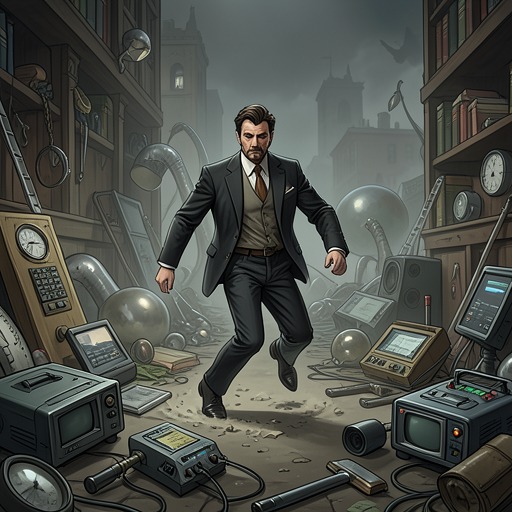
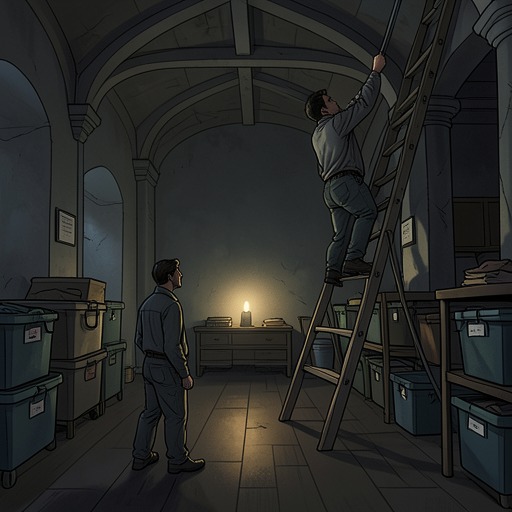
In the cellar, scale turns ordinary household objects into an environment with its own hazards and resources. Water is comparatively dependable: Scott catches the steady drip from a small leak beneath the pump tank in a thimble taken from a sewing box. Food is harder to secure. The quarter loaf of stale bread that has sustained him for five weeks is finally gone, leaving an open box of crackers beside the refrigerator’s coils as the only food he knows of in the cellar. The changing light also marks the limits of his refuge: windows cast broad, dim bars across the floor, while the bulb’s pull string hangs, from Scott’s perspective, a hundred feet above him and out of reach.
His physical predicament becomes entangled with a question about what it means to live. Scott recognizes that he has been fleeing in two ways: physically from threats, and mentally from his problems and fears. Finding food and water keeps him alive, but he doubts that instinctive persistence proves he remains a meaningful individual. The uncertainty is not resolved by endurance alone. At one point he considers suicide, yet something—whether fear, a buried wish to survive, or an outside influence—has kept him alive. He concludes that decision remains possible and that he can act as if alive, even before he has an answer for what makes that life meaningful.
Agency, Relationships, and the Choice to Observe
Scott’s isolation does not erase the pressures of his life beyond the cellar. In recollection, he adds nearly exhausted money, Louise Carey’s inability to find work, Beth Carey’s growing disrespect, the absence of news from the medical centre, and his continuing shrinkage to the burdens accumulating around him. Those concerns sharpen his anger, but they also show that his condition is not confined to measurements of height: it alters how he experiences family strain, financial insecurity, and the wait for medical help.
His response begins to change when he decides to use his mind rather than accept helplessness as the only available condition. He considers whether the cellar is, in its own terms, his universe, and whether he can determine its values and meanings because he is the one who lives within it. This shift does not promise control over the poison or its outcome. It restores a smaller but real kind of agency: the ability to make choices about attention, interpretation, and action.
Scott makes that choice explicit in a remembered conversation with a woman beside him. Rather than continue to rage at fate, he plans to write about what has happened and follow the process as far as he can. He intends to study the condition as an unusual experience with potential value, not only as a curse. The plan turns observation into a purpose. His shrinking cannot be stopped by resolve, but he can refuse to let fear be the only account of it, and he commits himself to continuing without fear.
Conflict and the Limits of Physical Power
That determination is tested by threats for which intellect alone offers no immediate protection. Scott’s confrontation with the cellar spider ends when he drives a spear into its body and kills it. Once it is no longer a danger, however, he does not simply leave it to die slowly: he enters the area in which it is trapped, and the final attack ends with the spider dead on the sand. The episode leaves him exhausted and unconscious, and he must recover the hook before continuing. Survival here demands force, but the aftermath also registers an unexpected remnant of compassion toward the creature that had threatened him.
The episode echoes a change in perspective already visible in Scott’s thoughts about his own body. He remembers once seeing a spider’s severed leg and imagining that his own leg might someday be as small. What had seemed impossible has become his condition; the comparison makes shrinking tangible without making it comprehensible. His body’s descent in scale does not abolish his capacity to judge, plan, or feel, though each of those capacities must operate in surroundings that can overwhelm him.
Acceptance and the World Beyond the Familiar Scale
Near what he believes to be the end of his life, Scott lies beneath the stars, warm and fed after finding leaves for bedding and water beneath the porch. He recognizes the stars as the same ones any man would see, and that continuity gives him contentment even as his own size has become radically different. He knows he has only hours left, yet he is glad to be alive. The moment contrasts with his earlier terror: there is no audience to praise his composure and no hope of commendation to sustain it. For Scott, this is courage precisely because it is not performed for anyone else.
The next morning overturns the scale on which he had understood that ending. Awake in an unfamiliar world, he realizes that the universe outside need not be the only universe. The microscopic and submicroscopic realms are not nothing simply because they fall beneath the human measure of an inch. In nature, he reasons, there is no zero point at which existence must cease; there may be further levels of reality, and intelligence may continue within them. The discovery frightens him at first, but the possibility that he need not be alone brings hope back into his thinking.
Scott runs toward the light and enters a world of unfamiliar vegetation, hills, trees, and shifting colors. He does not arrive with that world mastered: food, water, clothing, and shelter still need to be found. But the ending gives his life a direction beyond mere delay. He enters the new environment searching for what it contains, carrying forward the same mind that had been both a source of torment and, in the cellar, a possible means of salvation. His apparent disappearance from the human scale becomes instead an opening into another world, where the work of living begins again.