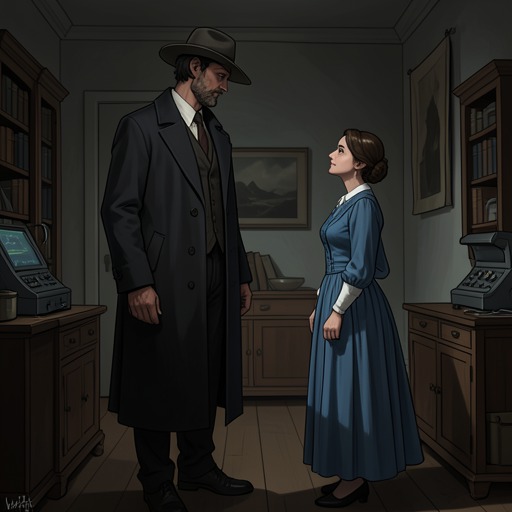
Scott Carey and Clarice
The Shrinking ManScott Carey and Clarice’s relationship offers Scott a form of companionship grounded in shared vulnerability rather than pity. In a room furnished to his scale, he meets a woman who, like him, belongs to a world made strange by ordinary human proportions. Their closeness gives him a brief experience of physical ease and intimacy, but its deeper consequence is a change in how he understands himself: Clarice recognizes him as a man when shrinking has made him feel isolated, diminished, and almost unrecognizable to those closest to him.
Recognition and Common Ground
Scott’s first encounter with Clarice begins in astonishment. The little room seems to restore a familiar scale: its chairs and couch are seats rather than engulfing objects, and its tables are beside him rather than towering above him. When Clarice enters and sees him, both are struck still. Scott introduces himself, but she does not know his name; instead, she falters over the question of whether he is like her. His answer establishes their immediate point of connection: they do not need a shared history to recognize a condition that has set them apart from the ordinary-sized world.
Their recognition is not simply a matter of matching physical circumstances. Clarice’s presence gives Scott a possible answer to the loneliness he has come to regard as inevitable. He tells her that once he had passed a certain height, he was absolutely alone. He feels strongly toward her because they share what he calls the pity of their lives. Clarice does not accept that description as self-evident: she says she has never thought of herself as pitiful. Scott immediately apologizes and acknowledges his bitterness. The exchange makes their bond more than a shared label; it reveals the difference between Scott’s despairing interpretation of their condition and Clarice’s own understanding of herself.
Intimacy and the Meaning of Manhood
Their first closeness is expressed through quiet physical gestures. Clarice steps toward Scott and lays her cheek against his; he puts his arms around her, and they cling to each other with tear-wet faces. Later they sit together on the couch, holding hands and smiling. Clarice says she feels close to him despite never having seen him before. Scott explains that they are the same because they share the pity of their lives, but the scene also shows that the connection is being made through tenderness, not merely through a diagnosis or an abstract resemblance.
For Scott, this intimacy answers a crisis of masculinity that shrinking has made painfully concrete. He longs to be a man again and to hold Clarice as one, while she welcomes his embrace and says it has been a long time. Yet she does not treat his manhood as something restored only by his size. In a remembered moment, Clarice tells him, “You aren’t pitiful,” and then, “You’re a man.” Scott recalls that her tense fingers moved across his chest as she said it, and describes the moment as a decisive alteration. Her response counters the shame and loneliness through which he has been interpreting himself. It does not change his body; it changes what he believes that body has taken from him.
Marriage, Family, and the Strain of Scale
The bond with Clarice develops against the deterioration of Scott’s existing family life. Before the crisis, he had imagined security as a structure built for himself and his family: work with his brother Marty, a possible business partnership, insurance, a bank account, a car, and eventually a house. His shrinking threatens that whole plan. At home, even gestures of affection become difficult to read. When Louise Carey strokes his cheek and remarks on how smooth it is, Scott wonders whether she is treating him like a boy. He notices that his wedding ring has had to be removed because his finger has grown too thin, and turns the conversation to the sweater she is making for Beth Carey.
The change in scale also unsettles his place as a husband and father. During his outbursts, Scott insists, “I’m still her father, damn it!” Louise Carey warns that the family cannot continue much longer on fifty dollars a week with everyone to feed, clothe, and house. Scott later understands that Beth Carey’s respect had depended partly on the visible difference between a six-foot-two father and a four-foot-one child, as well as on the depth and authority of his voice. As he becomes smaller and his voice changes, Beth Carey struggles to understand him as the same father. This background sharpens what Clarice’s companionship provides: a setting in which Scott can be met at his actual scale, rather than measured against the domestic roles that his changing body has made harder to sustain.
Scott makes that distinction explicit when he speaks to Louise Carey about Clarice. He says that his wife can have companionship if she wants it, while he cannot, and admits that Clarice offers him companionship, affection, and love. He asks for one night, explaining that Clarice has a trailer with furniture he can sit on; even sitting in a chair as a man, rather than feeling reduced to something less, matters to him. His appeal does not erase the separation between him and Louise Carey or establish that she approves. It shows how urgently he associates Clarice with ordinary human contact and a place designed for his body.
Change and Lasting Significance
Scott later remembers being with Clarice while lying in the cellar at two-sevenths of an inch tall. The recollection steadies his sense of identity: he is still a man, and size has changed nothing essential about his mind or uniqueness. The relationship has not reversed his shrinking, and the evidence does not offer it as a cure. Instead, it becomes the circumstance in which he can distinguish the physical process he cannot control from the person he still is.
In the morning after their night together, Scott tells Clarice that he will stop fighting the part of his condition he cannot beat. He admits that he knows he is incurable and recognizes that fear had helped drive him away from the doctors before testing was complete. His acceptance is not surrender to death or an end to action. He decides to follow his own experience, write about what has happened and what may happen, and study the shrinking as something with potential value as well as a curse. Clarice’s companionship is thus tied to a practical and inward change: Scott can face his condition without pretending it will be cured, and can continue observing and living with it without being ruled by fear. Their relationship matters not because it promises permanence, but because it gives him recognition at a moment when his former measures of intimacy, authority, and manhood have failed.