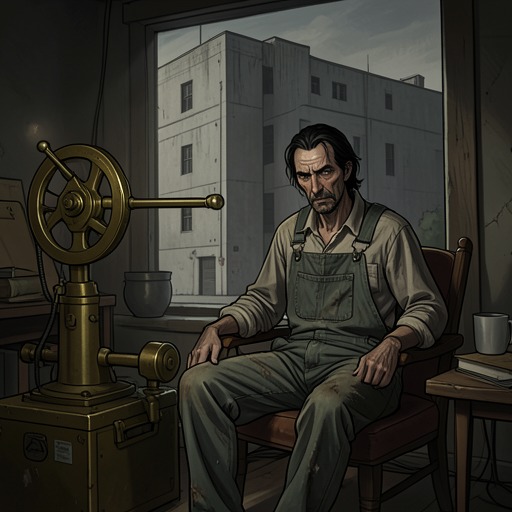
Scott Carey leaves the medical centre before testing is complete
The Shrinking ManScott Carey leaves the Columbia Presbyterian Medical Centre before his examination is complete, turning a decision about medical care into a dispute over dignity, money, and who has the right to decide what happens to him. On the drive away with Louise Carey, his refusal to remain under observation meets her alarm at the unfinished tests and the worsening practical reality of his shrinking. The departure does not resolve the medical uncertainty: it makes that uncertainty part of the conflict between them.
Background and Departure
Louise Carey has come to the Columbia Presbyterian Medical Centre to collect Scott after he told the doctors that he was leaving. Their blue Ford follows the graded road from Queens Boulevard toward the Cross Island Parkway after emerging from the Midtown Tunnel. The journey is quiet; Scott has turned off the radio and stares ahead, withdrawn into his thoughts. The ordinary details of the drive frame a decision that has been building for some time rather than a sudden quarrel begun in the car.
Scott’s tension reaches back to his arrival at the medical centre. He associates the stay with financial insecurity and with days of tests that, in his view, produced no useful result. The expected expense was not separate from the medical process: it made each day of continued investigation feel like another commitment to a future burden. By the time Louise came to collect him, frustration had accumulated alongside the original fear of the bills. He regards leaving as an end to an experience that has depleted him without giving him an explanation.
The encounter with Louise adds a personal shock to those accumulated pressures. She is angry about his decision and cannot conceal her reaction to seeing him four inches shorter than she is. Scott responds by withdrawing; he has spoken little since she entered his room, and his remarks remain guarded. The physical change is therefore present in the scene not as a diagnosis the doctors have explained, but as something Louise can see and as a new strain between spouses. Their shared ride carries both the unresolved illness and the immediate difficulty of facing it together.
The Argument Over Testing
Louise objects that the doctors said the process might take months and that Scott has not allowed them to finish. Her challenge identifies the central divide: she sees the incomplete investigation as a reason to stay, while Scott sees further testing as an extension of an intolerable routine. He answers by describing the doctors’ attention as fascination with an unusual case. In his view, they treat him less as a person seeking help than as a novel medical subject, preoccupied with his unusual catabolism.
Scott makes that sense of objectification concrete by recalling the repeated procedures: basal-metabolism and protein-bound tests, radioactive iodine and barium mixed with water, X-rays, blood cultures, Geiger-counter readings at his throat, and frequent temperature checks. The accumulation matters. He is not objecting to one examination in isolation; he describes a succession of tests that has taken over his days while, as far as he can tell, yielding no finding. He compares the experience to an inquisition, conveying how medical attention, intended to investigate his condition, has come to feel like pressure exerted on him.
Louise counters that the doctors are among the best in the country. Scott does not dispute their standing so much as question what that standing means when the costs fall on him and no result has emerged. He recalls asking one doctor why the tests were not being provided without charge and taking the response as evidence that his financial concern had offended him. His reasoning joins two complaints that might otherwise remain separate: he resents being scrutinized as a medical curiosity, and he cannot accept paying thousands of dollars for a process he believes has found nothing and may never find anything.
Money, Autonomy, and Marital Strain
Louise offers to work, indicating that she is willing to contribute financially rather than accept Scott’s assumption that the household must inevitably fail. Scott dismisses the offer as insufficient: he believes her earnings would not prevent them from going under. The exchange exposes a difference not only over money but also over whether continued treatment remains a possible choice. Louise proposes a practical response to the expense; Scott believes the scale of the problem makes that response futile and sees no reason to incur further costs for uncertain benefit.
When Louise insists that the doctors were not finished, Scott answers that the bills do not matter to her. Her offer to work complicates that accusation: she has just presented herself as willing to help, yet Scott interprets their financial positions and burdens as unequal. The exchange does not settle who is right about what they can afford. Instead, it shows how the medical decision has become entangled with their marriage, so that an argument about diagnostic tests also carries resentment about responsibility and the strain of facing an impossible future.
His anger does not bring relief. As the argument continues, Scott falls back against the seat and closes his eyes; the narration presents his fury as still burning even though it has been directed at someone who does not deserve it. That distinction marks a limit to his outburst. Louise is the person beside him, but she is not the source of the medical mystery or of the financial burden he fears. His anger persists without finding a satisfying target, leaving the drive suspended between his decision to leave and Louise’s belief that the doctors should have been allowed to continue.
Consequences and Significance
The departure ends Scott’s participation in this round of testing before the doctors have completed their work. It supplies no diagnosis and resolves none of the questions Louise raises about the months the investigation might require. For Scott, the immediate consequence is release from the procedures and expense he rejects; for Louise, it is the prospect of confronting his condition without the benefit of a completed medical examination. The difference between those consequences helps explain why the ride is so strained even when conversation falls silent.
The scene also complicates a simple opposition between medical expertise and individual refusal. Louise points to the doctors’ qualifications and the unfinished tests, while Scott emphasizes their fascination, the repeated procedures, the lack of findings, and the cost. The narrative gives specific grounds for both positions without claiming that leaving is medically sound or that continuing would have produced an answer. What it makes clear is that care, as Scott experiences it here, has become inseparable from scrutiny and expense. His choice is an assertion of control over a process he feels has reduced him to a case, but it leaves him and Louise carrying the same unexplained condition into the drive home.