Scott Carey’s transition into the microscopic world
The Shrinking ManScott Carey’s transition into the microscopic world turns his apparent disappearance into a threshold rather than an ending. On waking beside the leaves where he had slept, he finds the familiar world transformed by scale: the Sponge he wore becomes a jagged blue dome, and the leaf beneath him stretches into a plain. His discovery gives physical form to a new understanding of nature: there is no absolute zero at which existence must cease. He runs toward the light and enters a world where the practical work of survival begins again, accompanied by hope that he may not be alone.
Awakening to a Changed Scale
The event begins with an ordinary morning gesture: Scott Carey’s eyes open, and for a moment his mind remains clouded by sleep. Recognition arrives abruptly. He jolts upright and looks around, trying to understand where he is. The question is not simply geographical. The surroundings have become so unfamiliar that the measures by which he has understood his place in the world no longer seem adequate.
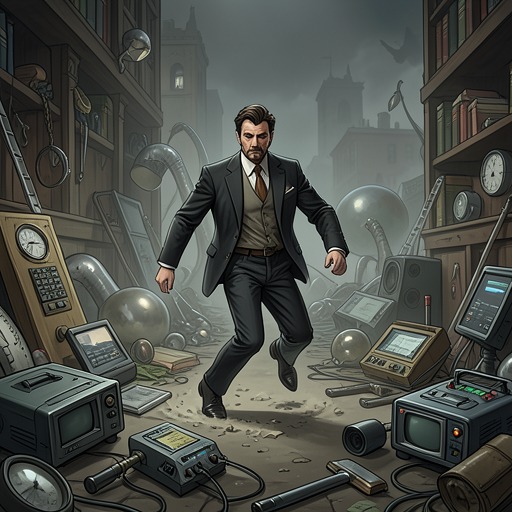
Above him, what appears to be a ragged blue sky is pierced by shafts of light. The space around him seems like an immense cavern, with an opening and brightness off to his right. He stands and discovers that he is naked, then searches for the Sponge. The apparent sky is the Sponge he had worn: an object once carried on his body now stretches hundreds of yards overhead. Its ordinary identity remains recognizable, but its scale has changed so completely that it reads as landscape.
Scott checks his own body, touching himself and finding that he is still himself. Yet that reassurance does not answer the central question: how far has he shrunk during the night? The uncertainty makes the scene a double discovery. His personal identity persists, while his proportions and surroundings have become almost impossible to reconcile with his former sense of reality.
The Leaf as Landscape
Remembering that he had lain on a bed of leaves the night before, Scott looks down. He is sitting on a vast, speckled plain of brown and yellow, cut by great paths that angle away from a gigantic avenue and continue beyond his sight. The apparent terrain is the leaf beneath him. Like the Sponge overhead, it has not ceased to be an ordinary object; it has become immense in relation to him.
The recognition does not immediately make the scene comprehensible. Scott shakes his head, confronted by the seeming contradiction of being less than nothing. That bewilderment gives way to an idea: if he had looked upward the previous night at a universe without, perhaps there is also a universe within—and perhaps there are universes within universes. He has always known that microscopic and submicroscopic worlds exist, but had not connected their existence to his own progressive shrinking. The event converts abstract knowledge into a possibility he must inhabit.
No Zero in Nature
Scott’s change in understanding depends on separating human measurement from nature itself. Inches belong to human reckoning; for a person, reaching zero inches appears to mean reaching nothing. But he now reasons that nature has no such zero. Existence continues through endless cycles and levels of dimension, so shrinking need not end in disappearance. The idea initially frightens him: endless continuation through unfamiliar dimensions is alien, not an immediate comfort.
A further possibility alters that fear. If nature has endless levels, Scott reasons, intelligence might exist at other levels too. He might not have to remain alone. The thought is not proof that another being is present, and the new world has not yet yielded such a discovery. Its importance lies in the change from an anticipated absolute end to an open question. The possibility of life gives his new scale a future as well as a physical setting.
Running Toward the Light
Scott responds to the idea by running toward the light. When he reaches it, he stands in speechless awe before a landscape of vivid vegetation, scintillating hills, towering trees, and a sky whose shifting hues seem filtered through moving layers of pastel glass. The opening in the apparent cavern has led not to an escape into his former world, but into another environment whose scale and appearance exceed the categories with which he woke.
Awe quickly meets practical necessity. Scott recognizes that there is much to do and much to think about: he must find food, water, clothing, and shelter. Above all, he must search for life. The sequence is decisive because hope does not remove the demands of survival; it gives him a reason to face them. The final action is therefore not passive acceptance of a theory but movement into the terrain itself. Scott Carey runs into the new world, searching, and the book ends with that search still open.